Monday, May 3, 2010

Two Thumbs Up

Movies weren't the only thing being premiered at the Tribeca Film Festival this year. Alexa Ray Joel made an appearance which introduced her new surgically refined nose to the world. In keeping with film lingo I give her "two thumbs up" for her final result. She looks beautiful! She is 100% recognizable as herself and has gone on the record to say how happy she is.

It is no secret that Alexa has had a tough year. It was only months ago that she was admitted to the hospital after an intentional overdose of the homeopathic medication Traumeel. Luckily this remedy for inflammation and joint pain wouldn't have killed her, but it was certainly a wake up call to her family and friends that she was not okay. Even before her rhinoplasty she seemed to rebound quickly, however now she appears more comfortable in her skin than ever before.

I can't imagine what it must be like to have Christy Brinkley as a mother. How is a young girl supposed to feel beautiful when you're staring at the face of perfection everyday of your life. We can be told thousands of time from a young age that beauty is only skin deep and true beauty comes from within, but let's get real. Have you met the society we live in? Not exactly the most forgiving critic of "outer beauty" flaws. I would have never looked at Alexa and thought she "needed" plastic surgery. Nobody "needs" plastic surgery. It is called elective surgery for a reason. It's done by choice and Alexa said having a rhinoplasty was something she'd been wanting to do for years. She has made a point to let the world know that she does not plan on having any further procedures.

Alexa was a great candidate for rhinoplasty. Her narrowed, more refined, nose allows the rest of her features to shine. She has beautiful facial structure, skin, and eyes. The subtle changes made to her nose give her a more delicate, feminine appearance. Working in the field of plastic surgery I have seen countless number of women and men credit their nose jobs for changing their lives and boosting their self esteem. The transformation inside and out is nothing shy of amazing. I am thrilled for Alexa! She has her whole life ahead of her and I hope this new beginning brings her lots of joy. She is a beautiful, talented musician with a very bright future. Christy who?

love this...

anthropologie earrings:Kate Spade lime coin purse:Willow silk-blend jacket:Dolce & Gabbana floral print tote:

1910-11 Quebec Bulldogs Joe Hall Jersey

Born in Staffordshire, England on this day in 1882, at the age of two years old Joe Hall moved with his family to Winnipeg, Manitoba. In 1902 he joined the Brandon Regals of the Manitoba Senior League.

The following season of 1903-04, he skated for the league champion Winnipeg Rowing Club and got his first taste of playoff hockey when the club challenged the Ottawa Silver Seven for the Stanley Cup, with all games to be played in Ottawa. The Silver Seven would win Game 1 of the best-of-three series in a romp, 9-1. Winnipeg fought back against the powerful Silver Seven with a 6-2 victory in Game 2 to force a deciding Game 3, which was won by Ottawa 2-0 to retain the cup for the third of of nine consecutive defenses over three years.

After another season as an amateur with Brandon Wheat Cities in 1904-05, Hall would turn professional with Houghton-Portage Lake of the International League where he would score 33 goals in 20 games and lead the league in penalty minutes with 98. He would also make his first appearances with the Quebec Bulldogs, seeing action in three games, scoring twice.

Back with Brandon Wheat Cities for 1906-07, Hall scored 14 goals in nine games, but was eventually expelled from the league due to a series of violent outbursts and rough play. He relocated to the east, splitting time between Montreal Hockey Club and the Montreal Shamrocks in 1907-08, averaging more than a goal a game. He would play for yet another Montreal club in 1908-09, this time the Montreal Wanderers, scoring 10 goals in five games. Hall was back with the Shamrocks in 1909-10, only this time in the newly formed National Hockey Association (NHA), where he would score seven goals in his first game with the club. His temper eventually got the best of him, when he was fined and kicked off the team for punching referee Rod Kennedy.

Hall would finally find some stability beginning in 1910-11 when he rejoined the Quebec Bulldogs, also now part of the NHA. Scoring however, proved elusive as Hall completed a transition from forward to defense. His scoring touch returned in full force in 1911-12 as Hall produced 15 goals in 18 games and won his first Stanley Cup when the league champion Bulldogs defeated the Moncton Victorias 9-3 and 8-0.

Joe Hall

The Bulldogs would repeat as NHA champions in 1912-13 to retain possession of the Stanley Cup and then fend off a challenge by the Sydney Millionaires in a two-game, total-goal series by a score of 20-5 in which Hall would contribute three goals to earn his second Stanley Cup.

Quebec Bulldogs

1913-14 was another fine offensive season for Hall, as he scored 13 goals in 19 games. Hall would play three more seasons for the Bulldogs in the NHA before the club would suspend operations due to financial difficulties prior to the 1917-18 season, which was to be the club's first in the brand new National Hockey League (NHL).

When the Quebec players were made available to the other NHL teams, Hall, known as "Bad Joe" for his rough style and numerous penalty minutes, became a member of the Montreal Canadiens, making him teammates with one of his main rivals, the Canadiens Newsy Lalonde.

In 1913, Hall and Lalonde had gone at each other in a game, trading slashes and crosschecks before Hall escalated things with a two-hander aimed at Lalonde's head, which knocked him out cold.

The following season, Lalonde sought his payback and whacked Hall in the head, opening a cut which required eight stitches to close, getting himself tossed from the game. Hall's revenge for that incident came two weeks later, as he charged Lalonde from behind, sending him headfirst into the boards which required ten stitches in return.

Incredibly, Hall and Lalonde would become roommates on the road and best of friends.

Hall scored 8 goals and 15 points in 21 games for his new club and was fined for another stick swinging duel which earned him an arrest on charges of disorderly conduct by the Toronto police.

Joe Hall

The 1918-19 season for the Canadiens saw them win the first half of the season schedule and qualify for the playoffs. They defeated the Ottawa Senators four games to one to advance to the Stanley Cup Finals against the Seattle Metropolitains of the Pacific Coast Hockey Association, with all games being played in Seattle.

Seattle romped in Game 1 by a score of 7-0. The Canadiens fought back to win Game 2, 4-2. Seattle responded with another big win, this time 7-2. Game 4 was played to a scoreless tie following a 20 minute overtime. Another overtime game followed in Game 5, when Montreal evened the series 4-3.

What the Canadiens did not realize at the time was that they had reached Seattle, they had already been exposed to the Spanish Influenza virus during a stop in Victoria, British Columbia for a pair of exhibition games. The flu epidemic began in March 1918 and lasted until June 1920, affecting 500 million people, 1/3rd of the Earth's population, killing an estimated 50-100 million people in locations all over the world from the Arctic to remote Pacific Islands, including 50,000 in Canada and an estimated half million to 675,000 in the United States.

Despite being vaccinated against the virus before leaving Montreal, the players began to fall ill, with Hall feeling poor enough to not even complete Game 5, with seven of the Canadiens bedridden at one point, causing the remainder of the series to be cancelled.

1919 Stanely Cup engraving

Hall was admitted to the hospital with a fever of 105ยบ. Eventually all the Canadiens recovered, except for Joe Hall, who died five days later on April 5, 1919 in a Seattle's Columbus Sanatorium at the age of 36.

Bill Coutu, Louis Berlinquette and Lalonde recovered and accompanied Hall home to Brandon, Manitoba to be pallbearers for their teammate.

In 1905, Hall, along with neighbor and shoemaker George Tackaberry designed a custom hockey skate from kangaroo hide with a snug fit and reinforced toe and heel as well as better arch support. Hall liked his new skates so much that other players began trying them out, eventually overwhelming Tackaberry with orders. The skates, named "Tacks" after being purchased by CCM after Tackaberry's death in 1937, were worn by every NHL scoring champion for the next 30 years and the name remains in use today.

Hall was inducted into the Hockey Hall of Fame in 1961.

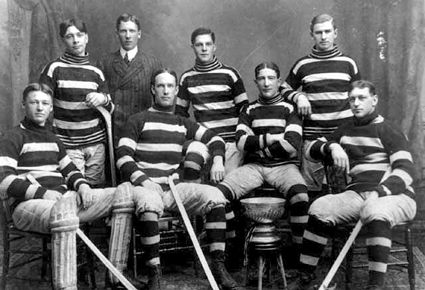
Today's featured jersey is a 1910-11 Quebec Bulldogs Joe Hall jersey. This jersey is in the barberpole style of the day.

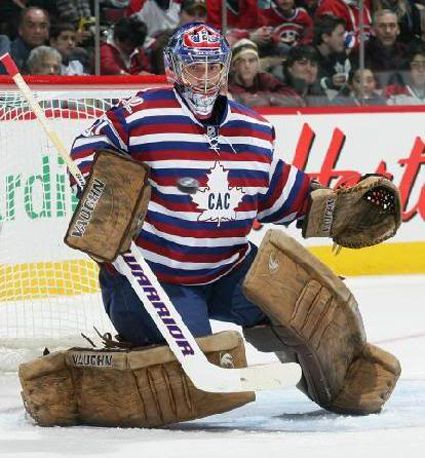
The barberpole style is best known for it's use by the dominant Ottawa Silver Seven and controversially revived by the Montreal Canadiens for a single game in each of the 2008-09 and 2009-10 seasons as part of their Centennial Jersey Program.

Joe Hall C-55

In the absence of any footage of Joe Hall, here's a cheery little film on the Influenza Pandemic of 1918.


Sunday, May 2, 2010

1989-90 Buffalo Sabres Alexander Mogilny Jersey

On this date in 1989, Alexander Mogliny, then just 20 years old, made a choice that would affect the rest of his life.

While in Stockholm, Sweden, having just completed winning a gold medal at the 1989 World Championships, Mogilny made the life changing decision to become the first Soviet player to defect, leaving behind his family but escaping the totalitarian rule of the communist system, and iron-fisted Soviet old school coach Viktor Tikhonov in particular, whom Mogilny felt would make his life not only at the rink, but outside of hockey, miserable for years to come due to his independent nature.

The story begins at the 1988 NHL Entry Draft when the Sabres, with one of their two picks in the fifth round, selected one of the most exciting young players in the world, Alexander Mogilny with the 89th overall pick. While many Soviet players had been chosen in the NHL draft before, it was generally in much later rounds when taking a flyer on a player unlikely to ever appear in an NHL game was worth the roll of the dice with an essentially meaningless pick.

Gerry Mehan, the Sabres general manager explains, "I would never have used the draft pick if I didn’t think he would be coming,” Meehan said. “The attitude then was, ‘There’s no way this guy is going to come out. He’s too big a young star.’ It was my view that it was inevitable that, sooner or later, the Russians were going to have to let their players come and play on a world stage other than the Olympics and the World Championship.”

At the beginning of 1989, former Sabre Don Luce, the club's Director of Amateur Evaluation, travelled to Anchorage, Alaska to to 1989 World Junior Tournament. There, Mogilny and linemate Pavel Bure, along with Sergei Fedorov, were finishing third and fourth in tournament scoring while leading the Soviets to a 6-1 record and the gold medal. Luce met briefly with Mogilny in Anchorage and gave him a business card, cementing Mogilny's decision to defect at the first opportunity.

That opportunity arrived four months later when the Soviets were given two days in Stockholm after winning the 1989 World Championship. Luce, at home in North America, received a phone call on this date in 1989 from a man who claimed to be Mogilny's agent, Sergei Fomitchev. Unsure if he was really in contact with Mogilny, he asked Fomitchev to have Mogilny repeat what he had said to him in Anchorage. Told then that he had not played very well, Mogilny had stated "I show you next game", prior to scoring a hat trick against Canada to clinch the gold medal.

After Mogilny repeated the phrase, Luce and Meehan were on a plane to Sweden three hours later, arriving midday on May 3rd. While waiting for Fomitchev to return from shopping, the got an urgent call saying Mogilny's defection had to happen right away because it would be his best opportunity to get away.

They met at a mall and drove off. The next two days were spent moving from hotel to hotel to avoid being found while Meehan worked with the U. S. Embassy to arrange the necessary paperwork.

At one point Mogilny, from the far eastern part of Russia where few players have originated from, attempted to call home and midway through the conversation the call was disconnected, giving rise to Mogilny's fears that the call had been traced and the authorities knew where they were.

The day they left they abandoned their rental car and took a taxi to the airport, and once inside the security gates, their fears of the Soviet officials was over. Meehan remembers, “He asked me in his broken English, ‘Am I free now?’ " And I said, ‘Yeah, you’re free.’ And he went over and had a beer. He couldn’t believe it. He said ‘free’, he didn’t say ‘safe’. He said ‘free’. I found that to be kind of poignant.”

Fedorov defected less than a year later at the 1990 Goodwill Games in Seattle and shortly afterwards the Iron Curtain fell and Bure joined the NHL without having to defect.

During his rookie season in the NHL, wearing he number 89 presented to him by the Sabres owner Seymour H. Knox III in recognition of his place in the draft and year of his defection, Mogilny would play 65 games, scoring 15 goals and 43 points as he became acclimated to living in North America and learning a new language and culture. "It was a huge adjustment to come to the NHL. The language barrier was the toughest part. Lack of communication affected me both on and off the ice. It also took some time to get used tot he airline travel. I had to deal with a fear of flying," Mogilny recalled.

He would double his goal total the following season to reach 30 for the first time.

The arrival of Pat Lafontaine in Buffalo would give Mogilny a world class teammate to work with and his point totals took another jump upwards, finishing 1991-92 with 39 goals and 84 points and became the first Russian on an NHL All-Star Team. Given a year to work together and now fully integrated into life in the United States and the NHL, Mogilny had one of the greatest seasons in league history in 1992-93. He would score 127 points from 51 assists and a remarkable 76 goals in 77 games. His 76 goals remain tied for fifth all-time in a single season with Teemu Selanne and Phil Esposito.

With Lafontaine limited to just 38 games over the next two seasons, Mogilny was named team captain in his absence, the first European to ever captain an NHL club, but his production suffered as a result of the missing Lafontaine. He was then traded to the Vancouver Canucks and reunited with Bure for the 1995-96 season, in which he would score 55 goals and 107 points, the second highest of his career in both categories. After five seasons of diminishing point totals in Vancouver, from 107 to 73, then 45 twice, he was dealt to the New Jersey Devils late in the 1999-00 season, having previously enjoyed the most minimal playoff success to that point in his career, having only escaped the first round once in ten seasons.

Prior to leaving the Soviet Union, Mogilny had already, just ten days after his 19th birthday, won a gold medal at the 1988 Olympics and then added he World Championship gold just days before his defection. Now with the Devils, Mogilny would see his first extended playoff run, which would evetnually lead to a Stanley Cup championship. When he won the Stanley Cup with the New Jersey Devils, he became just the ninth player in history to join the Triple Gold Club.

The move to New Jersey was a positive one for Mogilny, as he would regain his scoring touch and exceed 40 goals for only the third time in his career, with 43 goals during an 83 point season and another run to the Stanley Cup Finals.

He would sign with the Toronto Maple Leafs for the 2001-02 season, where he would play for three seasons, including winning the Lady Byng Trophy in 2003 and scoring his 1,000th point in 2003-04, before returning to the Devils for the final season of his career in 2005-06 before retiring with 473 goals and 1032 points in 990 games.

Following his defection, Mogilny would never play for the Soviet Union again and suit up for Russia just once in the 1996 World Cup of Hockey, cutting short what was destined to be a fine, if not outstanding, international career.

When asked following his career about the reasons for his defection, Mogilny responded, “Why did I do it? I did it for freedom. If the bird can fly and the fish can swim, you have to be able to move around the world and be free and not watched constantly. If a human being doesn’t have freedom, that’s not life. It’s like living in a cage. To me, you might as well be dead.”

Today's jersey is a CCM 1989-90 Buffalo Sabres Alexander Mogilny jersey from the greatest season of his career, his 76 goal campaign in 1992-93. This jersey features the Sabres 20th Anniversary patch worn in Mogilny's rookie season following his defection earlier that year.

This jersey also sports Mogilny's distinctive #89, which is based on the year of his defection from the Soviet Union.

Buffalo Sabres 89-90 F
Buffalo Sabres 89-90 B
Buffalo Sabres 89-90 P

In today's video section, an interview with Mogliny from the 1989 World Junior Championships in January, a few months prior to his defection in April after the World Championships. He sticks to the party line quite well, giving little hint as to what was to follow, or at least that's what the interpreter tell us...


Here is a look at the some of the career highlights of Alexander Mogilny.


Here, Mogilny scores his 70th goal of the 1992-93 season, only the seventh player to reach 70 in NHL history.


Speaking of the remarkable 1992-93 season, here is a brief feature story on the partnership between Mogilny and Lafontaine.


Animation - Scene 2 - Bat + Fox

This is where the animating starts to step up considerably. For this scene I needed to animate a walk sequence for my fox which unfortunetly proved to be quite a difficult and lengthy task.


One of the biggest issues with this particular piece of work was the fact the biped movement was more or less trial and error. After positioning the legs ready for the next movement, using the 'planted key' on the next frame would sometimes throw the limb completely out of position and required me to try slightly different positions on previous frames to get each section working.

After a lengthy period of trial and error with the biped I finally managed to produce a working version that is suitable for this scene and can even be used again!

The Bat fortunetly required very little animation and only appears in this scene for brief periods.


Saturday, May 1, 2010

Animation - Scene 1 - Intro

I had a good idea of how I wanted my animation to look like and a rough ideas of what camera angles would give the best effect.

Looking at the game trailer video i talked about in my inital ideas - I setup a scene containing varies trees, a simple landscape and obviously - all the models I would be animating. From here I experimented with using the camera and how I could be animated to move down the top of one of the trees (as seen in the game trailer.)


This was very easy - especially as the camera in travelling in a straight line! I set a starting keyframe at 0 and positioned the camera how I wanted it to end further along the timeline. This took a few attempts in order to get the desired length of scroll motion correct, however I am very pleased with the result!


1989 Washington Capitals Clint Malarchuk Jersey

Born on this day in 1961, Clint Malarchuk was originally drafted by the Quebec Nordiques #74 overall in the 1981 NHL Entry Draft and spent the majority of the season in the American Hockey League but did make his NHL debut with a pair of appearances with the Nordiques in 1981-82.

He would again spend most of his time in the AHL in 1982-83, but did earn his first NHL victory in 15 games with the Nordiques, posting an 8-5-2 record. The following season he again split time between the AHL and the Nordiques, only this time with the majority of games spent in the NHL, again finishing the season with a winning record of 10-9-2.

Clint Malarchuk

Malarchuk played all of 1984-85 with the Fredericton Express in the AHL before becoming a full time NHLer in 1985-86, seeing action in 46 games in Quebec, going 26-12-4. After one more season with the Nordiques, and appearing in a career high 54 games, Malarchuk was traded to the Washington Capitals as part of the deal which brought Dale Hunter to the Capitals.

As the Capitals number one netminder, he matched his career high with 54 games, winning 24 of them and leading the NHL in shutouts with 4. He made it into 42 games with the Capitals in 1988-89 before being traded on March 7th to the Buffalo Sabres who sent Calle Johansson to Washington.

15 days later Malarchuk would suffer a grotesque injury when his throat was slashed by a skate during a game, causing a ghastly scene on the ice as he bled profusely from a severed carotid artery and feared for his life. Sabres trainer Jim Pizzutelli, a former army medic in Vietnam, rushed to his aid to control the bleeding until doctors arrived, saving Malarchuk's life. It took doctors 90 minutes and 300 stitches to close the horrific wound, but Malarchuk would spend just one night in the hospital. Two days later he made an appearance at a Sabres game, receiving a two minute standing ovation. Incredibly, four days after the accident he would return to practice and a week later he played for the last five minutes of the final game of the regular season.

Clint Malarchuk

The following season he would play 29 games, going 14-11-2. An increase in games to 37 preceded his last season in the NHL, as he saw action in 29 games as he again split time with Darren Puppa.

Following the conclusion of his NHL career, Malarchuk would play three seasons in the IHL, first with the San Diego Gulls, followed by two with the Las Vegas Thunder, highlighted by going 34-10-7 in 54 games in 1993-94. He would get into 1 game in 1995-96 and three the following season while the assistant general manage and coach to conclude his playing career. His #30 would be the first number retired by the Thunder.

While in Las Vegas, Malarchuk, known for his wacky sense of humor, pulled one of our favorite pranks ever. He told a reporter that he spoke fluent Czech and proceeded to translate the reporter's questions to then 18 year old Radek Bonk, as well as Bonk's replies. The problem was, Malarchuk didn't actually know a single word of Czech, and was speaking gibberish to Bonk, who struggled to keep a straight face throughout!

Today's featured jersey is a CCM 1988-89 Washington Capitals Clint Malarchuk jersey, from his second season in Washington D. C.

This jersey features the five stars down the sleeves, which the Capitals jerseys had from 1974-75 until 1982-83 until going to just four stars for two seasons until reverting back to five again for the 1985-86 season.

The Capitals wore these jerseys from their inception in 1974 all the way through the 1994-95 season. What really sets the authentic version of the Capitals jersey apart from the replica jerseys is that each letter of the Capitals logo on the front is a separate piece of material, rather than the entire crest being embroidered in a smaller size onto a patch, which would then be sewn onto the jersey. Each of the 16 stars on the chest and sleeves are also separate pieces of material which are sewn on. If you can get an old game worn or authentic Capitals jersey, do so, as it is one of the largest differences in quality between the authentic and the replica of any jersey.

Washington Capitals jersey

Today's video section begins with an interview with Malarchuk shortly after his injury. You have to just shake your head at the part where he says "it's part of the game."


Here is Malarchuk having a full on slugfest with Troy Gamble and then discussing the fight and his subsequent suspension while playing for the Las Vegas Thunder.