Showing posts with label USA. Show all posts

Thursday, June 23, 2011

1989-90 Buffalo Sabres Phil Housley Jersey

The 2011 NHL Entry Draft will be held in St. Paul, Minnesota today. As the final part of our countdown to the draft, we are going to take a look today at the greatest Minnesotan ever selected in the history of the NHL draft.

Phil Housley is one of the rare NHL players who never played a single game in the minors. He was drafted 6th overall in the 1982 NHL Entry Draft out of South St. Paul High School by the Buffalo Sabres.

He was a model of dependability for Buffalo, playing no less than 72 games, scoring a minimum of 15 goals, with a high of 31 in 1983-84, and totaling between 62 and 81 points for each of his eight seasons with the Sabres.

Housley Sabres

He was sent to the Winnipeg Jets in a deal that saw Dale Hawerchuk go to Buffalo and spent three seasons in Winnipeg cranking out the exact same kind of numbers he had for the Sabres, which included leading the Jets in scoring in both 1990-91 and 1991-92. While he did not lead the Jets in scoring in 1992-93, thanks to the arrival of rookie sensation Teemu Selanne, the high scoring Finn helped Housley to reach a career best 97 points thanks to 18 goals and 79 assists, which ranked seventh in the league and first among defensemen, ahead of even the likes of Paul Coffey.

Housley Jets

Housley was then traded to the St. Louis Blues for the 1993-94 season, but was limited to just 26 games in St. Louis before once more being dealt in the offseason, this time to the Calgary Flames. He would play all of the abbreviated 1994-95 season and then 59 games of the 1995-96 season before being shipped to the New Jersey Devils for the final 22 games of the season.

Housley Devils

He then signed as a free agent with the Washington Capitals for the 1996-97 season, during which he would play in his 1000th game. His second season with the Capitals would see Housley make his only appearance in the Stanley Cup Finals.

Housley Capitals

He made a return to Calgary for the next three seasons followed by two as a Chicago Blackhawk who traded him to the Toronto Maple Leafs, his eighth and final team, where he would play in just a single regular season game and three playoff games to end his 21 year career.

Housley Flames

Internationally, Housley played for the United States in the 1984 and 1987 Canada Cup tournaments, the World Championships for the United States in 1982, 1986, 1989, 2000, 2001 and 2003 and was a member of the championship winning Team USA at the 1996 World Cup of Hockey.

Housley USA

When Housley retired in 2003, he held the record for most games played by not only a native Minnesotan, but an American, as well as the record for most career points by an American, a feat made even more impressive considering he spent the majority of his career playing defense, although he did skate at forward at times as well. His final statistical totals were 1,495 games played, 338 goals and 894 assists for 1,232 points.

He was inducted into the Buffalo Sabres Hall of Fame in 2007 and the United States Hockey Hall of Fame in 2004.

Today's featured jersey is a 1989-90 Buffalo Sabres Phil Housley jersey from the season Housley scored his most points in a Sabres jersey with 81.

This classic Sabres jersey style would remain in use through the 1995-96 season until replaced by an all new look for Buffalo when the team's colors changed to red, black and white. It was brought back as an alternate jersey in 2006-07 and was the basis for a new, modernized alternate in 2008-09 before being promoted to the team's primary jersey in 2010-11, much to the delight of the fans.

Buffalo Sabres 89-90 jersey


Bonus Jersey: Today's bonus jersey is a 2003 Team USA Phil Housley jersey as worn during Housley's final appearance for the United States National Team and his final competitive hockey before his retirement.

This style USA jersey was introduced for the 2001 World Championships and was used through the 2004 World Cup of Hockey.

This jersey sports Bauhaus sponsor patches on the shoulders, which is a unique element of jerseys worn during the World Championships.

USA 2003 jersey

Here is the rock solid Housley absorbing a blow from Sergei Fedorov and quickly skating away while Fedorov is shaken by the collision.


Here Housley plays for the United States in the 1984 Canada Cup versus Dominik Hasek and Czechoslovakia and gets an assist with a blast from the point.


Once more Housley gets an assist with a blast from the point versus Hasek, only this time while playing for the Capitals and wearing the unfamiliar #96.


Saturday, June 4, 2011

1996 Team USA Derian Hatcher Jersey

Born on this date in 1972, Derian Hatcher put up good offensive numbers as a defenseman playing for the North Bay Centennials of the junior OHL, scoring first 52 points and then 63 in 1989-90 and 1990-91. His 6' 5", 235 pound size also did not go unnoticed as he was drafted 8th overall by the Minnesota North Stars in the 1990 NHL Entry Draft.

Hatcher North Stars

He adapted well to the NHL game, scoring a goal in his debut on October 12, 1991 for the North Stars. After his second NHL season concluded, Hatcher began his international career, playing for the United States at the 1993 World Championships.

Hatcher then moved with the team to Dallas for the 1993-94 season and immediately set a career high in points with 31, thanks to another career high, this one for goals with 12. He was joined on the Stars roster in the strike shortened season of 1994-95 by his older brother Kevin Hatcher. Derian matched his 31 point best again in 1995-96, the season he was named team captain, a position he would hold for the remainder of his time in Dallas.

Hatcher again suited up for the United States for the 1996 World Cup of Hockey, a roster which also included his brother Kevin. The United States won the North American Pool by going undefeated and then eliminated Russia before defeating Canada 2 games to 1 in one of the greatest moments in American hockey history.

After two more seasons with Dallas, including playing in the 1997 NHL All-Star Game and another 31 point season in 1997-98, Hatcher made his Olympic debut for Team USA in Nagano, Japan.

Hatcher All-Stars
Derian (right) with his brother Kevin at the 1997 NHL All-Star Game

After making the conference finals the previous season, the Stars finished with the NHL's best record in 1998-99 and then defeated Edmonton, St. Louis and Colorado to advance to the Stanley Cup Finals where they downed the Buffalo Sabres in six games to make Hatcher the first American to captain a Stanley Cup winning team in over 100 years of competition. Hatcher set a career playoff high with seven points in 18 games.

Hatcher Stars
Derian hoists the Stanley Cup while wearing the Stars alternate jersey

Dallas returned to the finals the following season, but came up short in their quest for a repeat. Hatcher would play three more seasons in Dallas, from 2000-01 to 2002-03, competing in 242 out of a possible 246 games while maintaining his steady scoring pace, as he scored between 22 and 30 points in eight consecutive seasons.

When the Stars missed the playoffs in 2002, it gave Hatcher another opportunity to play in the World Championships for the United States.

Prior to the 2003-04 season, Hatcher signed with the Detroit Red Wings as a free agent, but played only 15 games after a severe knee injury. The following fall, he was named to the United States 2004 World Cup of Hockey squad, but withdrew from the team prior to the tournament.

Following the World Cup, the NHL season was eventually cancelled due to the lockout and Hatcher dabbled in some minor league hockey for 24 games with Red Wings teammate Chris Chelios when they suited up for the short-lived Motor City Mechanics of the United Hockey League.

Hatcher Mechanics
NHL veteran Hatcher towers over the minor league competition while playing for the Motor City Mechanics during the NHL lockout

Hatcher was bought out of his contract by the Red Wings due to the newly instituted salary cap and signed on with the Philadelphia Flyers for the 2005-06 season. He was named interim captain in January of 2006 due to the absence of the injured Keith Primeau.

Hatcher Flyers

After two full seasons with Philadelphia, he was limited to 44 games of the 2007-08 season but returned in time to play 15 playoff games for the Flyers in what turned out to be the conclusion of his career. He intended to play the 2008-09 season, but was forced to sit out while recovering from another knee injury. Finally in June of 2009, Hatcher had knee replacement surgery and announced his retirement two weeks later.

His career totals were 1,045 games played, 80 goals and 331 points as well as 1,581 penalty minutes, a testament to his rugged presence and strong physical play on the blueline which made him at times one of those players who hated, unless he was on your team.

Hatcher Flyers
Hatcher was known for his physical presence and toughness

He was inducted into the United States Hockey Hall of Fame in 2010.

Today's featured jersey is a 1996 Team USA Derian Hatcher jersey as worn in the 1996 World Cup of Hockey, won by the United States over rivals Canada.

This waving flag style jersey features sublimated stripes, as well as stars which fade in and out of view in the center of the stripes they are contained in. It also features the bold, flowing USA crest, which fits in nicely with the waving flag motif of the jersey. The sleeve numbers are placed on a single red star, a simple and effective treatment that has been sorely underused on future jerseys for the United States.

The blue road versions of this jersey are particularly sought after by collectors, as they were never made in retail versions for the public in favor of the white home version.

1996 United States jersey

Bonus Jersey: Today's bonus jersey is a 1998-99 Dallas Stars Derian Hatcher jersey from the season Hatcher became the first American to captain a team to the Stanley Cup. Dallas did not wear this jersey during the playoffs however, opting for their striking new alternate jerseys which were just introduced that season.

The alternate jerseys were promoted to the team's new road jerseys the following season, retiring today's bonus jersey, which was a dull jersey, whose green color was far too dark for the black background, resulting in the outlines around the name and numbers being impossible to see and the larger waist and sleeve stripes having far too little contrast.

During the Stars first season in Dallas, this jersey did have three color numbers, green trimmed in black and outlined in white, which looked much better when compared to the boring white numbers with disappearing trim of the jerseys worn after 1994-95.

1998-99 Dallas Stars jersey

Today's video section features some hard hitting, literally bone-breaking action from Derian Hatcher. Just ask Jeremy Roenick.


Here's a classic back alley brawl between Hatcher and seriously irate Brendan Shanahan.


Here Hatcher knocks Joffrey Lupul into next week. Problem was they were teammates! That's what you get for spelling "Jeffrey" that way.


Finally, here is his induction video from the United States Hockey Hall of Fame.


Thursday, June 2, 2011

1983-84 United States National Team Scott Bjugstad Jersey

After starring at Irondale High School, where he set records for most goals in a career with 80, as well as most points in a season, coincidentally also numbering 80, Scott Bjugstad, who was born on this date in 1961, attended the University of Minnesota for four years.

He began slowly, but my his junior season he scored his greatest number of goals as a collegian with 29 on his way to 43 points in 36 games. As a senior, he scored at a torrid pace with 56 points despite being limited to just 26 games, an average of more than 2 points per game for the season.

Bjugstad Gophers

Bjugstad joined the United States National Team the following season in preparation for the 1984 Olympics in Sarajevo, Yugoslavia. He scored 31 goals and 51 points in 54 games in the United States pre-tournament schedule followed by three goals and four points in the United States six Olympic contests. Some of his teammates on the 1984 Olympic team included Ed Olczyk, Chris Chelios, Al Iafrate and Pat Lafontaine.

Following the games, he made his NHL debut with the Minnesota North Stars, a game in which his "welcome to the NHL moment" was a broken nose. He still managed to play five games with the North Stars and gained additional seasoning during 15 games with the Salt Lake Golden Eagles (a rare four word team name!), scoring 18 points in 15 regular season games prior to seven points in five playoff contests.

Bjugstad's first NHL season was a disappointment, as he scored just 15 points in 72 games and was a -21. He rebounded in 1985-86 with a vengeance in 1985-86 playing on a line with Neal Broten and Dino Ciccarelli which resulted in a phenomenal 43 goals and 76 points.

Bjugstad North Stars

He was unable to repeat that performance and scored just 14 more goals for the North Stars over the next two seasons in 72 games, which included an 11 game stint in the minors with the Springfield Indians as well as a series of injuries that included a pulled abdominal muscle, a separated shoulder and a torn knee ligament, which eventually required surgery after being re-aggravated.

He missed the start of the 1988-89 season with strained knee ligaments and was assigned to the Kalamazoo Wings on his return to action, but after four games he was dealt to the Pittsburgh Penguins in December. His Penguins career lasted just 24 games, during which he scored three goals and no assists. His season ended when he was suspended for refusing a minor league assignment in March and was later released.

For the 1989-90 season he signed with the Los Angeles Kings as a free agent. Looking to re-establish himself as an NHL player, he had a terrific season with the New Haven Nighthawks of the AHL, scoring 45 goals and 66 points in 47 games. Recalled by Los Angeles, he played in 11 games, as well as two in the playoffs.

Bjugstad Kings

Injuries again caught up to him and he was limited to just 31 games with the Kings in 1990-91. He divided his time between Los Angeles and the IHL's Phoenix Roadrunners in 1991-92 but suffered a torn abdominal muscle which ended his season in March.

He returned briefly in 1992-93 with Phoenix but played in just seven games before retiring with 317 NHL games played, 76 goals, more than half of which came during his 43 goal season, 68 assists and 14 points.

Today's featured jersey is a 1983-84 United States National Team Scott Bjugstad jersey. This particular jersey was worn during the national team's pre-Olympic schedule of games. The white jerseys worn during the actual Olympic games had the red and blue colors on the arms reversed, with blue now being the predominant color. The cresting and numbers remained red outlined in blue, but the names on the back changed to two color, red outlined in blue, to match the numbers and cresting.

USA 83-84 jersey
USA 83-84 jersey

Today's video is Bjugstad trading punches with Dean Kennedy of the Pittsburgh Penguins.


Thursday, February 24, 2011

1980 United States Olympic Team Dave Christian Jersey

While everyone recalls the "Miracle on Ice" from February 22, 1980, many do not recall that the United States victory over the Soviet Union was not the gold medal winning game.

In fact, the tournament format in 1980 did not even have a gold medal final, as the teams were not placed in a single elimination bracket, as is the case with the Olympics and World Championships of today, for back in 1980 the top two teams from both the Blue and Red Divisions of First Round play were then placed in a new four team Final Round group.

Once placed in the Final Round group, each advancing team was scheduled to play the two surviving teams from the opposite group, with their previous game against the team advancing from their First Round group carrying over into the Final Round standings.

What this meant for the United States in 1980 was their tournament opening tie against Sweden carried over to the Final Round, as did the Soviet Union's 4-2 win over Finland, which meant the standings heading into the final four matches stood at;
  1. Soviet Union 2 pts
  2. Sweden 1 pt.
  3. United States 1 pt.
  4. Finland 0 pts.
The United States first game was their historic matchup with the Soviets, which they famously won 4-3 and later was named the Top Story of the Century by the International Ice Hockey Federation, only it guaranteed the United States absolutely nothing.

Fortunately for the United States, nordic rivals Finland and Sweden tied in their game the evening of the 22nd, (yes, the United States game versus the Soviet Union was not even in prime time on US television despite the game being played in the United States!) and the standings heading into the final two games on this date in 1980 were:
  1. United States 3 pts.
  2. Sweden 2 pts.
  3. Soviet Union 2 pts
  4. Finland 1 pt.
Heading into the final two games on Sunday, the worst case scenario for the United States was if Finland beat the United States by two goals and Sweden and the Soviet Union tied, the gold would go to the Soviet Union and the United States would drop out of the medals altogether since all four teams would have the same 3 points and the USA would have the worst goal differential.

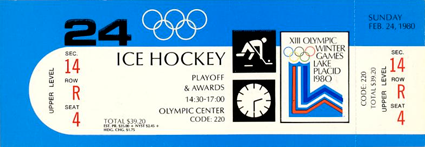
Still, the victory over the Soviet Union left the United States fate in their own hands, as a victory over Finland would elevate them to an unreachable 5 points and earn them the coveted gold medal. Oddly, the USA was scheduled to play at 11AM in Lake Placid.

1980 Olympics USA vs Finland

USA coach Herb Brooks pregame speech was short and directly to the point. "If you lose this game, you'll take it to your grave. Your f***ing grave."

"He didn't have to say much more than that. We knew he was right," USA forward Mark Johnson recalled.

Unfortunately for the United States, Jukka Porvari got Finland out on top with the first goal of the game at 9:20 of the first period with a one-timer slapshot over USA netminder Jim Craig's glove. The period would end with the USA leading 14-7 in shots on goal, but trailing on the scoreboard 1-0, the sixth time in seven games they had fallen behind.

The United States evened the score at 4:39 of the second period on Steve Christoff's unassisted goal on a backhander that went through Finnish goaltender Jorma Valtonen's pads only to have Finland regain the lead less than two minutes later when Mikko Leinonen put a second shot past Craig at 6:30 on the power play. Once again, the United States held the edge in shots on goal at 8-6, but had just twenty minutes to get out of the hole they found themselves in to a team that have never won a medal, nor beaten the United States in Olympic hockey.

Just over two minutes into the third period Dave Christian skated from his own zone into the Finnish end, drew the defense toward him and passed to left wing Phil Verchota who fired a wrist shot just inside the right post to tie the game at 2-2 at 2:25.

Less than four minutes later the United States struck again when Johnson, behind the Finland goal, passed the puck to Rob McClanahan, who saw Valtonen start to go down put the puck in between his gaping legs for a 3-2 lead for the USA at 6:05.

Before the United States could relax, Neal Broten took a hooking penalty at 6:48 followed by Christian's tripping penalty at 8:54. The USA successfully killed off both penalties only to have Verchota whistled for roughing at 15:45 with the game still in doubt.

With both Broten and Christoff keeping Finland in their own zone during the power play, the puck was shot out toward the blueline, where it was intercepted by Johnson, who skated in, beat a defender, and made a backhand attempt, which Valtonen saved. The rebound however, went right back to Johnson who quickly smacked a forehander which went over Valtonen's right skate for a shorthanded goal to give the United States a 5-3 lead with 3:35 left to play, sending the arena into bedlam, as loud as it had been against the Soviets two days earlier, as the United States led for the first time all game.

The Americans were now on a roll with their ultimate goal in sight and kept up the pressure, nearly scoring twice more on one shot that hit the pipe and another off the crossbar. Finally time ran out and the United States had secured their gold medal in a game many do not even remember, especially given the attention history has focused on the game against the Soviet Union and the "two days later the miracle was made complete" treatment it received in the movie "Miracle" - all of five seconds of game footage.

1980 USA Finland

Still, somewhat unbelievably, there was another game left to play between the Soviet Union against Sweden at 2:30PM. Following the Soviet's demolition of Sweden 9-2, the final placings were now all known and the medal ceremony took place on the ice with Sweden still wearing their jerseys from their game.

1980 Medal Ceremony

1980 Gold Medal

Following the presentation of the medals and the playing of the Star Spangled Banner, team captain Mike Eruzione famously called the rest of the team up onto the top level of the victory podium, which miraculously was just large enough, barely, to hold each and every member of the team.

1980 Medal Podium

Today's featured jersey is a 1980 United States Olympic Team Dave Christian jersey as worn in the gold medal clinching game against Finland on the final day of the 1980 Olympic tournament, the sixth time the United States had come from behind during their seven games.

The blue jerseys are the lesser known jerseys from the tournament, as it was the white ones they were wearing when they defeated the Soviet Union and the style which has been much more heavily marketed since then.

USA #23 Road 1980 F
USA #23 Road 1980 B

Our video section begins with Rob McClanahan's game winning goal at 6:05 of the third period.


This clip starts with a replay of Mark Johnson's goal with 3:35 left to play and runs through the end of the game.


The next part picks up with some of the on ice post game celebration and continues with a thrilled Jim McKay reacting to the win and scenes of the celebration on the streets of Lake Placid.


This final part includes interviews with Eruzione, Brooks, who gets a phone call from President Jimmy Carter, Craig, Johnson and McClanahan.


Sunday, December 26, 2010

2004 Team USA Zach Parise Jersey

Today kicks off the IIHF 2011 World Junior Hockey Championships in Buffalo, New York where the 2010 champions from the United States will be looking to defend their title on home ice.

The World Juniors have become a much anticipated annual event, particularly in Canada, and anybody who's anybody has played in the tournament on their road to the NHL, dating back to Wayne Gretzky, Jari Kurri, Mario Lemeiux, Steve Yzerman, Alexander Mogilny, Sergei Fedorov, Jeremy Roenick, Mike Modano, Pavel Bure, Jaromir Jagr and Peter Forsberg through current NHL stars Jarome Iginla, Daniel and Henrik Sedin, Zach Parise, Ryan Getzlaf, Alexander Oveckin, Evgeni Malkin, Sidney Crosby, Johnathan Toews and Patrick Kane, making it a must-see event each year.

The ten teams in this year's edition are divided into two groups of five and each team will play the other four teams in it's group once each in the Preliminary Round, with the top three advancing to the Playoff Round. With so few games determining each team's fate, no one can afford to take a night off as each and every game is critical to each team's chances.

For the unfortunate four clubs who finish in the bottom two of their groups, they will be placed in the Relegation Round. Following a round-robin schedule among the four, the bottom two teams of the group will be demoted to the Division I level for 2012 and will need to earn their way back up to the Top Division, which can only be achieved by winning a championship in Division I. Second place earns you nothing but another season at the Division I level. This relegation format ensures that nearly every game matters in the World Juniors and the games that determine which clubs stay up can be very exciting affairs when two countries are battling with survival on the line. We strongly encourage those in attendance take in the final day of the relegation round if the placings have not already been determined at that point. Spirited games in the much more homey secondary arena can provide some terrific competition in a small town or collegiate atmosphere that differs greatly from the environment more polished main rink and is a recommended part of the World Junior Tournament experience.

Once in the Playoff Round, the two group winners will receive a bye directly into the semifinals as a reward, while the second place team in Group A will face the third place team in Group B and vice-versa, with those two quarterfinal games taking place on January 2nd.

The two quarterfinal winners advance to face the group winners, who will enjoy the advantage of two days of rest, in the semi finals on January 3rd. The semifinal losers will meet for the bronze medal on January 5th with the winners meeting for the gold medal later that evening.

Thanks to some unexpected results in recent tournaments, the usual even distribution of familiar hockey powers in each group has been thrown out the window for 2011. Group A consists of the United States, Switzerland, who finished a strong fourth in 2010, Finland, Slovakia and recently promoted Germany.

Group B on the other hand, has been declared "The Group of Death" and is stacked with Canada, Sweden, Russia, who were classified a disappointing 6th in 2010, the Czech Republic, who shockingly found themselves in the Relegation Round in 2010, and underdogs Norway.

In Group A, the Americans are favored to advance and will be looking to earn one of the coveted byes into the semifinals. Finland and Switzerland are also expected to advance to the Playoff Round and must avoid giving away points, or worse, being upset by either Slovakia or Germany. The Slovaks goal will be to avoid the relegation round, and to do so, must upset one of the favored three teams and steal a point by getting to overtime against one of the other two.

Germany's goal for 2011 will be to maintain their place in the Top Division by surviving the Relegation Round. Their game against Slovakia on December 27th will be a key opportunity to gain points towards that end should Slovakia be the other team placed in the Relegation Round, as the game between the two teams from each group that are placed in the Relegation Round will carry over to the Relegation Round standings.

Group B is obviously a lot more complicated, as annual championship contenders Canada, Sweden, who have strongly re-emerged from a down period with three consecutive medal placings, Russia, who will not want a repeat of last year's disappointing placing following five consecutive finishes in the medals, and the Czech Republic, will all slug it out for the bye awarded to the group winner, with one of those four guaranteed a place in the fight to avoid relegation.

Poor Norway will be in for a rough go and will most certainly be hoping one of the four teams ranked above them will be having a down year and that they can take some points out of the game against the club that will join them in the relegation round for a shot at unlikely survival.

Canada put together a dominant run of five consecutive titles from 2005 to 2009, but their program is a victim of it's own success in breeding top quality players, as tournament eligible players Matt Duchene and Ryan O'Reilly (Colorado), Tyler Seguin (Boston), Jeff Skinner (Carolina), Evander Kane (Atlanta), Taylor Hall (Edmonton) and Kyle Clifford (Los Angeles) will not take part due to having found gainful employment in the NHL. Still, 16 of the 22 Canadian players are already first round draft picks in the NHL. Once again, similar to 2005 when the United States hosted the tournament in Grand Forks, North Dakota, the proximity of the tournament to Canada, this time less than four miles from the Canadian border, should ensure the Canadians will feel right at home playing in front of tens of thousands of red-clad supporters waving the Maple Leaf each time they take to the ice.

The host United States has eight players returning from the team that won gold in overtime to break Canada's streak last year. Goaltender Jack Campbell, defenseman John Ramage and forwards Ryan Bourque, Jerry D'Amigo, Chris Kreider, Jeremy Morin, Kyle Palmieri and Jason Zucker all are back in an attempt to capture a second consecutive gold, this time on home ice.

The tournament begins with four games today, with Germany taking on Switzerland in the opening game at 12:30 PM (all times eastern) in the first of three games at the 18,000 seat HSBC Arena in Buffalo.

The NHL Network in the United States will be replaying last year's gold medal game between the United States and Canada at 2 PM (following replays of the USA's 2010 quarterfinal and semifinal games) as a prelude to their airing of the all-important second game on the schedule between Canada and Russia at 4 PM, also in Buffalo. The game will be carried in Canada by TSN.

Also starting at 4 PM, Norway opens against Sweden at the 2,100 seat Dwyer Arena on the Niagara University campus and the day is capped off by the United States beginning it's championship defense with a stiff challenge from Finland, which will be televised by the NHL Network in the US and on TSN2 in Canada at 6 PM.

Fans in attendance in Buffalo will have the luxury of being able to attend any game they choose since the two arenas are located just 16 miles apart, unlike some other years when the two host arenas have been several hours drive between them. With the large number of games compressed into such a small schedule, the second arena can often find itself hosting some terrific matchups, such as Sweden vs. Russia on December 28th and the Czech Republic vs. Russia on December 31st in a more personal atmosphere than the professional sized main rink has to offer. We highly recommend taking in one game at the secondary arena during the Preliminary Round each year when possible.

In the United States, the NHL Network will be airing all four of the Preliminary Round games for both the United States and Canada, as well as the game on Thursday between Sweden and the Czech Republic at 3 PM. With each game for the US and Canada of the preliminary round being aired, it means each team in the tournament will be on TV at least once.

Once the Playoff Round begins, all six games on January 2nd, 3rd and 5th will be aired through the gold medal final.

For viewers in Canada, the four Canadian Preliminary Round games, as well as the US vs. Finland on December 26th (8 PM - TSN 2), Sweden vs. Russia on December 28th (7 PM), both Sweden vs. the Czech Republic (3 PM) and Germany vs. the United States (7 PM) on December 30th and the United States vs. Switzerland on December 31st (8 PM) will be aired prior to their coverage of the six Playoff Round contests.

In a nice bit of traditional scheduling, the tournament always takes off New Year's Day between the Preliminary Round and the commencement of the playoffs, avoiding any conflict with the now annual NHL Winter Classic, which just also happens to take place less than four hours drive down the freeway in Pittsburgh for the more ambitious (and financially well off) ones in attendance in Buffalo.

Today's featured jersey is a 2004 United States National Team Zach Parise jersey from the first American team to ever capture a gold medal at the World Junior Tournament, which took place in Helsinki, Finland. The United States won their group by defeating Austria, Slovakia, Sweden and Russia before defeating Finland and then Canada in the final to claim the championship.

Parise led the US with five goals and 11 points on his way to being named the Most Valuable Player of the tournament.

This style of jersey was first used by the United States at the 2002 Olympics in Salt Lake City and remained in use through the 2005 World Junior Tournament.

2004 USA F jersey
2004 USA B jersey

Here are extended highlights from the 2004 World Juniors when the United States captured the gold medal thanks to an errant clearing attempt by Canadian goaltender Marc-Andre Fleury.


This next highlight is the gold medal winning goal in overtime by American John Carlson from last year's World Juniors, the second title for this year's hosts the United States.


Monday, May 31, 2010

1980 Team USA Jim Craig Jersey

Born on this date in 1957, Jim Craig played college hockey at Boston University for three seasons which included winning a National Championship in 1978 and being named an NCAA All-Star in 1979.

Jim Craig Boston University

Following his college career, Craig gained valuable international experience as goaltender for the United States in the 1979 World Championships, posting a 2-1-2 record.

Craig gained his greatest fame as the starting goaltender for the United States at the 1980 Olympics in Lake Placid, New York.

Jim Craig

The young Americans opened their tournament with a come from behind tie against Sweden followed by a confidence building 7-3 hammering of traditional international hockey power Czechoslovakia.

They took care of business with wins against Norway 5-1, Romania 7-2 and West Germany 4-2 to finish the First Round undefeated at 4-0-1, earning a place in the four team Final Round.

"My goal in every game was to keep my team in a position to win," Craig recalled.

It was there that Craig cemented his legacy in hockey history, holding off the heavily favored Soviet Union, winners of five of the last six Olympic gold medals, in what would become known as "The Miracle on Ice". In all, Craig made 36 saves as the US was outshot 39 to 16 and won 4-3.

1980 Miracle on Ice

Despite the euphoria of that victory, the United States still had to come from behind to defeat Finland two days later 4-2 to clinch the gold medal.

Jim Craig

"We were just a bunch of talented, dedicated, wonderful guys who believed in one goal, and stuck all of their own personal ambition away to achieve it. If that's a miracle, I believe in that," said Craig.

Craig had little time to savor the victory, as less than a week later he made his NHL debut for the Atlanta Flames and stopped 24 shots in a 4-1 win over the Colorado Rockies.

Jim Craig

He would see action in just three more games, going 0-2-1 before being traded to his hometown Boston Bruins for a pair of draft picks at the 1981 NHL Entry Draft.

He would struggle for playing time in Boston, but see action in 23 games and finishing the season with a 9-7-6 record.

Jim Craig

The 1981-82 season was a litany of medial problems for Craig, including a broken finger which caused him to miss the 1981 Canada Cup, surgery to remove a benign lump in his shoulder, a fall off a ladder which broke his ankle and finally back spasms which ended his season after only 13 games for the Bruins minor league affiliate in Erie, Pennsylvania.

He spent the next season with the United States National Team, playing in 26 games played well enough to earn another shot at professional hockey. He finished his playing career with 27 games with the Salt Lake Golden Eagles of the CHL and three games with the Minnesota North Stars in the NHL before retiring from hockey.

Jim Craig

Craig was inducted into the Boston University Hall of Fame in 1989 and the International Hockey Hall of Fame in 1999.

Today's featured jersey is a Norcon 1980 Team USA Jim Craig jersey. This jerseys is a true icon of hockey and is notable for it's contrasting blue nameplates with white lettering.

While many manufacturers have produced replicas of the jerseys worn in Lake Placid by the United States "Miracle on Ice" squad, the original jersey manufacturers were Norcon of Forest Lake, Minnesota.

1980 United States jersey

Today's video section highlights Jim Craig's performance in the 1980 Olympics.


This look at Craig's career includes footage from his NHL debut with the Flames vs. the Rockies.