Tuesday, January 4, 2011

1975-76 Buffalo Sabres Gerry Desjardins Jersey

Following the success of the 1972 Summit Series between Team Canada and the Soviet Union, more opportunities were sought for competition between teams of North American professionals and Soviet squads. The second such series took place in 1974, when a team of players representing the World Hockey Association, who were not allowed to participate in the 1972 version, faced off against the Soviet National Team.

The concept was then expanded beyond the two-team exhibition series format with the introduction of the 1976 Canada Cup, a tournament format which featured national teams from six nations, who played a round robin format with the top two teams meeting in a best-of-three final.

Later in 1976, a new idea came to the fore, the "Super Series", in which the best two club teams from the Soviet League would travel to North America to play exhibition games against NHL member clubs, no doubt motivated by the opportunity to profit financially from the interest in seeing the exotic and still mysterious teams from behind the Iron Curtain.

Sabres Wings Program cover
Goal magazine program cover for the 1976 Super Series

The first of those games took place later in 1976 when both the famed Central Red Army (HC CSKA Moscow) and Soviet Wings (Krylya Sovetov Moscow) teams arrived in late December to play four games each against NHL competition. Such was the continued importance of beating the teams from North America from a propaganda standpoint, that both Soviet clubs also had the addition of a few of the better players from other Soviet clubs. Central Red Army was bolstered by a pair of skaters from Dynamo Moscow, while the Wings added four members of Spartak Moscow to increase their strength.

Central Red Army got things underway with a game on December 28, 1975 when they throttled the New York Rangers 7-3 at Madison Square Garden. The Soviet Wings tour began the very next day with similar results when they defeated the Pittsburgh Penguins 7-4.

Next up for the dominant club of Soviet club hockey, Central Red Army, was their famed battle with the Montreal Canadiens, a team on the verge of a dynasty of four straight Stanley Cups, on New Year's Eve in 1975, a 3-3 tie between two of the finest clubs ever in mid-season form, which is often called the greatest game of hockey ever played.

Next on the schedule, on this date in 1976, was the meeting between the Soviet Wings and the host Buffalo Sabres. The game was played at the Buffalo Memorial Auditorium in front of 16,433 fans.

Buffalo was one of the NHL's top teams at the time, having just competed in the Stanley Cup Finals at the conclusion of the previous season. They were led by "The French Connection" line of Gilbert Perreault, Rick Martin and Rene Robert. They, and the rest of the Sabres, were under pressure to win, as the NHL was still winless after the first three games.

Sabres GM Punch Imlach had a plan to deal with the Wings to take advantage of something the Sabres had that they did not, size on defense. Jocelyn Guevremont, Bill Hajt, Jerry Korab and Jim Schoenfeld were all at least 6' 2" and more than 200 pounds were all instructed to hit the Wings hard and as often as possible and outwork the Wings.

The fans in Buffalo created an atmosphere that was simply electric as they sought to support not only their team, but the democratic way of life in the face of the communist system the Wings represented to them. "We came out onto the ice, and it had to be several minutes until it quieted down. We were so excited we could almost feel the ice shake," recalled Korab.

Soviet Wings
Krylya Sovetov Moscow

The four defensemen hit any and every puck carrier they could and Guevremont opened the scoring at 6:10 of the first period, which caused the Buffalo faithful to let out a thunderous roar. Exactly one minute later Perreault scored on Wings goaltender Alexander Sidelnikov to continue the celebration. Midway through the period Martin extended the Sabres lead to 3-0 but the Wings stemmed the tide when they scored a power play goal on the Sabres Gerry Desjardins at 13:45, but a little more than a half a minute later Martin struck again at 14:23. Sergei Kapustin closed out the period with a goal at 19:16 to keep the Wings within striking distance at 4-2 in favor of the Sabres. The period ended with the Sabres leading in shots on goal 17-9.

The second period was even more of a track meet as the Sabres extended their lead with a power play goal by Jim Lorentz at 4:32 followed by Robert a minute later at 5:32 to put Buffalo in a commanding 6-2 lead. The Wings' Vladimir Repnev kept the goals coming 27 seconds later to make the score 6-3. The teams again traded goals with Korab scoring on the power play at 8:26 and Victor Shalimov responding at 8:40. The seventh Sabres goal chased Sidelnikov from the Wings goal in favor of Alexsandr Kylikov. The Sabres then kept their foot on the gas when Danny Gare scored at 11:44 followed by Peter McNab, who made it 10-4 at 13:17 to continue the party in the stands as Kylikov's stay in the net ended after less than five minutes. The second period ended with the Sabres up 9-4 and now leading in shots 34-16.

The third period was more of the same as Kapustin got his second of the game for the Soviets at 3:28. Fred Stanfield added his name to the goal scoring roll call at 9:41 as the Sabres reached double digits followed by Yuri Lebedev for the Wings at 11:32.

The Sabres then hammered home their point when Danny Gare scored at 14:04 and Brain Spencer finished off the worst loss ever by a Soviet team in international competition with his goal at 18:04 on another power play, the Sabres third of the game as they became the first NHL club to ever defeat a Soviet team. The final shots on goal for the evening were 46-25 in favor of Buffalo.

Sabres Wings final scoreboard
The scoreboard shows the final score of the Sabres historic victory

Martin was voted the games first star following his two goal, five point night. "You could tell they didn't like the fact they got out skated. When we were out on the ice, they all had this dumbfounded look on their faces. They didn't expect that. When we saw that would could skate with them, we just went for it and it worked," Martin said afterwards.

So popular was the Sabres win with NHL fans that they received a standing ovation before their next game - in Montreal!

Imlauch called the game "was the all-time high point for the Sabres"as well as the highlight of his lengthy career.

Sabres Wings pennant
Such was the significance of the Sabres victory that a souvenir of a game is created following the contest

"I had never been so fired up for a game," said Martin. "I had played in a lot of big games, but that truly was the game I'll never forget."

The Wings rebounded from their crushing defeat by Buffalo to down the Chicago Black Hawks three days later 4-2 and conclude their North American foray with a 3-1 record after their 2-1 defeat of the New York Islanders.

Today's featured jersey is a 1975-76 Buffalo Sabres Gerry Desjardins jersey, the winning goaltender is the Sabres victory over the Soviet Wings.

The Sabres original jerseys had a lace up collar and no names on the back, which were later added by league mandated rules in 1977. You will notice however, that the Sabres did have names on the backs of their jerseys in the photo above, taken at the conclusion of the game against the Soviet Wings.

Popular belief among team owners at the time was that names on the back would result in less sales of game programs, but common practice at the time was to add names for games that were nationally televised and this may have been the case for the game against the Wings, either for American audiences or perhaps even possible viewers back in Russia. The font used for the names does have serifs on the letters, while the standard font for names on the backs of Sabres jerseys beginning in 1977 was a simpler block font without serifs.

The Sabres jerseys retained their lace up collars until 1978-79 when they were replaced by v-neck sweaters.

Desjardins began his NHL career with the Los Angeles Kings in 1968-69 and was later involved in a trade which sent him to the Chicago Black Hawks in 1969-70. Chicago actually traded him to the California Seals on September 9th, 1971, only to be sent back to Chicago in another trade five weeks later before ever playing a game for California!

The New York Islanders claimed him in the 1972 expansion draft from Chicago. He suffered through two losing seasons as the Islanders found their feet in the NHL. Desjardins sought greener pastures in the WHA, but signed for the 1974-75 season with the unstable Michigan Stags franchise, which became the Baltimore Blades mid-season, a move which triggered an escape clause in his contract, allowing him to sign with the Buffalo Sabres in time to appear in nine regular season games as well as the teams playoff run all the way to the Stanley Cup Finals.

With Buffalo, he found not only stability, but success as well, easily setting career highs with 29 and then 31 wins as the Sabres number one goaltender before being forced to retire after being struck in the eye by a puck after playing just three games of the 1977-78 season.

Buffalo Sabres 76-77 jersey

Our video section today begins with the introductions of the conquering heroes, the Buffalo Sabres.


Pull up a chair and get comfortable, here are extended highlights of the goals from the Sabres win over the Soviet Wings, the first win for an NHL club over a Soviet team.


Monday, January 3, 2011

Resolutions

I decided to take a page from my friend Foodiebia's book and check back to see how I did on my resolutions this past year. No fun if there isn't any accountability. (Also, I only had 4 resolutions? Wow, I expected more than that)

They were:
1) Think twice before taking a cab - Check. Let me tell you, I have taken many a bus this year, and most of the time just preferred to hoof it. I mostly arrived places on time and got a lot of good exercise, not to mention a good tan this summer, as I walked all over my fair city. Farther than normal people would walk, but hey I had nothing else to do. Now what shall I do with all the money I've saved?....

2) Oh right, I know, I spent all that saved cab money on this. Resolution #2, getting a fancy pants Chloe bag. I love this bag. Love love. Don't regret its purchase for a second. Well, as long as I pretend to not remember how much it cost... Good thing I've been taking less cabs.

3) Get a swine flu shot - Check. I have no idea why this made the list of resolutions, but as someone who gets sick ALL THE TIME, I figure it's best to get my flu shots. Already got my flu shot for this winter too. Woohoo!

4) Be better about eating gluten-free. I actually did a really good job at this one, stocked up on g-free items and got creative in the kitchen. Didn't cheat nearly as much as I normally do, but due to some horrible gall stones and a severely restricted diet I've been told to basically eat nothing but saltines and toast. I've never seen g-free saltines and g-free bread tastes like [insert something horrible, dense, and flavorless here]. So if I'm going to have nothing to eat but saltines and broth for 6 weeks, then I'm at least eating ones with gluten (and flavor) in them! But, hey, I made it pretty far through the year if I'm only just falling off the wagon.


And now for this year. What fashionable things shall I resolve?

1) To shower and shave on a regular basis. I have heard of too many moms who only shower once a week and, frankly, it grosses me out. I need to wash my hair. And myself. And as a person who basically only wears skirts and dresses, shaving cannot fall off the agenda. Hey, if I can manage to shave regularly at 36 weeks pregnant when I can harldy even reach my legs (it really is a bit of a struggle these days), then there's no reason I can't do it post-baby.

2) Umm.... gosh, I can't think of any other resolutions for myself. I really just don't want to be a dowdy mom. Let's just list it twice under my resolutions because it's just that important.

3) Don't spend a million zillion dollars on cute baby clothes. This will be hard. Baby girl things are just too cute with the ruffles and bows, but I must resist. I am proud to say that of the many outfits in our ridiculously stuffed dresser of baby clothes I have only purchased 9 things for BabyWP (one of which is a New Kids on the Block onesie I bought 2 years ago, so I'm not even sure if that counts). BabyWP just has lots of aunts who are looking to spoil her, plus a Grammy who I'm pretty sure buys her a new outfit everyday. I think we're all set on clothes for a while.

4) I was going to put "lose the baby weight" on my list, but in weird unpredictable pregnancy developments, I have only just gotten to my pre-pregnancy weight at 35 weeks. So maybe I should shoot for the weight I had at the lowest point in the pregnancy? Because that would be fun. And I'm sure I'll be halfway there just by giving birth. Got to love attainable goals. Alright, let's go with that. So not so much losing the baby weight, but getting to my skinniest weight this year... which was when I was 20 weeks pregnant. What a strange year it's been.

5) I resolve to get my hair dyed as soon as humanly possible after the baby is born. I really can't look at my grays or ombre hair any longer. I'm really impressed I've made it this long. I wonder if I can get my colorist to come to the hospital after I deliver....

What are your resolutions this year? Fashion-centric resolutions not required, but always encouraged :)

NYE

my new year's eve:Yigal Azrouel one shouldered dress:wearing my new Louboutins of course:Such a great night with best friends!
What did you do for new year's eve?

1977-78 Maine Mariners Rick St. Croix Jersey

Born on this date in 1955, Rick St. Croix began his road to the NHL with his hometown Kenora Muskies in the Manitoba Junior Hockey League in 1969-70. From there he progressed up the ladder to the Oshawa Generals of the Ontario Hockey League for another three seasons.

Following his junior career, St. Croix was then drafted by both the Houston Aeros of the WHA 169th overall and the Philadelphia Flyers of the NHL 72nd. Since the Flyers drafted St. Croix much higher and were the defending Stanley Cup champions, they must have seemed the more attractive choice for St. Croix, which proved correct when the Aeros folded just three seasons later.

In a convenient move for St. Croix, he went from playing for the Generals to the... Generals, only this time with Flint of the International Hockey League. There he played two seasons in 1975-76 and 1976-77 prior to joining the Maine Mariners of the American Hockey League. He played 40 games for the Mariners that season to lead the Mariners in starts among the four goaltenders used by Maine that season on his way to a 22-14-2 record along with a pair of shutouts.

Once in the playoffs, the Mariners received a bye in Round 1 as a result of their first place finish in the North Division. In Round 2 they defeated the Nova Scotia Voyageur in seven games to advance to the Calder Cup Finals, where they defeated the New Haven Nighthawks in five games to win the AHL championship in only their first season of existence.

Also during the 1977-78 season, St. Croix made his NHL debut with the Flyers and appeared in seven games with a 2-4-1 record.

The following season St. Croix dressed for 22 games with the Mariners (10-9-3), the Philadelphia Firebirds, also of the AHL, for nine games (4-4-1) as well as a pair of games with the Flyers (0-1-1).

St. Croix was once again the number one goaltender for Maine in 1979-80, going 25-14-7 in 45 games on his way to being named an AHL First Team All-Star and sharing the Harry "Hap" Holmes Award as Maine led the AHL with the lowest goals against average. He also appeared in a single game for the Flyers that season, a win in which he allowed just two goals.

His performance with the Mariners led to St. Croix becoming a full-time member of the Flyers for 1980-81 as part of a goaltending trio with veteran Phil Myre and former Mariners teammate Pete Peeters. St. Croix went 13-7-6 in 27 games as a rookie.

In 1981-82 St. Croix posted a 13-9-6 mark in 29 games, but became expendable the following season with the emergence of Swede Pelle Lindbergh. Oddly, despite the lack of room in the Philadelphia goal, St. Croix would be traded in mid-January to the Toronto Maple Leafs for another goaltender, Michel Larocque, who would only play two games for the Flyers before he too was traded away a year later.

St Croix Maple Leafs
St. Croix guarding the net, with some additional help, while in Toronto

St. Croix arrived in Toronto in time to play in 17 games for the remainder of the 1982-83 season. He was also assigned to the St. Catharines Saints of the AHL for their first round playoff series against the Rochester Americans, which they lost in seven games.

Back with Toronto for the 1984-85 season St. Croix fought for playing time in the overcrowded Maple Leafs crease, managing to get into 11 games while battling with Tim Bernhardt (37 games), Ken Wregget (23) and Allan Bester (15). Unable to secure enough minutes in Toronto, St. Croix was assigned to St. Catharines once again, where he played in 18 contests.

He spent his final season as a professional with the IHL's Fort Wayne Comets, where he led the club in games and wins with a 25-13-0 record in 42 starts on the way to a first place finish in the West division.

St. Croix was Ed Belfour's goaltending coach with the Dallas Stars in 1999 when they won the Stanley Cup and is currently an assistant coach with the Manitoba Moose of the AHL and runs the well known Rick St. Croix's School of Goaltending.

Today's featured jersey is a 1977-78 Maine Mariners Rick St. Croix jersey. St. Croix played three seasons with the Mariners, during which they won the Calder Cup trophy as AHL champions in both 1978 and 1979, the only team in AHL history to win the Calder Cup in their first two seasons. The Mariners naturally adopted the Flyers colors and jersey template during their time as a Flyers affiliate.

In 1983-84 the Mariners affiliation changed to the New Jersey Devils and won their third Calder Cup despite a losing record during the regular season and no players in the top ten in league scoring! After the Mariners final season of 1986-87, New Jersey relocated the franchise to Utica, New York and renamed it the Devils.

A new Maine Mariners club was immediately created in 1987-88 to replace the franchise which moved to Utica, only this time affiliated with the Boston Bruins. That club was moved to Providence, RI in 1992. After a one year gap, the Baltimore Skipjacks moved to Portland, Maine, where they became the Portland Pirates, where they continue to play in the AHL today. The Pirates duplicated the Mariners feat, and brought the Calder Cup back to Portland in 1994 in their first season of existence.

Maine Mariners 77-78 jersey

Bonus Jersey: Today's bonus jersey is a 1981-82 Philadelphia Flyers Rick St. Croix jersey. 1981-82 was the first season the Sandow SK logo would appear on the back of the Flyers jerseys which had previously carried no brand identification.

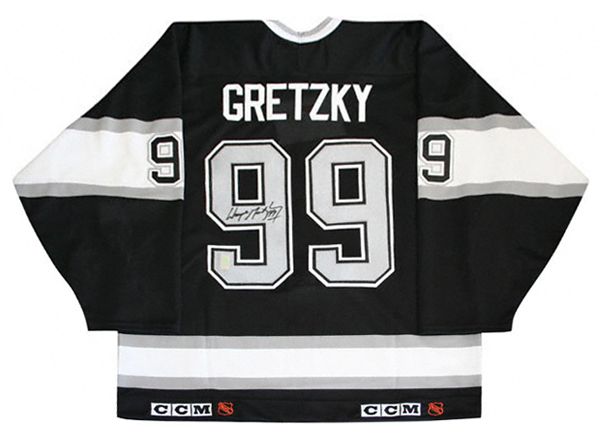
Both Sandow SK and Maska logos began appearing on NHL jerseys during the 1979-80 season and eventually migrated from the lower right side of the jerseys to the upper back, just below the neck line. They became so important that CCM and Starter began putting them on both the lower right and left side of Wayne Gretzky's jerseys because of his habit of tucking in the right side of his jersey hid their logo from view.

Philadelphia Flyers 81-82 jersey


2011 World Junior Tournament Quarterfinal Report

The quarterfinals of the 2011 World Junior Championship provided some real fireworks on Sunday.

In the first game Canada fell behind by a goal just 1:09 into the contest but did not ignore the wakeup call and came back to score four straight goals from four different players to dispatch Switzerland in the early game, setting up the game everyone in North America was hoping for against the United States, only one round too early thanks to Sweden defeating Canada in a shootout on New Year's Eve.

In the second game, Finland led 3-1 with 3:41 to play when Yevgeni Kuznetsov bashed in a puck that appeared to be covered by Finnish goaltender Joni Ortio on a power play to pull Russia to within one and set up an exciting last few minutes.

Kuznetsov dazzled the crowd when he streaked into the Finland zone with under two minutes to play and danced his way though the defense to get a close range shot on Ortio, who made the save but failed to contain the puck, which was then sent home by Maxim Kitsyn to tie the score and cause the building to erupt.

The game then moved to overtime and Kuznetsov again was at the center of the action when he got the puck in the left faceoff circle from Kitsyn. He then fired passed a Finnish defender and over Ortio and into the top right corner to complete the amazing comeback for Russia.

The Russians (3-2) now advance to play unbeaten Sweden (3 regulation wins and 1 shootout win) Today at 3:30 PM eastern time, followed by the host United States (3 wins and 1 overtime win) taking on rivals Canada (4 wins and 1 shootout loss) at 7:30 PM to determine the gold medal finalists on Wednesday.

Meanwhile, in the Relegation Round, Slovakia had an easy time of Norway 5-0 to ensure Norway's return to Division I next season, while the Czech Republic did the same to Germany with a narrow 3-2 win with a goal with just one minute remaining.

Following today's semifinals, all four clubs will get a day of rest before the bronze and gold medal games, but Tuesday still has three games scheduled, with Germany and Norway and the Czech Republic and Slovakia finishing out the Relegation Round schedule even though both teams in the second game have already had their survival assured, taking away any final drama at the Dwyer Arena.

Finland and Switzerland will meet at the HSBC Arena to determine fifth place only because they have to in order to determine which group each will be placed in for next season's tournament in Edmonton and Calgary.

Sunday, January 2, 2011

2011 World Junior Tournament Update

With the Group Stage now completed at the 2001 World Junior Tournament in Buffalo, New York, the pairings are now set for the quarterfinals, which will both take place today.

The United States earned a bye into the semifinals by winning Group A with their hard fought 2-1 win over scrappy Switzerland on Friday night, while Sweden prevailed over Canada in a thrilling 6-5 game determined by a shootout in their final Group B contest, easily the best game of the tournament to date.

The quarterfinal matchups were determined by having the second place finisher from Group A, Finland, facing the third place team in Group B, Russia. They will face off today at 3:30 PM, followed by the second place finisher in Group B, Canada, playing the Group A third place team, Switzerland, in the evening game at 7:30 PM.

The quarterfinal losers will meet in an all but meaningless game on Tuesday to determine 5th and 6th place that will affect which groups they will be placed in for next season.

As for the four teams not already mentioned, Slovakia, Germany, Czech Republic and Norway, after finishing fourth and fifth in their groups, they have been placed in the Relegation Round to determine which two teams will be demoted to Division I for next season. Since Slovakia and Germany have already faced each other in the Preliminary Round, the result of their 2-1 overtime win for Slovakia will carry over to the Relegation Round standings, as will the result of the 2-0 win for the Czech Republic over Norway, meaning the Czechs already have the advantage of 3 points in the standings in the fight for survival which will take place on Monday and Tuesday at Niagara University's Dwyer Arena. Slovakia enters with 2 points, Germany 1 and Norway facing an uphill battle with zero. The two teams who drop down for next year's tournament in Edmonton and Calgary will be replaced by Latvia and Denmark, this year's Division I champions.

In the semifinals, Sweden will play the winner of the Russia/Finland battle at 3:30 PM on Monday afternoon. Things really promise to heat up when the winner of today's early game between Switzerland and Canada will advance to meet the United States tomorrow at 7:30 PM with a shot at the gold medal on the line, with the expected matchup expected to be the United States versus Canada that is guaranteed have the building rocking.

The semifinals losers will meet on Wednesday at 3:30 PM in the bronze medal game to determine which of the two teams will go home happy with a medal, while the other will finish on a down note with two consecutive losses.

The tournament championship will be settled on Wednesday night at 7:30 PM when the semifinal winners play for the gold medal and the IIHF championship trophy with everyone in Buffalo hoping for the host United States in a position to repeat as champions, while those from just across the border in Canada longing for another Canadian gold medal while the European teams are looking to spoil the party for the North Americans.


Saturday, January 1, 2011

2008-09 Chicago Blackhawks Jonathan Toews Jersey

On this date in 2009, the Chicago Blackhawks hosted the Detroit Red Wings in the second NHL Winter Classic at the historic Wrigley Field.

The Black Hawks, two separate words at the time, were founded in 1926, one of three United States based teams added that season along with the Detroit Cougars and New York Rangers, and were named after their original owner Frederic McLaughlin's military unit nicknamed the "Blackhawk Division" which he had been a commander of during World War I.

Their original jerseys were white with black striping and featured a logo which depicted Chief Black Hawk of the Sauk nation who McLaughlin's military division was named after.

Irvin Pictures, Images and Photos
Dick Irvin of the 1926-27 expansion Chicago Black Hawks

For the team's second season the colors of their jerseys were reversed to black sweaters with white stripes. This jersey was used from 1927-28 through 1933-34, the season the Black Hawks would win their first Stanley Cup Championship.

Chicago Black Hawks jersey Pictures, Images and Photos
Teddy Graham wearing the revised Black Hawks jersey in 1930

The following season the Black Hawks would debut new black sweaters which featured a bold white chest stripe with red trim while continuing use of their black and white logo from the previous jerseys.

Black Hawks 1926 logo

This style was short-lived and was replaced midseason by a jersey of the same template, only with tan replacing the white and a new colorized version of their logo.

Black Hawks 1935 sweaters
Black Hawks 1935 logo

After just two and a half seasons of use, the black and tan sweaters were replaced by the striking new barberpole jerseys which were adorned with multiple red and white stripes on a black jersey for the 1937-38 season just in time for the club to win it's second Stanley Cup title.

Bill Mosienko jersey Pictures, Images and Photos

The logo underwent a series of tweaks throughout the life of the barberpole jersey, including this variation used in 1947-48 when the feathers were white with red veins.

blackhawks1947-1948

After 18 seasons, the barberpole jersey would be retired in favor of what would become the Black Hawks iconic style which is still in use today, with only some evolutionary changes to the secondary logo and main crest, as illustrated by this example from 1963.

Chicago Blackhawks 1963 jersey
1963 Chicago Black Hawks Reg Fleming jersey

Since the introduction of their new set of jerseys in 1955, the only two other jerseys to be used by the team were a revival of the barberpole style for the NHL's 75th anniversary season in 1991-92 and a striking black alternate version of their white jersey used from 1996-97 to 2006-07, and again in 2008-09.

Chicago Blackhawks 91-92 TBTC 7 FaaaaChicago Blackhawks 00-01 F

The Blackhawks, who by now had settled on single word version of the team name found in the original franchise documents, had no other need for a new jersey until their 2009 appearance in the second annual NHL Winter Classic, which they hosted at historic Wrigley Field.

In keeping with the throwback spirit of the outdoor contest, the Blackhawks, looked back to the 1935 black and tan jerseys and mated them with the crest from their 1947-48 sweaters to create today's featured jersey, a 2008-09 Chicago Blackhawks Jonathan Toews jersey as worn in the 2009 Winter Classic.

This jersey proved so popular that it was promoted to the team's new alternate jersey beginning with the 2009-10 season, only with the addition of the crossed-tomahawks "C" secondary logos on the shoulders.

Two aspects of this jersey we found particularly appealing was the use of the black on black captain's "C" and assistant captain's "A's" outlined in tan and red and the design of the Winter Classic patch, which did an excellent job of incorporating the Winter Classic wordmark with the iconic Wrigley Field marquee.

Of the now ten throwback jerseys used in the Heritage Classic in 2003 and the four Winter Classic games, taking into account today's game between the Pittsburgh Penguins and Washington Capitals, we consider this to be our favorite of the group.

With the team having only ever used nine jerseys throughout their history to pick from when needing a throwback, we can only wonder how long until their art deco 1927-1934 jerseys are pressed into service once more.

Chicago Blackhawks 08-09 WC F
Chicago Blackhawks 08-09 WC B
Chicago Blackhawks 08-09 WC P

You may have become tired of it having seen it a million times when it first aired, but given two years off, this commercial for the 2009 game now stands the test of time quite well.


Here are highlights of the 2009 Winter Classic from the Frozen Confines of Wrigley Field, featuring today's featured jersey in action.