Showing posts with label Chicago Blackhawks. Show all posts

Monday, September 26, 2011

1942-43 Chicago Black Hawks Fido Purpur Jersey

The first player born and raised in North Dakota to play in the NHL, Cliff "Fido" Purpur, was born on this date in 1912.

He first turned professional in 1932-33 with the Minneapolis Millers of the Central Hockey League. In two seasons for the Millers, Purpur played in 81 games and scored 28 goals and 41 points, which caught the attention of the St. Louis Eagles of the NHL. The Eagles signed Purpur to play at the age of 20 for the 1934-35 season, the Eagles one and only in the league prior to folding.

Purpur Eagles

After playing 25 games with St. Louis, including scoring his first NHL goal, Purpur rejoined the Millers for the remainder of the season.

It was in Minneapolis that he acquired his unusual nickname when a sportswriter wrote Purpur was "busier than a springer in a field of pheasants." leading to his unusual canine nickname.

It was back to St. Louis for the 1935-36 campaign, only this time with the St. Louis Flyers of the American Hockey Association in time for the Flyers to win the league championship. His first two seasons with the Flyers started out slowly, scoring 20 goals in 79 games, but he found his offensive game beginning in 1937-38 with 23 goals prior to setting career highs in goals (35), assists (43) and points (78) in 1938-39 to lead the club in scoring on their way to their second consecutive title. His speed and determined play, combined with his smaller size ( 5' 6" and 155 lbs.) and accessibility made him a fan favorite in St. Louis.

He would back up his 35 goals with another 32 in 1939-40 on his way to a 70 point season and conclude his run with the Flyers by helping them to their fourth championship in his six seasons with the club.

His successes in the minors earned him a second opportunity in the NHL, this time with the Chicago Black Hawks. His stay only lasted eight games, as he also developed a medical condition which gave him a persistent fever. The remainder of the 1941-42 season was spent on the other side of Missouri with the Kansas City Americans.

Purpur returned to the Black Hawks full time in 1942-43, setting a career NHL best in all offensive categories with 13 goals, 16 assists and 29 points and played on a line with brothers Max and Doug Bentley. After another full season with Chicago, he split time in 1944-45 between the Black Hawks (21 games) and the Indianapolis Capitols (26 games). He then played briefly with the Detroit Red Wings for seven games of that season's playoffs.

Purpur Black Hawks

It was back to St. Louis for 1945-46 to rejoin the Flyers, where he had his highest scoring season in four years with 18 goals.

His final season of 1946-47 was spent back in the Twin Cities of Minnesota, only this time across the river in St. Paul with the Saints of the United States Hockey League where he scored the final 15 goals of his career.

Purpur's final NHL totals stand at 144 games played with 25 goals and 35 assists for 60 points.

Following his playing days, Purpur played senior hockey in Grand Forks with his brothers Ray and Ken, coached at both the high school level in Grand Forks and the University of North Dakota from 1949 to 1956.

Purpur Brothers
Ray, Ken and Fido Purpur while with the Grand Forks Amerks

He was inducted into the United States Hockey Hall of Fame in 1974 and was given the highest citizen honor of North Dakota, the Theodore Roosevelt Rough Rider Award in 1981.

Fido Purpur

Today's featured jersey is a 1942-43 Chicago Black Hawks jersey from Purpur's finest NHL season when he set career highs in all offensive categories.

The Black Hawks barbepole style was originally adopted in 1937 and went through a few minor revisions in striping and logo before arriving at this design in 1941 which remained unchanged until 1947 before there were some additional tweaks to the logo. The Black Hawks would continue to wear this basic barberpole style jersey until 1955 before changing to the original version of their jerseys which remain in use today.

This jersey was revived as the Blackhawks Turn Back the Clock jersey for the NHL's 75th Anniversary season when the Original 6 teams all wore throwback jerseys from their past at times during the 1991-92 season.

Chicago Black Hawks 42-43 jersey

Saturday, January 1, 2011

2008-09 Chicago Blackhawks Jonathan Toews Jersey

On this date in 2009, the Chicago Blackhawks hosted the Detroit Red Wings in the second NHL Winter Classic at the historic Wrigley Field.

The Black Hawks, two separate words at the time, were founded in 1926, one of three United States based teams added that season along with the Detroit Cougars and New York Rangers, and were named after their original owner Frederic McLaughlin's military unit nicknamed the "Blackhawk Division" which he had been a commander of during World War I.

Their original jerseys were white with black striping and featured a logo which depicted Chief Black Hawk of the Sauk nation who McLaughlin's military division was named after.

Irvin Pictures, Images and Photos
Dick Irvin of the 1926-27 expansion Chicago Black Hawks

For the team's second season the colors of their jerseys were reversed to black sweaters with white stripes. This jersey was used from 1927-28 through 1933-34, the season the Black Hawks would win their first Stanley Cup Championship.

Chicago Black Hawks jersey Pictures, Images and Photos
Teddy Graham wearing the revised Black Hawks jersey in 1930

The following season the Black Hawks would debut new black sweaters which featured a bold white chest stripe with red trim while continuing use of their black and white logo from the previous jerseys.

Black Hawks 1926 logo

This style was short-lived and was replaced midseason by a jersey of the same template, only with tan replacing the white and a new colorized version of their logo.

Black Hawks 1935 sweaters
Black Hawks 1935 logo

After just two and a half seasons of use, the black and tan sweaters were replaced by the striking new barberpole jerseys which were adorned with multiple red and white stripes on a black jersey for the 1937-38 season just in time for the club to win it's second Stanley Cup title.

Bill Mosienko jersey Pictures, Images and Photos

The logo underwent a series of tweaks throughout the life of the barberpole jersey, including this variation used in 1947-48 when the feathers were white with red veins.

blackhawks1947-1948

After 18 seasons, the barberpole jersey would be retired in favor of what would become the Black Hawks iconic style which is still in use today, with only some evolutionary changes to the secondary logo and main crest, as illustrated by this example from 1963.

Chicago Blackhawks 1963 jersey
1963 Chicago Black Hawks Reg Fleming jersey

Since the introduction of their new set of jerseys in 1955, the only two other jerseys to be used by the team were a revival of the barberpole style for the NHL's 75th anniversary season in 1991-92 and a striking black alternate version of their white jersey used from 1996-97 to 2006-07, and again in 2008-09.

Chicago Blackhawks 91-92 TBTC 7 FaaaaChicago Blackhawks 00-01 F

The Blackhawks, who by now had settled on single word version of the team name found in the original franchise documents, had no other need for a new jersey until their 2009 appearance in the second annual NHL Winter Classic, which they hosted at historic Wrigley Field.

In keeping with the throwback spirit of the outdoor contest, the Blackhawks, looked back to the 1935 black and tan jerseys and mated them with the crest from their 1947-48 sweaters to create today's featured jersey, a 2008-09 Chicago Blackhawks Jonathan Toews jersey as worn in the 2009 Winter Classic.

This jersey proved so popular that it was promoted to the team's new alternate jersey beginning with the 2009-10 season, only with the addition of the crossed-tomahawks "C" secondary logos on the shoulders.

Two aspects of this jersey we found particularly appealing was the use of the black on black captain's "C" and assistant captain's "A's" outlined in tan and red and the design of the Winter Classic patch, which did an excellent job of incorporating the Winter Classic wordmark with the iconic Wrigley Field marquee.

Of the now ten throwback jerseys used in the Heritage Classic in 2003 and the four Winter Classic games, taking into account today's game between the Pittsburgh Penguins and Washington Capitals, we consider this to be our favorite of the group.

With the team having only ever used nine jerseys throughout their history to pick from when needing a throwback, we can only wonder how long until their art deco 1927-1934 jerseys are pressed into service once more.

Chicago Blackhawks 08-09 WC F
Chicago Blackhawks 08-09 WC B
Chicago Blackhawks 08-09 WC P

You may have become tired of it having seen it a million times when it first aired, but given two years off, this commercial for the 2009 game now stands the test of time quite well.


Here are highlights of the 2009 Winter Classic from the Frozen Confines of Wrigley Field, featuring today's featured jersey in action.


Tuesday, December 21, 2010

1937-38 Chicago Black Hawks Paul Thompson Jersey

Although not as well known as his older brother "Tiny" Thompson, who played goaltender for the Boston Bruins, Paul Thompson was the one who made history on this day in 1937 by becoming the first player in NHL history to score a goal against his brother at 19:31 of the third period of the Black Hawks game against the Bruins in Boston. Tiny got the last laugh however, as the Bruins won the contest 2-1.

Tiny Thompson Bruins
The Boston Bruins Tiny Thompson, brother of Paul Thompson

Paul first played junior hockey for the Calgary Canadians back in 1924 and was a member of the Canadians Memorial Cup championship team in 1926 when he contributed 12 goals in nine playoff games.

He joined the New York Rangers the following season as a role player. The left winger averaged 14 points a season during his five years with the Rangers, which included a Stanley Cup championship in 1928.

1927-28 New York Rangers Pictures, Images and Photos
The 1927-28 Stanley Cup champion New York Rangers

The following season they faced off against each other in the Stanley Cup Finals, with Tiny's Bruins winning bragging rights over Paul at the family dinner table 2 games to none over the Rangers.

He was traded to Chicago for the 1931-32 season and showed more of his offensive game, immediately setting a career best with 22 points, which continued to climb each of the next four seasons, from 33 in 1933 to his first 20 goal season in 1933-34 when he scored 36 points as well as seven more in eight playoff games as the Black Hawks captured their first Stanely Cup, the second of Thompson's career.

Paul Thompson Black Hawks
Thompson wearing the second style of Black Hawks jersey he wore from 1931 to 1934

After his 39 point season in 1935, he had his first 40 point campaign in 1935-36. He rebounded nicely from his first drop in production, to 35 points the following season, by setting career highs in 1937-38 with 22 goals, including the one he scored against his brother on this day in 1937, and and equal number of assists for 44 total points. Four goals and seven points followed in the playoffs as the Black Hawks again captured the Stanley Cup, their second in four years.

Thompson would play 33 games of the following season's schedule before retiring mid-season to become head coach of the Black Hawks, a job he would retain until 1944.

His final NHL totals were 582 games played, 153 goals and 179 assists for 332 points and three Stanley Cup championships.

While there have been other sets of brothers in the NHL, such as the Bentleys (the first brothers to play on a line together), Sutters, Staals, Drydens (the first brothers to face each other in goal), Mahovlichs, Richards, Sedins, the Redmonds, Hunters and Primeaus (who have all fought each other!) the Hulls, Stastnys, Plagers and several generations of Patricks, it's not too often one becomes a goaltender while the others are skaters, but it has happened a few times.

Brian Smith of the Los Angeles Kings, who was later memorialized on the Ottawa Senators jerseys with the "Smitty" patch, scored twice on his brother Gary Smith of the Oakland Seals shortly after the NHL expanded on December 19, 1967. Phil Esposito rudely welcomed his brother Tony Esposito to the NHL by scoring on him twice during Tony's NHL debut on November 3, 1968 and Mathieu Biron of the Florida Panthers scored a game winner on sibling Martin Biron of the Buffalo Sabres on November 24, 2003, the first time in 23 years a brother scored against his brother following Phil Esposito's final goal against Tony on November 5, 1980.

Today's featured jersey is a 1937-38 Chicago Black Hawks Paul Thompson jersey. This was the first season for the Black Hawks new "barberpole" style of red and black jerseys, which would later be revived by Chicago for the 1991-92 season when the Original 6 teams all wore a throwback jersey from their past.

Paul Thompson Black Hawks


Friday, November 26, 2010

1927-28 Chicago Black Hawks Teddy Graham Jersey

This being Black Friday, today we feature the first black jersey in NHL history.

When the NHL was founded in 1917, it consisted of just four member clubs. At the time, the custom was that each club wore only one sweater for both home a road contests. With the limited number of teams in the league, this was possible since each team could adopt a unique color and look which was unlike any of the other three. By 1917 the Montreal Canadiens had already adopted their signature red sweaters with the blue band across the chest, while the Montreal Wanderers wore white sweaters with a red band. The Ottawa Senators had long been wearing their distinctive black, red and white striped "barberpole" jerseys and the Toronto Arenas wore solid blue with white trim.

The green clad Toronto St. Pats joined in 1919 and in 1920 the Hamilton Tigers arrived on the scene. Now an argument could be made for the Tigers to be given credit for the first black jersey, as they wore vertically striped gold and black sweaters, but with the colors being divided 50/50, we can't honestly call it a "black" sweater since it's really a "striped" sweater with black as one of the colors.

Now the first team that likely comes to mind when thinking of black sweaters would be the Boston Bruins, who arrived on the scene in 1924, but for their first ten years of their existence, the Bruins wore various styles of brown and gold sweaters, taken from their owner Charles Adams grocery store chain, First National Stores. The other to join the league in 1924 was the Montreal Maroons, who wore, obviously, maroon sweaters.

The league continued to expand in 1925 with the arrival of the Pittsburgh Pirates, who favored gold sweaters, but did use black as a trim color. Meanwhile, the Tigers relocated to become the New York Americans who dressed in the expected red, white and blue.

1926-27 was one of change for the NHL. The Americans welcomed the New York Rangers into their Madison Square Garden home and we all know of the Rangers nickname of "The Broadway Blueshirts", a color they have worn from day one. When the Western Hockey League folded, two of it's teams rosters were purchased by the expansion Detroit Cougars, who took the same route of the defunct Wanderers and went with white sweaters with the red chest stripe, and the Chicago Black Hawks, who wore white sweaters with multiple black stripes for their inaugural season.

Irvin
Dick Irvin in the Black Hawks original white sweaters
worn in their inaugural season of 1926-27

Finally for the league's 11th season, the first black sweater saw action on NHL ice when the Black Hawks reversed the colors of their white sweaters to more accurately reflect their club's name "Black Hawks" and donned their new imposing black sweaters with multiple white stripes in what was certainly the most art deco jersey in league history.

Adopted in the Black Hawks second season, this style would remain in use for seven seasons, concluding with a Stanley Cup championship in 1934.

1933-34 Chicago Blackhawks
The Stanley Cup champion 1933-34 Chicago Black Hawks

The cup winning jersey was immediately replaced by a new style the following season which would later be revived for the 2009 Winter Classic at Wrigley Field.

Blackhawks Winter Classic
Patrick Kane wearing the revival of the 1935 Black Hawks sweaters
from the 2009 Winter Classic

While the Bruins would change from brown and gold to black and gold in 1934, the black was a trim color on a white jersey and there would not be another black jersey until the 1948 season when the concept of separate home and road jerseys was now becoming the norm and the Bruins debuted their first ever black jersey for games on the road.

Today's featured jersey is a 1927-28 Chicago Black Hawks Teddy Graham jersey. This was the first black sweater in NHL history, created when the Black Hawks reversed the colors of their original white sweaters worn during their inaugural season in 1926-27. This style was worn for seven seasons, which concluded with the Black Hawks first Stanley Cup championship in 1934.

Graham was a member of the Black Hawks for five seasons and would later play for the Maroons, Detroit Red Wings, St. Louis Eagles, Bruins and Americans in his ten year NHL career.

A defenseman, Graham played 359 games and scored 14 goals and 39 points in his career.

Chicago Black Hawks jersey Pictures, Images and Photos

Friday, October 22, 2010

1961-62 Chicago Black Hawks Bobby Hull Jersey

One of the most dynamic and prolific scorers in NHL history, Bobby Hull scored his first NHL goal on this date in 1957 in a 2-1 win over the Boston Bruins.

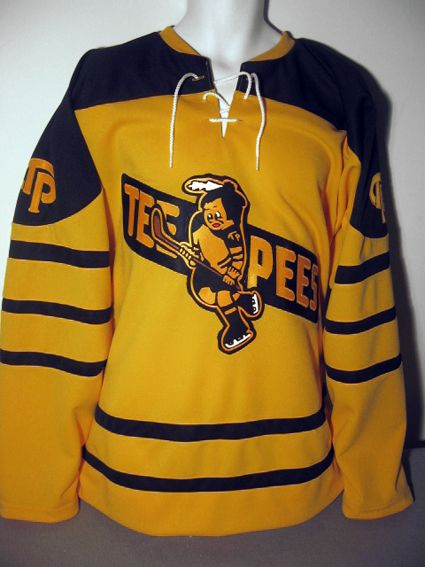
Hull played his junior hockey for the St. Catharines Teepees in the Ontario Hockey Association from 1954-55 to 1956-57, a season in which he scored 33 goals in 52 games, giving a glimpse into the future as to what was to follow.

He made his NHL debut with Chicago at the age of 18 and finished second in the rookie of the year voting following his 13 goal, 47 point season, which included the first of over 600 NHL goals (and over 900 professional when his days in the WHA are taken into account) scored on this date.

His second season was a repeat of the first, with his goals and points edging upwards to 18 and 50. His game really took flight in 1959-60 when he more than doubled his previous goal total to 39 along with 42 assists to lead the league in both categories and capture the first Art Ross Trophy of his career with 81 points.

Hull and the Black Hawks would achieve even greater heights in 1960-61. Although Hull would relinquish the scoring title, he would still top 30 goals with 31, but his 14 points in 12 playoff games would help the Black Hawks to their first Stanley Cup championship in 23 years.

Bobby Hull 1961 Stanley Cup
Hull with the 1961 Stanley Cup

Individual honors would return to Hull's trophy case in 1961-62 when he again led the NHL in both goals and points when he became just the third player in NHL history to reach 50 goals in a single season on his way to 84 points. Hull again added 14 points in the playoffs as Chicago again reached the finals, but fell short in six games.

Bobby Hull 50 goals
Hull celebrates goal #50 (wearing #7)

After a 31 goal season in 1962-63, Hull once more led the league in goals in 1963-64 with 43 and came in second to teammate Stan Mikita in the points chase 89-87.

The 1964-65 awards ceremony had more in store for Hull, as he took home the Hart Trophy as the league's Most Valuable Player as well as the only Lady Byng Trophy of his career. In the postseason, Hull led Chicago in playoff scoring with 10 goals and 17 points in 14 games as the Black Hawks took the Montreal Canadiens to the full seven games before succumbing.

He really turned on the jets beginning in 1965-66 when he led the league in goal scoring for the first of four consecutive seasons with his second 50 goal season when he netted an NHL record 54 goals as part of his league leading 97 points, which garnered Hull his third Art Ross Trophy and second Hart Trophy.

The next two seasons he again led the league in goals with 52 and then 44 before breaking his own NHL single season record with a career high 58 goals and his first 100 point season when he amassed 107 in 1968-69 as the NHL entered a new era in scoring, at which Hull was at the forefront. At the time, Hull owned four of the six 50 goal seasons in NHL history.

Limited to 61 games the following season, Hull still scored 38 goals and passed the 500 career goals mark, on the third player after Maurice Richard and Gordie Howe to reach that milestone. His final season with the Black Hawks in 1971-72 saw him surpass the 600 goal mark during yet another 50 goal season, his fifth, while only Phil Esposito had more than one to his credit with two.

It was then that the upstart World Hockey Association came calling with an offer too good to refuse, and Hull joined the Winnipeg Jets, becoming the centerpiece of the WHA and giving the league an instant shot of credibility.

Today's featured jersey is a 1961-62 Chicago Black Hawks Bobby Hull jersey. During Hull's first two seasons, the Black Hawks white jerseys had the crossed tomahawks secondary logo located over the sleeve stripes. In 1959 the logo was moved to the now customary position on the shoulders above the sleeve numbers.

This jersey would remain unchanged until 1963 when a third sleeve stripe was added to match the waist striping.

Hull originally broke into the NHL wearing the #16. He would later change to #7 before adopting his more familiar #9. Eventually, back in the NHL following the WHA's merger with the NHL, during the final season of his career he would join Gordie Howe on the roster of the Hartford Whalers and once more wear the #16 in deference to Howe.

Chicago Black Hawks 61-62 jersey

Today's first video is a trip down memory lane, with a look at Munro's Bobby Hull table hockey game. Love the automatic puck dropping scoreboard with the flags. Rod hockey at it's finest. Check out the teams too, Chicago vs. Minnesota. Perfect, and a nice break from Montreal vs. Toronto.


Forgive the quality of the video taping of the TV screen on this video, but the historical nature of Hull scoring goal #600 makes it worth it.


In this next video, Hull wins the only Stanley Cup of his career in 1961.


Finally, a recent interview with Hull on the occasion of becoming a part of the Blackhawks organization once more after far too long of an absence.


Thursday, September 30, 2010

2000-01 Chicago Blackhawks Tony Amonte Jersey

On this date in 2000, Tony Amonte became the 30th man to be named team captain in Chicago Blackhawks history. Amonte joined the NHL following two seasons at Boston University when he skated in a pair of playoff games for the New York Rangers following the conclusion of his college career in 1991.

Amonte played three seasons for the Rangers before being dealt to Chicago in the deal that brought Stephane Matteau to New York. After seven seasons with the Blackhawks, in which he scored over 40 goals three times, Amonte rose to the captaincy, joining an elite group of men to wear the "C" for one of the league's historic Original 6 franchises.

The list of men to wear the "C" for Chicago reads like a trip to the Hockey Hall of Fame in Toronto, beginning with Dick Irvin, the original captain from 1926 to 1929. Irvin would later become the Black Hawks head coach.

Irvin
Dick Irvin

Goaltender Charlie Gardiner (who sadly passed away at age 29) served as captain from 1933 to 1934. Earl Seibert was captain from 1940-42 and proceeded Doug Bentley, who held the job from 1942-1944. Following Bentley was Clint Smith in 1944-45 and John Mariucci in 1945-46.

Bentley
Doug Bentley

Bentley regained the captaincy in 1949-50 prior to giving way to Jack Stewart for 1950 to 1952, followed by Bill Gadsby, who wore the "C" from 1952 to 1954. Defenseman Pierre Pilote was the longest serving team captain in Black Hawks history, serving from 1961 through 1968.

Pilote
Pierre Pilote

All-time franchise scoring leader Stan Mikita was one of three captains in the 1976-77 season and Denis Savard served in the 1988-89 season.

Savard
Denis Savard

Of these men, Irvin was inducted into the Hockey Hall of Fame in 1958, Gardiner in 1945 and Siebert 1963. When he was elected, he became part of the first father/son combination in the Hall of Fame with his father Oliver Siebert.

Doug Bentley was inducted in 1964, Mariucci in 1985, Smith in 1991, Gadsby in 1970 and Stewart joined in 1964. Pilote got the call in 1975 and Savard in 2000.

More recent captains, and certainly some who will receive consideration for the hall, are Dirk Graham (1989-1995), Chris Chelios (1995-1999) and Doug Gilmour (1999-2000) prior to Amonte, who was captain from 2000-2002.

Graham
Dirk Graham

Since the departure of Amonte, the Blackhawks captains have been Russian Alexi Zhamnov (2002-2004), Adrian Aucoin (2005-2007), Martin Lapointe in 2006, and now Stanley Cup winning captain Jonathan Toews, who looks primed to give Pilote a run for his money in the longevity department, having become the third youngest captain in NHL history when he was given the "C" at age 20, and is now the second youngest captain to hoist the Stanley Cup. Toews is currently signed through the 2014-15 season with Chicago.

Toews
Jonathan Toews

Today's featured jersey is a 2000-01 Chicago Blackhawks Tony Amonte jersey. This black alternate jersey was introduced in 1996 and worn through 2006-07 before being retired with the changeover to the new Reebok Edge jerseys. After one season it was revived for a year om 2008-09 before being replaced by the black jersey worn in the Winter Classic held in Chicago's Wrigley Field on January 1st, 2009.

This Amonte jersey features the Blackhawks 75th Anniversary patch to mark their joining the NHL in 1926, one of the more understated team anniversary patches in recent memory befitting an Original 6 franchise.

Chicago Blackhawks 00-01 F
Chicago Blackhawks 00-01 B
Chicago Blackhawks 00-01 P

Our video selection today is a look back at Chicago Blackhawks history, now spanning over 80 years.


Monday, September 6, 2010

1980-81 Chicago Blackhawks Glen Sharpley Jersey

Glen Sharpley, born on this date in 1956, was the Minnesota North Stars first round draft pick, third overall, in the 1976 NHL Amateur Draft following a season with the Hull Festivals of the QMJHL when he scored 60 goals and 74 assists for 134 points in 69 games, just a silver under a two point per game average.

His first season with the North Stars was a good one, as he scored 25 goals and 57 points for third place in team scoring. He quite nearly equalled those totals in 1977-78 with 22 goals and 55 points, fourth on the North Stars.

Glen Sharpley

Following the season, Sharpley was named to Team Canada for the 1978 World Championships and scored 4 points in 10 games.

Demonstrating consistency, yet a slight decline each season, he scored 53 and then dipped to 47 points over the next two seasons.

Minnesota then traded Sharpley to the Chicago Black Hawks after a falling out with the North Stars coach for a player and a 2nd round draft pick midway through the 1980-81 season in which he once more hit the 50 point mark with 22 goals and 28 assists combined between the two clubs.

On December 19, 1981 in Washington D.C., Sharpley was forechecking when he was hit in the eye by a Capitals defenseman's stick. The injury caused damage to the muscles which controlled the pupil of his eye, essentially causing it to go dead. He later returned to the Blackhawks late in the regular season with the help of his doctors in time to score 6 goals and 9 points in 15 playoff games.

The Black Hawks did not offer a Sharpley a contract for the 1982-83 season, nor did any other club. After briefly playing in Switzerland, Sharpley returned to the United States before attempting a return to hockey in 1985. The Pittsburgh Penguins took a chance on Sharpley and assigned him to the Baltimore Skipjacks of the AHL. After only 7 games he was released and signed with the Peoria Rivermen of the IHL. There he showed good form, scoring 26 goals and 37 assists for 63 points in just 50 games.

Sharpley signed on with the Salt Lake Golden Eagles, also of the IHL for the start of the 1986-87 season. 32 games later, having scored 25 points, Sharpley would join the Dundee Rockets of the British National League, where in 15 games he would score an astounding 31 goals and 40 assists for 71 points, an average of 4.73 points per game! In the playoffs, he would continue his torrid pace with a dominating 19 points in 5 games. With that, Sharpley would retire as a professional player at the age of 31.

Today's featured jersey is a 1980-81 Chicago Black Hawks Glen Sharpley jersey. This Sandow SK jersey features the iconic Black Hawks crest on the front and always ranks at or near the top of "best jersey" lists. This jersey style was originally introduced back in 1955 and has undergone only minor changes as the decades have gone by.

1980-81 Chicago Black Hawks jersey,1980-81 Chicago Black Hawks jersey

Here Sharpley, then with Chicago, gets into a pretty good scrap with Pat Price of the Penguins.


Thursday, June 10, 2010

2009-10 Chicago Blackhawks Jonathan Toews Jersey

The Chicago Blackhawks are Stanley Cup champions.

After 49 years, the Stanley Cup will be returning to Chicago after a hard-hitting, dramatic final series that began when the Blackhawks, the #2 seeded team from the west, swept the San Jose Sharks to gain their place in the finals after a long season which began back in early October with a pair of games in Helsinki, Finland. Their opponents were the surprising and tenacious Philadelphia Flyers, who only qualified for the playoffs by winning a shootout against the New York Rangers on the final day of the season.

Seeded 7th, the Flyers eliminated the #2 New Jersey Devils, climbed out of the deepest of holes to defeat the Boston Bruins 4 games to 3 after falling behind 3 games to none, not only in the series, but 3-0 in Game 7 itself, to become only the third team in NHL history to win after being down 3-0 out of 162 tries. Taking advantage of the surprising number of first round upsets, the #7 Flyers faced off against the #8 Montreal Canadiens, who they eliminated in five games.

Game 1 of the finals was a bizarre affair, as puck after puck found the back of the net, with five goals in the first period, followed by five more in the second, leaving the teams tied at 5-5 after two periods in a flashback to the firewagon hockey of the late 1980's. Tomas Kopecky won the game for Chicago with the only goal of the third period, leaving everyone thinking they had just watched the National Pond Hockey League championships.

Game 2 was the kind of tight playoff hockey everyone expected Game 1 to be, as both teams rededicated themselves to defense first. Chicago was able to emerge with the victory after Marian Hossa and Ben Eager scored 28 second apart in the second period. Philadelphia made it a nail-biter with a power play goal at 5:20 of the third, but Antti Niemi held off the Flyers to win the game 2-1.

Philadelphia dug deep to win Game 3 at home when Claude Giroux deflected in a goal at 5:59 of overtime to win the game 4-3.

The Flyers took advantage of every opportunity to punish each Chicago mistake in Game 4 to take a 3-1 lead after the first period. Ville Leino put the Flyers up by 3 with 13 minutes to play but the Blackhawks sent a reminder that no lead was safe when they closed the margin to 1 with a pair of goals less than four minutes apart, but the Flyers sealed the victory with a Jeff Carter empty net goal with 25 seconds remaining and Chicago looking to force overtime.

Chicago continued the trend of the home team winning each game by dominating the first period, which included the physical game as well as the scoreboard, as Dustin Byfuglien sent Flyers defenseman Chris Pronger flying with the most memorable hit of the series.


Chicago's three goals on 13 shots to chase Flyers starting goaltender Michael Leighton from the game gave them a commanding lead after one period thanks to coach Joel Quenneville shaking up his line combinations, including breaking up the Jonathan Toews-Patrick Kane-Byfuglien line so Pronger would not be able to shut down all of them. For the remainder of the game, each time the Flyers would score, Chicago would respond to maintain the three goal cushion, the final one coming into an empty net 31 seconds after the Flyers pulled within two with 2 1/2 minutes remaining. Pronger would finish the game a remarkable -5 and was in the penalty box for another goal.

Game 6 back in Philadelphia saw Byfuglien score his 11th goal of the playoffs on the power play to open the scoring as Chicago dominated play, only to have the Flyers escape the period even at 1-1 with a goal with less than 20 seconds left in the first period.

The Flyers took a lead at the 8 minute mark, taking advantage of a fallen Chicago defender. Patrick Sharp's 11th goal of the playoffs two minutes later evened the score at 2-2.

Andrew Ladd tipped in a shot from an unguarded Niklas Hjalmarsson at 17:43 of the second. Chicago however, allowed the Flyers to take the game to them, especially in the second half of their third period, which finally paid off for the Flyers as they evened the score when a puck deflected past Niemi off of Marian Hossa's skate. Hossa was looking for his first Stanley Cup on his third consecutive trip to the finals with this third different club.

The remainder of the third period was played scoreless and the game moved to overtime. Some shaky play by Chicago nearly cost them the game early, but with four minutes gone, Kane got the puck out near the point from Brian Campbell, who held in a clearing attempt, put several dekes on Flyer's defenseman Kimmo Timonen and cut around him as he drove to the corner. There, from a sharp angle, he fired the puck at Leighton and watched as it beat the goalie just under his pad as he tried to get his leg down fast enough.

Kane scores

Once past Leighton, the puck dissappeared into the lining of the goal. Kane erupted in celebration as no one else seemed to be aware that he had just scored the cup winning goal, as the red light never came on, the referee never signaled a goal and the players on both teams failed to react. As Kane jubilantly flew down the ice waving his arms, the rest of the Blackhawks joined in on the fun as the goal was confirmed, which set off a new round of euphoria for the Blackhawks and made Niemi the first Finnish goaltender to backstop his team to the Stanley Cup.

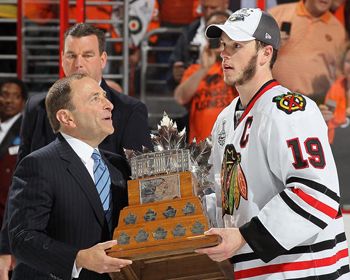
Toews was named the winner of the Conn Smythe Trophy and then returned to the red carpet to accept the Stanley Cup on behalf of his teammates before handing it off to Hossa for the honor of being the first to receive it from the team captain.

Toews Stanley Cup

The championship is only the fourth ever won by the Blackhawks, and only the second since 1938.

The Blackhawks turnaround has been a remarkable thing to watch. Named "The Worst Franchise in Professional Sports" by ESPN in February of 2004, the team let go their announcer of 25 years, Pat Foley, and reached a low point in 2006-07 with an average attendance of 12,727.

The turnaround began with the drafting of Toews third overall in 2006. After the 2006-07 season, fortune smiled on the Blackhawks. After finishing with the fourth-worst record in the NHL, the won the draft lottery, which allowed them to select Kane first overall in 2007.

Prior to the start of the 2007-08 season, long time club owner Bill Writz passed away and the team was taken over by his son Rocky, who immediately changed many of his father's long-standing and unpopular policies, including not allowing home games to be shown on television locally. The team also reconnected with several estranged star players of the past, including the charismatic trio of Bobby Hull, Stan Mikita and Tony Esposito as well as bringing back play by play man Foley.

They also spent money freely for new players, held their first fan convention and won the right to host the Winter Classic, the annual outdoor game on New Year's Day. They also brought in hockey genius Scotty Bowman as a senior advisor and made a quick and decisive change in coaches, putting Quenneville behind the bench after only four games of the season. By the end of the 2008-09 season, the Blackhawks, thanks in part to the 40,818 fans in attendance at the Winter Classic, averaged 22,247 fans per game, the highest average attendance of any professional hockey club in the world, just two short years after ranking 29th out of 30 in the NHL. Even without the bump from the Winter Classic, they still had the highest average attendance in the league for games played at the United Center.

They also made the playoffs in 2008-09 after missing the playoffs nine times in the previous ten seasons, making it all the way to the conference finals and gaining valuable experience for their young lineup, which they clearly put to good use in winning the championship last night.

Blackhawks celebrate

Our featured jersey is a Reebok 2009-10 Chicago Blackhawks Jonathan Toews jersey, which features the 2010 Stanely Cup Finals patch, as worn when Toews was named the winner of the 2010 Conn Smythe trophy.

At just 22 years of age, Toews now has two World Junior Championship gold medals, a World Championship gold medal, an Olympic gold medal from the tournament in Vancouver where he was named Best Forward, and now a Conn Smythe Trophy and a Stanley Cup.

The Stanley Cup victory makes him the youngest member, at 22 years and 41 days of age, of the Triple Gold Club for players who have won a World Championship gold medal, Olympic gold medal and the Stanley Cup.

2009-10 Chicago Black Hawks jersey

Here is video of Patrick Kane's unusual game winning goal, which was not immediately apparent to anyone but Kane himself!


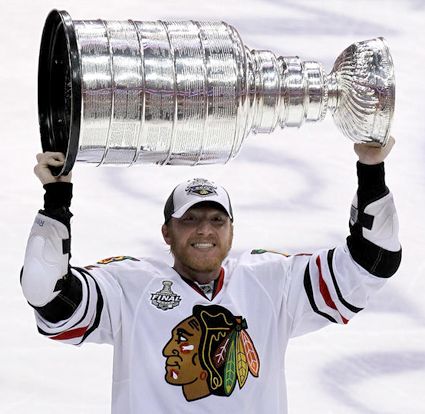
In this video, Jonathan Toews lifts the Stanley Cup for the Blackhawks for the first time since 1961.