Showing posts with label Hull Bobby. Show all posts

Friday, October 22, 2010

1961-62 Chicago Black Hawks Bobby Hull Jersey

One of the most dynamic and prolific scorers in NHL history, Bobby Hull scored his first NHL goal on this date in 1957 in a 2-1 win over the Boston Bruins.

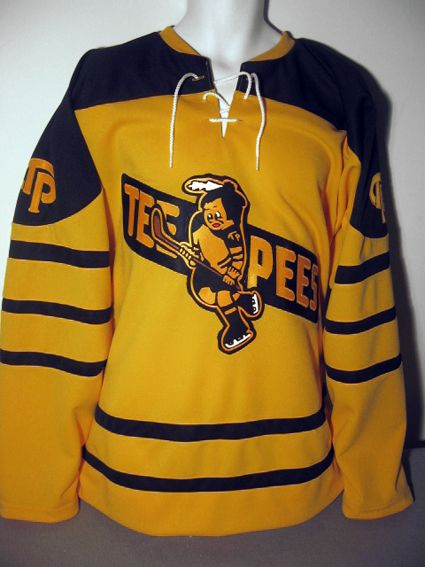
Hull played his junior hockey for the St. Catharines Teepees in the Ontario Hockey Association from 1954-55 to 1956-57, a season in which he scored 33 goals in 52 games, giving a glimpse into the future as to what was to follow.

He made his NHL debut with Chicago at the age of 18 and finished second in the rookie of the year voting following his 13 goal, 47 point season, which included the first of over 600 NHL goals (and over 900 professional when his days in the WHA are taken into account) scored on this date.

His second season was a repeat of the first, with his goals and points edging upwards to 18 and 50. His game really took flight in 1959-60 when he more than doubled his previous goal total to 39 along with 42 assists to lead the league in both categories and capture the first Art Ross Trophy of his career with 81 points.

Hull and the Black Hawks would achieve even greater heights in 1960-61. Although Hull would relinquish the scoring title, he would still top 30 goals with 31, but his 14 points in 12 playoff games would help the Black Hawks to their first Stanley Cup championship in 23 years.

Bobby Hull 1961 Stanley Cup
Hull with the 1961 Stanley Cup

Individual honors would return to Hull's trophy case in 1961-62 when he again led the NHL in both goals and points when he became just the third player in NHL history to reach 50 goals in a single season on his way to 84 points. Hull again added 14 points in the playoffs as Chicago again reached the finals, but fell short in six games.

Bobby Hull 50 goals
Hull celebrates goal #50 (wearing #7)

After a 31 goal season in 1962-63, Hull once more led the league in goals in 1963-64 with 43 and came in second to teammate Stan Mikita in the points chase 89-87.

The 1964-65 awards ceremony had more in store for Hull, as he took home the Hart Trophy as the league's Most Valuable Player as well as the only Lady Byng Trophy of his career. In the postseason, Hull led Chicago in playoff scoring with 10 goals and 17 points in 14 games as the Black Hawks took the Montreal Canadiens to the full seven games before succumbing.

He really turned on the jets beginning in 1965-66 when he led the league in goal scoring for the first of four consecutive seasons with his second 50 goal season when he netted an NHL record 54 goals as part of his league leading 97 points, which garnered Hull his third Art Ross Trophy and second Hart Trophy.

The next two seasons he again led the league in goals with 52 and then 44 before breaking his own NHL single season record with a career high 58 goals and his first 100 point season when he amassed 107 in 1968-69 as the NHL entered a new era in scoring, at which Hull was at the forefront. At the time, Hull owned four of the six 50 goal seasons in NHL history.

Limited to 61 games the following season, Hull still scored 38 goals and passed the 500 career goals mark, on the third player after Maurice Richard and Gordie Howe to reach that milestone. His final season with the Black Hawks in 1971-72 saw him surpass the 600 goal mark during yet another 50 goal season, his fifth, while only Phil Esposito had more than one to his credit with two.

It was then that the upstart World Hockey Association came calling with an offer too good to refuse, and Hull joined the Winnipeg Jets, becoming the centerpiece of the WHA and giving the league an instant shot of credibility.

Today's featured jersey is a 1961-62 Chicago Black Hawks Bobby Hull jersey. During Hull's first two seasons, the Black Hawks white jerseys had the crossed tomahawks secondary logo located over the sleeve stripes. In 1959 the logo was moved to the now customary position on the shoulders above the sleeve numbers.

This jersey would remain unchanged until 1963 when a third sleeve stripe was added to match the waist striping.

Hull originally broke into the NHL wearing the #16. He would later change to #7 before adopting his more familiar #9. Eventually, back in the NHL following the WHA's merger with the NHL, during the final season of his career he would join Gordie Howe on the roster of the Hartford Whalers and once more wear the #16 in deference to Howe.

Chicago Black Hawks 61-62 jersey

Today's first video is a trip down memory lane, with a look at Munro's Bobby Hull table hockey game. Love the automatic puck dropping scoreboard with the flags. Rod hockey at it's finest. Check out the teams too, Chicago vs. Minnesota. Perfect, and a nice break from Montreal vs. Toronto.


Forgive the quality of the video taping of the TV screen on this video, but the historical nature of Hull scoring goal #600 makes it worth it.


In this next video, Hull wins the only Stanley Cup of his career in 1961.


Finally, a recent interview with Hull on the occasion of becoming a part of the Blackhawks organization once more after far too long of an absence.


Sunday, June 27, 2010

1972-73 Winnipeg Jets Bobby Hull Jersey

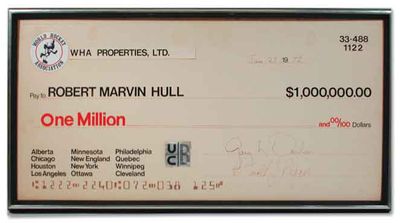
On this date in 1972, the Winnipeg Jets signed Bobby Hull to a $2.5 million ten-year contract, which included a $1 million signing bonus, firing the first major shot in the WHA/NHL war for the control of hockey.

Photobucket

Hull had been a member of the Chicago Black Hawks of the NHL for fifteen seasons when the upstart World Hockey Association came looking for a star player to jump start the league and attempt to buy instant credibility, and found their man in Hull.

Coming off a 50 goal season with Chicago, when Hull jokingly told the WHA he'd jump for a million dollars, the WHA owners and league officials agreed to contribute to the cause and Hull was signed to a ten year, one million dollar contract. The WHA would not last the full ten years.


Once Hull was in the fold, other players soon followed, mainly in search of the higher paychecks offered by the new league, as Gerry Cheevers, Pat Stapleton, Ralph Backstrom, J. C. Tremblay and Rejean Houle also jumped leagues.

Despite an injunction filed by the Black Hawks which kept Hull out of the first 14 games of the 1972-73 season, the damage was done and eventually Hull became a full time Jet and the WHA was off and running.

Hull paid immediate dividends to the league and the Jets, raising the profile of the league and leading the Jets in scoring with 51 goals and 52 assists for 103 points, placing fourth in league scoring as the Jets finished atop the Western Division standings and leading Winnipeg to the Avco Cup Finals. Hull was also named the WHA Most Valuable Player in 1973, but it could be said that he had already earned that distinction by simply signing with the league in the first place!

While not every team and every building in the WHA was first class, the league debuted with teams in Cleveland, Boston, New York, Ottawa, Philadelphia and Quebec City in the east and Edmonton, Chicago, Houston, Los Angeles, Minneapolis/St. Paul and Winnipeg in the west, with the Boston franchise, known as "New England" taking the inaugural championship.

In order to compete, or more accurately try to gain an advantage, the WHA embarked on a policy of signing underage players, as NHL rules prohibited the signing of any player under the age of 20, which the WHA gleefully ignored, allowing it to scoop up players such as Wayne Gretzky, the Howe brothers Mark and Marty, Mike Gartner and Mark Messier over the course of it's history.

For the next season, Hull was joined in the league by NHL legend Gordie Howe, who was lured out of retirement in order to play with his sons in Houston with the Aeros. Hull would top his goal output with 53, but the Jets would drop in the standings and get bounced in the playoffs in four straight by Howe and the Aeros.

The franchise shifting began in season two, with the New York Raiders being renamed the "Golden Blades" and then moving out of Madison Square Garden to save money, landing in New Jersey in a rink so bad the ice surface wasn't level as the puck would vanish from the goalies view as it sank into the dips of the waves on the ice surface! Worse, the visiting teams had to change out of their gear only after being bused back to their hotel. Additionally, the Philadelphia market was lost as the Blazers relocated out west to Vancouver, while Ottawa moved into Maple Leaf Gardens in Toronto. The season concluded with the Howe's leading the Aeros to the title.

The league expanded in 1974-75 with new teams being added in questionable markets such as Indianapolis and Phoenix, the New England franchise abandoned Boston for Hartford, the bad joke that was New Jersey moved to San Diego while the former Los Angeles franchise briefly stopped in Detroit before moving to Baltimore mid-season before folding for good. It would be the very first franchise to fold completely in the league, setting the tone for what was to follow, as Chicago was lost for good after the season. At the conclusion of the season, Houston defended their title.

Cincinnati was added to the league, along with Denver, but the Franchise shifting continued in 1975-76, as the brand new Denver club moved to Ottawa mid-season and then quit after 41 games and the Minnesota Fighting Saints called it quits after 59 games. Meanwhile, Vancouver moved inland to Calgary and Winnipeg claimed their first championship.

The league continued to press on in 1976-77, but the hopes of lasting long enough for a merger with the NHL started to become the goal, as the league, which once had teams in New York, Chicago, Los Angeles and Philadelphia, now had teams in Birmingham, Cincinnati, Indianapolis, Phoenix and San Diego.

The unsettled nature of the league continued as Cleveland moved to St. Paul but failed to last the whole season. Toronto moved to the deep south to Birmingham. Quebec won their only championship that season.

San Diego, Calgary and Phoenix failed to answer the bell for the 1977-78 season as the league shrunk down to only eight clubs and the Jets won their second championship.

Long time franchise Houston threw in the towel after the 1977-78 season, leaving the final WHA season with seven clubs, beginning with Indianapolis, who folded after 25 games, leaving just six teams to stagger home to the finish line - Cincinnati and Birmingham plus mainstays Edmonton, New England, Quebec and Winnipeg, who won their second consecutive, and third overall, title.

Following the conclusion of the seventh season of the WHA, a merger agreement was struck, which allowed Edmonton, Quebec, Hartford and Winnipeg to join he NHL as expansion teams, with some rather strict provisions that cost them millions of dollars and many of their players, leaving them at an enormous competitive disadvantage, which some clubs dealt with better than others, primarily the Oilers, who won the Stanley Cup just five seasons later, their first of five in seven seasons.

Despite the history of unstable franchises, the WHA left a legacy of entertaining, wide-open play, higher player salaries and the acceptance of European players.

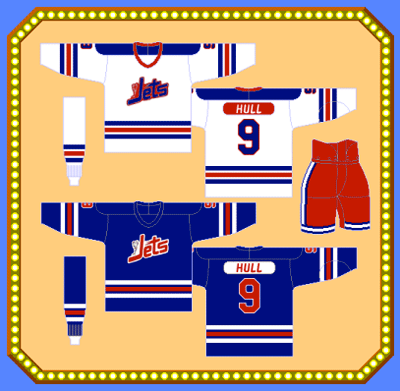
Today's featured jersey is a 1972-73 Winnipeg Jets Bobby Hull jersey as worn by Hull in the preseason prior to the first ever WHA regular season when they changed to jerseys with the same first year only crest, but with a different striping pattern.

The regular season set of jerseys were notable for their contrasting nameplates, the blue jerseys having white nameplates with red lettering and the white jerseys sporting red nameplates with white letters.

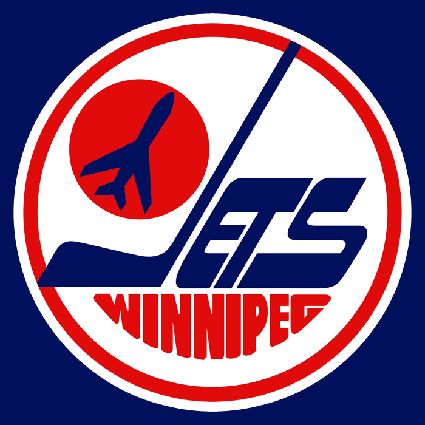
For the second season the Jets adopted their more familiar round logo, which survived the entire lifespan of the WHA and lasted until the 1989-90 NHL season before undergoing a modernization.

72-73 Winnipeg Jets jersey

Our first video is an interview with Hull on the occasion of the Jets retiring his jersey #9 in 1989.


Our next video features other WHA players giving their scouting reports on Hull followed by Hull's thoughts on joining the league. Notice the white nameplates with red lettering on the Jets first year jerseys.