Showing posts with label Winnipeg Jets. Show all posts

Saturday, June 25, 2011

The Jersey History of the Winnipeg Jets 1972-1996

With the seventh pick in the 2011 NHL Draft, the Winnipeg NHL franchise selected...

the name Winnipeg Jets.

We heard speculation ranging from the True North ownership group keeping the Manitoba Moose name and identity intact for their new NHL franchise, to the use of the historic name Winnipeg Falcons, the first team to win an Olympic gold medal for ice hockey back in 1920, or the choice of the brand new name Winnipeg Ice, with a polar bear logo while using a main color of light blue, as well as the rumored return of the classic name Winnipeg Jets, which was the obvious clear fan favorite.

The Winnipeg Jets name dates back to 1967 and a junior franchise which played in the Western Canada Hockey League. With the arrival of the professional WHA franchise, the junior team changed it's name to the Winnipeg Clubs in 1973-74, followed by the Winnipeg Monarchs in 1976-77 for a single season prior to relocating, when they became the Calgary Wranglers for 10 years. After one more move, the club became the Lethbridge Hurricanes in 1987, where they still compete today.

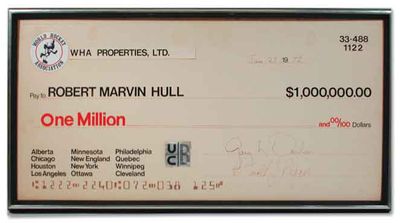
With the formation of the World Hockey Association back in 1972, the new professional franchise adopted the name Jets, and they immediately rocked the hockey world by signing one of the biggest stars of the NHL, Bobby Hull of the Chicago Black Hawks.

hull Pictures, Images and Photos

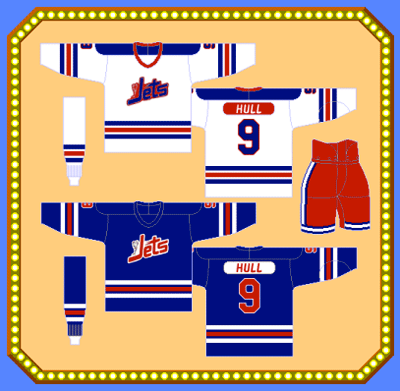
The Jets first jerseys were a simple blue sweater with white/red/white stripes around the arms and waist and sported a Jets wordmark on the front created with beautiful chain stitching accented with an overly detailed hockey player inside the J. The most unique aspect of the initial Jets sweaters was the treatment of the chain stitched name on the back. A unique rounded and color-contrasting nameplate carried the player's name in an unusual font, reminiscent of comic sans, which made it appear almost hand written. The white home jerseys also had contrasting nameplates done in an arresting red color.

Winnpeg Jets 72-72 road jersey

Winnpeg Jets 72-73 home jersey
(This example was prepared for use but never received a red nameplate)

This jersey set would only be used for one season until being replaced by new sweaters for year two which coincided with the arrival of Swedish sensations Anders Hedberg and Ulf Nilsson, who combined with Hull to form the most prolific line of the decade in either the WHA or the NHL.


While the basic jersey striping pattern remained the same, a new round logo filled the front of the jersey, which gave the sweaters a much more clean and modernized look compared those of the previous season.

Winnipeg Jets 75-76 road jersey

Winnipeg Jets 75-76 home jersey

The Jets would wear patches on each shoulder in 1975-76 in celebration of the Summer Olympics to be held in Montreal, Canada in the summer of 1976. The franchise would also win the Avco World Cup as champions of the WHA for the first time that same season.

Winnipeg Jets 75-76 jersey

While the white jerseys had a blue shoulder yoke since their inception, the blue road jerseys were a solid color until 1977-78, when a white shoulder yoke was added for the first time. The team would also win their second Avco World Trophy at the conclusion of the season and repeated as champions in 1978-79 by winning the final game in the history of the WHA.

The WHA had started out with 12 teams in 1972-73 and grown to a high of 14 teams by 1974-75, the league suffered from instability and frequent franchise relocation, which led to franchises folding with greater frequency as the league shrank to 12, then 10 and finally seven clubs in 1978-79. After the conclusion of the 1978-79 season, four of the six surviving clubs were allowed into the NHL as expansion teams under highly restrictive, nearly crippling, stipulations which affected the Jets more than any other of the four surviving WHA clubs.

While the Hartford Whalers (73 points) and Edmonton Oilers (69 points) qualified for the playoffs during their first season in the NHL in 1979-80, the Quebec Nordiques missed out on the playoffs with 61 points and the Jets tied for last place in the league with the moribund Colorado Rockies with 51 points just one year removed from back-to-back WHA championships.

To celebrate their move to the NHL, the Jets took the opportunity to revamp their jerseys, introducing an entirely new (to them) jerseys which featured full length sleeve striping, a pattern formerly used by the New York Rangers while under the control of general manager John Ferguson, who now held the reins in Winnipeg. One unique feature of the jersey was the extremely thin font used for the names on the back.

Winnipeg Jets 84-85 road jersey

Winnipeg Jets 82-83 home jersey

This style would serve the Jets well through 11 seasons until 1989-90. In 1981-82 the team would wear a Ten Seasons patch. The 1987-88 season would see the addition of the first Goals for Kids patch on the right arm as well as a thickening of the lettering used for the names on the back, something long overdue for readability. The following year the Goals for Kids patch would be revamped, making the lettering bolder and easier to read.

Winnipeg Jets 88-89 road jersey

In 1990-91, the Jets jerseys underwent their final redesign, with bold waist and arm stripes trimmed with thinner red stripes replacing the full length arm stripes. Additionally an attractive new modernized logo was unveiled, creating a new and exciting, yet simple and classic look at the same time, aided in part by the choice of single color names and numbers in an era where only three other of the 20 teams opted for one color numbers, Original 6 clubs Detroit and Toronto as well as Quebec.

The Goals for Kids patch was also modernized at the same time and was worn through the remainder of the club's tenure in Winnipeg. The other patches worn on this style jersey were the NHL 75th Anniversary patch in 1991-92 and the Stanley Cup Centennial patch in 1992-93. Unusually, all the teams wore the patch with a bold white outline, save for the Jets, who during the second half of the season, wore a version of the patch without the white outline after having done so during the first half of the season.

Winnipeg Jets 92-93 F
Winnipeg Jets 92-93 B
Winnipeg Jets 92-93 P2aaaWinnipeg Jets 92-93 P1

Winnipeg Jets 90-91 home jersey

The final season of the Jets in Winnipeg saw them wear the Cherished Memories patch for the final ten games of the regular season and their playoff series against Detroit before the club's sale and relocation to Phoenix for the 1996-97 season.

Winnipeg Jets 95-96 P1

With the recent announcement that the Atlanta Thrashers had been sold to a group from Winnipeg who would be moving the team to Manitoba, speculation over the name of the club had been talked about since the announcement on May 31st. Finally last night during the first round of the 2011 NHL Draft, team chairman Mark Chipman simply announced that club general manager Kevin Cheveldayoff would make their pick "on behalf of the Winnipeg Jets", sending the many fans who made the trip down to St. Paul from Winnipeg into a loud celebration on the confirmation of the name that everyone wanted to return for over 15 years.

The team did not, however, unveil their team colors, logo or jersey, as first round draft pick Mark Scheifele wore a generic black and silver jersey adorned with the NHL logo when posing for photos with Jets executives on stage.

Winnipeg Jets Scheifele

Time will tell if the new Winnipeg Jets will continue the use of the original Jets red, white and blue colors or claim a new set of colors in an effort to distinguish the new era of hockey in Winnipeg.

Today's video section begins with Teemu Selanne scoring the goal which broke Mike Bossy's 15 year old rookie scoring record in two parts.


Next, last night's announcement of the choice of the name Jets for the relocating franchise and the team's use of the generic black NHL jersey for draft pick Scheifele. The footage of Scheifele's proud mother was one of the highlights of the entire evening.


Thursday, June 9, 2011

1976-77 Winnipeg Jets Dan Labraaten Jersey

Swedish left winger Dan Labraaten, born on this date in 1951, played in the Swedish second division for three seasons from 1966-67 to 1968-69.

He moved up to to the top level of Swedish hockey when he joined Leksands IF. During that time period he also skated for Sweden in the European Junior Championships in both 1968 (winning bronze), 1969 (silver) and 1970.

Labraaten continued to skate for the dominant Leksands IF over the course of the next six seasons, with his standout being the 1974-75 season in which he scored 24 goals and 38 points in 30 games while playing with future Minnesota North Stars Per-Olav Brasar and Roland Eriksson.

Labraaten Leksands IF

During Labraaten's time with the Leksands IF from 1970 to 1976, the team were playoff runners up in 1971 and 1972 and winners of the Le Mat Trophy as playoff champions in 1973, 1974 and 1975. Labraaten played for the Sweden National Team at the 1974 World Championships where he came away with a bronze medal.

He also added to his international resume with two more appearances in the World Championships, first in 1975 when he scored nine goals in ten games, and again in 1976 with eight points in ten games, coming home again with bronze medals both times. In September of 1976, Labraaten was a member of the Sweden National Team in the inaugural Canada Cup.

Following the success of Swedish imports Ulf Nilsson and Anders Hedberg, Labraaten joined the Swedish superstars as a member of the high flying Winnipeg Jets of the World Hockey Association for the 1976-77 season. While his 51 points were far and away his career high to date, thanks to a much longer season than in Sweden, it paled in comparison to to the 131 by Hedberg. The playoffs were another matter, as Labraaten was third in team scoring with 24 points in 20 games, just five back of Hedberg and three behind Nilsson but two ahead of the great Bobby Hull.

Labraaten Jets

His second season in Winnipeg proved to be less personally successful, as he was limited to just 47 games, which naturally lowered his final offensive numbers to 34 points, but the Jets would capture the Avco Cup as league champions at the end of the season.

He was not retained by the Jets and signed with the Detroit Red Wings of the NHL for the 1979-80 season. The going was a bit tougher in the NHL, as Detroit was going through the "Dead Wings" era, during which they missed the playoffs 15 of 17 seasons. Despite playing in 31 more games with Detroit, he only scored four more points than he did in with Winnipeg, a reflection of playing with a losing team in a less wide open league. With Detroit missing the playoffs yet again, Labraaten was available for World Championship duty for Sweden in 1979, which resulted in his fourth bronze medal in as many tries.

Labraaten Red Wings

Labraaten then had the best season of his career, setting career highs with 30 goals and 57 points in 1979-80. A poor first half in 1980-81 saw the Red Wings trade him to the Calgary Flames where he was strictly a role player over the next season and a half during which he played in just 70 games and scoring 38 points to close out the NHL portion of his career.

Labraaten returned to Sweden for the 1982-83 season and rejoined Leksands IF, with whom he would play the final six seasons of his professional career. Proving he had not lost his offensive touch, Labraaten had the finest season in Sweden during 1983-84 during which he score 23 goals and 44 points in 36 games to win the Elitserien scoring championship. He had one final 20 goal season in 1985-86.

He also made two more World Championship appearances, the first in 1985 and a final one in 1986 which earned Labraaten a long awaited silver medal to go with his four bronzes.

His combined totals across three leagues and his many international appearances are 786 games, 340 goals and 627 points as well as a fist full of World Championship medals.

Today's featured jersey is a 1976-77 Winnipeg Jets Dan Labraaten jersey as worn during his first season of hockey in North America.

The Jets adopted this style for their second WHA season of 1973-74 and used it throughout the remainder of their six seasons in the WHA. Upon entry into the NHL in 1979-80, they celebrated with a new set of sweaters, retiring their WHA era jerseys which had seen them through three championship seasons.

1976-77 Winnipeg Jets jersey


Bonus Jersey: Today's bonus jersey is a 1979 Sweden National Team Dan Labraaten jersey. This jersey is from a unique period of Swedish hockey in the late 1970's and early 80's when Sweden did not wear their famous three crowns logo which is most closely associated with Swedish hockey, but opted instead for a polar bear crest below the words "tre kronor", Swedish for "three crowns".

1979 Sweden jersey

Monday, March 28, 2011

1989-90 Winnipeg Jets Laurie Boschman Jersey

Following a stellar season with the Brandon Wheat Kings in which he scored 66 goals and 149 points as well as 215 penalty minutes, center Laurie Boschman was drafted 9th overall in the 1979 NHL Entry Draft by the Toronto Maple Leafs.

Boschman's first season in Toronto went well enough for an NHL rookie, as he played 80 games and scored 48 points, but year two was derailed by a bought of mononucleosis, from which he returned too quickly and lacked the necessary energy to compete at the NHL level as a result. Worse, he was criticized by the notoriously cantankerous Maple Leafs owner Harold Ballard for being too soft as a result of a religious conversion. Despite the "soft" accusations, Boschman racked up 178 penalty minutes in just 53 games that season.

Boschman Maple Leafs

A third abbreviated season in Toronto was cut short by a stomach ulcer before Boschman requested a trade and was dealt to the Edmonton Oilers in time for the final 11 games of the 1981-82 season, freeing him from Ballard's criticisms. After playing the majority of the 1982-83 season with the Oilers, Boschman was once again on the trading block due to the depth of the Oilers roster. He landed in Winnipeg with the Jets, a move which would fit him like a glove.

After playing four NHL seasons with a high of 48 points, his first full season with the Jets would see his production immediately increase to 74 points despite playing in just 61 games due to time missed with a separated shoulder. He would also total 234 penalty minutes, making him a true power forward.

Boschman Jets

The following season Boschman set a career high with 76 points, which included another career best of 32 goals, one of a record six Jets to score 30 or more goals. After scoring 69 points, along with a career high of 241 penalty minutes, Boschman's offensive production would decline somewhat as his season totals were in the 40's in 1987 and 1988 before 36 in 1989 and 27 in his final season in Winnipeg in 1989-90.

After eight stable years in Winnipeg, Boschman was sent to the New Jersey Devils where he would play for two seasons.

Boschman Devils

He was then left unprotected in the 1992 NHL Expansion Draft by the Devils, and was subsequently selected by the Ottawa Senators, who named him their first captain in team history. Boschman would play 70 games for the Senators that season, which would include his 1,000th NHL game on this date in 1993.

Boschman Senators

While the Senators would rarely win a game during their first season, going 10-70-4 for a meager 24 points, Boschman would appear in 70 games, his 12th consecutive season with 61 games or more. He would retire following his only season with the Senators, but would return for seven games, in which he scored 18 points, with the Fife Flyers of the British Hockey League in 1994-95 before retiring for good.

Today's featured jersey is a 1989-90 Winnipeg Jets Laurie Boschman jersey as worn during his final season in Winnipeg. This jersey has the Goals for Kids patch worn for the first time in 1988-89, although with the different design which incorporated the Jets logo.

This was the only season during which this style jersey, first introduced back in 1979 when the Jets entered the NHL after the demise of the WHA, with this style of Goals for Kids patch, as the following season would see an all new Jets jersey style that had not only a new Goals for Kids patch, but stripes around the arms rather than down the length of the arms.

Winnipeg Jets 89-80 jersey

Bonus Jersey: Today's bonus jersey is a 1992-93 Ottawa Senators Laurie Boschman jersey as worn during the Senators inaugural season in which they wore the Stanley Cup Centennial patch. Boschman was named the Senators original captain that season, one in which he played in his 1,000th NHL game.

Ottawa Senators 92-93 jersey

Today's video segment begins with Boschman having a good scrap with the Rangers Doug Weight.


Here is the most famous goal Boschman didn't score - a disallowed goal in the 1991 playoffs which would have completed a Devils comeback from three goals down while leading 3 games to 2. Pittsburgh went on to win the game and eventually the Stanley Cup.


Wednesday, March 2, 2011

1992-93 Winnipeg Jets Teemu Selanne Jersey

During the fledgling Buffalo Sabres inaugural season of 1970-71, their first ever draft pick Gilbert Perreault scored a goal during the Sabres first ever game on October 10, 1970. He went on to lead the club in scoring that season with 38 goals and 34 assists for 72 points. Perreault's 38 goals established a new NHL rookie scoring record and earned him the 1971 Calder Trophy.

Gilbert Perreault
Gilbert Perreault

Perreault would not hold the record long, as it would be broken the very next season by the Sabres next first round draft pick, Rick Martin. Teamed with Perreault and Rene Robert, the trio formed the explosive "French Connection" line. While Robert would not arrive until later in the season via a trade, Martin and Perreault found instant chemistry which carried throughout the entire season. With Perreault's playmaking abilities paired with a good finisher in Martin, their sats for the season were a virtual mirror image of each other, as Perreault scored 26 goals and 48 assists while Martin had an identical 74 points, but with 44 goals and 30 assists. Martin's 39th goal on February 19, 1972 broke Perreault's rookie scoring record and during the remaining 19 games, Martin raised the record to 44.

Rick Martin
Rick Martin

Martin's record fell on February 25, 1978 when the New York Islanders first round pick in the 1977 NHL Amateur Draft, Mike Bossy, scored the 45th goal of his rookie campaign. Playing on a line with center Bryan Trottier and rugged left winger Clark Gilles, the trio finished 1-3-4 in team scoring. While Trottier led the team with 123 points, it was Bossy who benefited from Trottier's playmaking to break the rookie goal scoring record. Similar to Martin, Bossy still had 20 games remaining after breaking the record and proceeded to elevate the record up to 53, which was second in the NHL that season. Like, Perreault, Bossy was also the winner of the Calder Trophy.

Mike Bossy
Mike Bossy

Bossy's record would endure for 15 seasons, including surviving Joe Neiuwendyk's rookie total of 51 in 1987-88, until it was broken on this date in 1993 by Finnish sensation Teemu Selanne, who scored a hat trick for his his 52nd, record tying 53rd and record breaking 54th goal of the year at home against the Quebec Nordiques.

Teemu Selanne
Teemu Selanne

Like those before him, Selanne was not content to simply eclipse the record, as he simply destroyed Bossy's mark of 53 as he pushed the mark into the stratosphere with a final total of 76, which tied for the league lead in goals with fourth year player Alexander Mogilny, earning Selanne a Calder Trophy like Perreault and Bossy before him.

In addition to his 76 goals, Selanne totaled 132 points to set a rookie point scoring record as well. He and Mogilny became only the second and third European players to lead the league in goals as the became members of an exclusive club of only eight men to have ever scored 70 or more goals.

Today's featured jersey is a 1992-93 Winnipeg Jets Teemu Selanne jersey. While Selanne had hoped to wear #8, it was already in use by Randy Carlyle, who would later coach Selanne in Anaheim, necessitating Selanne to wear his second choice of #13 during his rookie season. Following Carlyle's departure from Winnipeg, Selanne would switch to #8.

During the 1992-93 season, all players would wear the Stanley Cup Centennial patch on the right chest of their jerseys. Exceptions were the New York Rangers, who wore the patch on their right shoulders, and the Pittsburgh Penguins, who did not wear the patch on their new black road jerseys, both due to their diagonal cresting.

The only other oddity was that of the Winnipeg Jets. While they did wear the patch all season in the expected location, during the latter half of the season the patches worn by the Jets did not have the same bold white outline as all the other clubs.

This determination of the borderless patch being worn in the latter half of the season is corroborated by all pictures of Selanne with the assistant captain's "A", earned later in the season, being paired with the borderless patch.

The Jets would adopt a new jersey style upon entering the NHL in 1979 and wear it through 1989-90 until changing to today's featured style, which was worn through the remainder of their time in Winnipeg.

Winnipeg Jets 92-93 F
Winnipeg Jets 92-93 B
Winnipeg Jets 92-93 P2aaaWinnipeg Jets 92-93 P1

Today's video section recalls the night Selanne broke Mike Bossy's 15 year old record in front of the rabid Jets fans in Winnipeg, including his memorable celebration following the record setting goal.


For further viewing, we recommend Teemu Selanne - The New Boss Parts 1, 2 & 3 about his arrival on the NHL scene, essentially the long version of the first entry in today's video section.

Friday, February 25, 2011

1975-76 Winnipeg Jets Anders Hedberg Jersey

Having first played for his hometown club of MoDo in Ornskosvik, Sweden at the age of 16, Anders Hedberg, born on this date in 1951, settled into the normal career pattern for high level European players - establishing himself with a club team and annual appearances at the World Championships with his national team each spring.

Hedberg made an immediate impression with 12 goals and 18 points in 24 games in 1967-68. He also made his first of many appearances for Sweden when he played in the European Junior Championships in 1968 with 7 points in 5 games.

His second season with MoDo saw his confidence grow as he topped the point per game mark with 23 points in 19 games. He also scored 5 goals in 5 games in the 1969 European Juniors on his way to being named Swedish Junior Player of the Year for 1969.

He repeated as Swedish Junior Player of the Year in 1970 after 24 points in 14 games for MoDo and 6 goals in 5 games during his third consecutive European Juniors. He was also named to the senior Sweden National Team for the World Championships in 1970, where he scored 5 points in 9 games while just having turned 19.

After two more seasons with MoDo and another World Championshps in 1973, Hedberg moved to Djurgardens IF in Stockholm for the 1973-74 season and what would prove to be his final appearance for some time with the national team at the 1974 World Championships where he again impressed with 7 goals and 10 points in 10 games.

It's at this point that the words "typical" and "usual" get thrown out the window, as over in North America the hockey landscape was undergoing a revolutionary war between the established, if not staid, National Hockey League and the upstart World Hockey Association, which had made a splash in 1972 by singing Chicago Black Hawks star Bobby Hull for $1 million to play for the Winnipeg Jets.

With the two leagues competing for players to fill 14 WHA and 18 NHL rosters, up from just 14 NHL teams in 1971-72 before the arrival of the WHA, teams now began to look beyond the borders of North America for really the first time. There had been the odd cases of players born in Europe who migrated to Canada in their youth, and even some Europeans who had brief stays in the NHL, Europeans were generally regarded as inferior players who were not tough enough to survive in the NHL.

That stereotype began to fade in 1973 with the arrival in Toronto of left wing Inge Hammarstrom and even more so defenseman Borje Salming, who would go on to play 17 seasons in the NHL. Hammarstrom would play in six NHL seasons and score a high of 24 goals and 43 points, but did not set the world on fire.

It was at this point that the Jets would look to Sweden and sign not only Hedberg, but fellow Swede Ulf Nilsson and team them up with Hull.

The result was simply the most dynamic line in the history of the WHA.


The trio would light up scoreboards all over the league, with each player reaching 100 points with Hedberg's 100 coming on 53 goals and 47 assists in 65 games which was good for seventh overall in the league and WHA Rookie of the Year honors.

1975-76 would again see the trio of Hull (53 goals, 123 points), Nilsson (114 pts.) and Hedberg (105 pts.) all top 100 points and the Jets improve 25 points in the standings to capture the Canadian Division title. Once in the playoffs, the Jets would sweep the Edmonton Oilers in 4, oust the Calgary Cowboys in 5 and sweep the Aeros in 4 to capture their first WHA championship and the Avco World Trophy as the line combined for 32 goals and 65 points in 13 games.

Hedberg was again chosen as a member of the Swedish National Team, this time for the inaugural Canada Cup in the fall of 1976, scoring 5 points in 5 games.

While Hull was limited to just 34 games of the 1976-77 regular season Hedberg stepped up and led the team with a career high 131 points which saw him finish second overall in the league, which he led with 70 goals. The Jets returned to the finals to defend their title but lost in seven games to the Quebec Nordiques.

Hedberg was fourth in WHA scoring in 1977-78 with 122 points and second on the Jets behind Nilsson. His 63 goals were first on the Jets and second in the WHA. He also led the Jets in playoff scoring with 15 points in 9 games as the Jets again captured the league championship.

With their contracts having expired and the WHA on the ropes, down to just seven teams from 14 three seasons earlier, Hedberg and Nilsson signed with the New York Rangers of the rival NHL for the 1978-79 season.

While Hedberg would never reach the scoring heights he achieved with Winnipeg, he was a regular 30 goal scorer while a member of the Rangers, hitting 30 or more four times, 25 once and 20 in his final season, in which he was limited to 64 games. Following his final NHL season of 1984-85, Hedberg was named the winner of the Masterton Trophy for perseverance, sportsmanship and dedication to ice hockey.

He also was a member of the NHL All-Star Team in the 1979 Challenge Cup against the Soviet National Team.

While his obligations to the Jets and Rangers during the spring playoff season prevented him from ever taking part in the World Championships for Sweden after coming to play in North America, Hedberg was able to get one final chance to play for Sweden in the 1981 Canada Cup, held in the fall prior to the start of the NHL season, where he scored 6 points in 5 games in his final international appearance.

In 1997, Hedberg was inducted into the International Ice Hockey Federation Hall of Fame.

Today's featured jersey is a 1975-76 Winnipeg Jets Anders Hedberg jersey. The Jets were a founding member of the WHA and adopted this jersey style for their second season of 1973-74, which they would wear for the remainder of their time in the WHA. The Jets would adopt a new style jersey for the 1979-80 season, their first as a member of the NHL.

During this particular season the Jets wore a patch on each shoulder commemorating Canada's hosting of the 1976 Summer Olympics in Montreal. While the Montreal Canadiens of the NHL understandably wore the patch, Toronto, Quebec, Edmonton and Calgary of the WHA and Toronto and Vancouver of the NHL did not, leaving us to wonder why the patriotism and support of Montreal's Olympic Games from the Winnipeg club and none of their other fellow Canadians?

Another surprising element of this jersey is the crudely shaped numbers on the back, which look as if they may have been hand cut, a far cry from today's uniformly identical machine cut twill numbers.

Winnipeg Jets 75-76 jersey

Bonus jersey: Today's bonus jersey is a 1976 Sweden National Team Anders Hedberg jersey from the 1976 Canada Cup, which features the traditional three crowns cresting, known as the "Tre Kroner".

In all, Hedberg competed for Sweden on seven occasions, resulting in 30 goals and 51 points in 54 games.

Sweden 1976


Sunday, June 27, 2010

1972-73 Winnipeg Jets Bobby Hull Jersey

On this date in 1972, the Winnipeg Jets signed Bobby Hull to a $2.5 million ten-year contract, which included a $1 million signing bonus, firing the first major shot in the WHA/NHL war for the control of hockey.

Photobucket

Hull had been a member of the Chicago Black Hawks of the NHL for fifteen seasons when the upstart World Hockey Association came looking for a star player to jump start the league and attempt to buy instant credibility, and found their man in Hull.

Coming off a 50 goal season with Chicago, when Hull jokingly told the WHA he'd jump for a million dollars, the WHA owners and league officials agreed to contribute to the cause and Hull was signed to a ten year, one million dollar contract. The WHA would not last the full ten years.


Once Hull was in the fold, other players soon followed, mainly in search of the higher paychecks offered by the new league, as Gerry Cheevers, Pat Stapleton, Ralph Backstrom, J. C. Tremblay and Rejean Houle also jumped leagues.

Despite an injunction filed by the Black Hawks which kept Hull out of the first 14 games of the 1972-73 season, the damage was done and eventually Hull became a full time Jet and the WHA was off and running.

Hull paid immediate dividends to the league and the Jets, raising the profile of the league and leading the Jets in scoring with 51 goals and 52 assists for 103 points, placing fourth in league scoring as the Jets finished atop the Western Division standings and leading Winnipeg to the Avco Cup Finals. Hull was also named the WHA Most Valuable Player in 1973, but it could be said that he had already earned that distinction by simply signing with the league in the first place!

While not every team and every building in the WHA was first class, the league debuted with teams in Cleveland, Boston, New York, Ottawa, Philadelphia and Quebec City in the east and Edmonton, Chicago, Houston, Los Angeles, Minneapolis/St. Paul and Winnipeg in the west, with the Boston franchise, known as "New England" taking the inaugural championship.

In order to compete, or more accurately try to gain an advantage, the WHA embarked on a policy of signing underage players, as NHL rules prohibited the signing of any player under the age of 20, which the WHA gleefully ignored, allowing it to scoop up players such as Wayne Gretzky, the Howe brothers Mark and Marty, Mike Gartner and Mark Messier over the course of it's history.

For the next season, Hull was joined in the league by NHL legend Gordie Howe, who was lured out of retirement in order to play with his sons in Houston with the Aeros. Hull would top his goal output with 53, but the Jets would drop in the standings and get bounced in the playoffs in four straight by Howe and the Aeros.

The franchise shifting began in season two, with the New York Raiders being renamed the "Golden Blades" and then moving out of Madison Square Garden to save money, landing in New Jersey in a rink so bad the ice surface wasn't level as the puck would vanish from the goalies view as it sank into the dips of the waves on the ice surface! Worse, the visiting teams had to change out of their gear only after being bused back to their hotel. Additionally, the Philadelphia market was lost as the Blazers relocated out west to Vancouver, while Ottawa moved into Maple Leaf Gardens in Toronto. The season concluded with the Howe's leading the Aeros to the title.

The league expanded in 1974-75 with new teams being added in questionable markets such as Indianapolis and Phoenix, the New England franchise abandoned Boston for Hartford, the bad joke that was New Jersey moved to San Diego while the former Los Angeles franchise briefly stopped in Detroit before moving to Baltimore mid-season before folding for good. It would be the very first franchise to fold completely in the league, setting the tone for what was to follow, as Chicago was lost for good after the season. At the conclusion of the season, Houston defended their title.

Cincinnati was added to the league, along with Denver, but the Franchise shifting continued in 1975-76, as the brand new Denver club moved to Ottawa mid-season and then quit after 41 games and the Minnesota Fighting Saints called it quits after 59 games. Meanwhile, Vancouver moved inland to Calgary and Winnipeg claimed their first championship.

The league continued to press on in 1976-77, but the hopes of lasting long enough for a merger with the NHL started to become the goal, as the league, which once had teams in New York, Chicago, Los Angeles and Philadelphia, now had teams in Birmingham, Cincinnati, Indianapolis, Phoenix and San Diego.

The unsettled nature of the league continued as Cleveland moved to St. Paul but failed to last the whole season. Toronto moved to the deep south to Birmingham. Quebec won their only championship that season.

San Diego, Calgary and Phoenix failed to answer the bell for the 1977-78 season as the league shrunk down to only eight clubs and the Jets won their second championship.

Long time franchise Houston threw in the towel after the 1977-78 season, leaving the final WHA season with seven clubs, beginning with Indianapolis, who folded after 25 games, leaving just six teams to stagger home to the finish line - Cincinnati and Birmingham plus mainstays Edmonton, New England, Quebec and Winnipeg, who won their second consecutive, and third overall, title.

Following the conclusion of the seventh season of the WHA, a merger agreement was struck, which allowed Edmonton, Quebec, Hartford and Winnipeg to join he NHL as expansion teams, with some rather strict provisions that cost them millions of dollars and many of their players, leaving them at an enormous competitive disadvantage, which some clubs dealt with better than others, primarily the Oilers, who won the Stanley Cup just five seasons later, their first of five in seven seasons.

Despite the history of unstable franchises, the WHA left a legacy of entertaining, wide-open play, higher player salaries and the acceptance of European players.

Today's featured jersey is a 1972-73 Winnipeg Jets Bobby Hull jersey as worn by Hull in the preseason prior to the first ever WHA regular season when they changed to jerseys with the same first year only crest, but with a different striping pattern.

The regular season set of jerseys were notable for their contrasting nameplates, the blue jerseys having white nameplates with red lettering and the white jerseys sporting red nameplates with white letters.

For the second season the Jets adopted their more familiar round logo, which survived the entire lifespan of the WHA and lasted until the 1989-90 NHL season before undergoing a modernization.

72-73 Winnipeg Jets jersey

Our first video is an interview with Hull on the occasion of the Jets retiring his jersey #9 in 1989.


Our next video features other WHA players giving their scouting reports on Hull followed by Hull's thoughts on joining the league. Notice the white nameplates with red lettering on the Jets first year jerseys.


Tuesday, June 8, 2010

1991-92 Winnipeg Jets Thomas Steen Jersey

Born on this date in 1960 in Sweden, Thomas Steen began his career with Grums IK in 1975-76 and moved over to the Leksands IF junior team in 1976-77, the year he made is debut for the Sweden National Team at the European Junior Championships where he scored 8 points in 6 games as Sweden took home the gold medal.

After a move up to the Elitserien in 1977-78, Steen would play three seasons with Leksands IF. He would also participate for Sweden in the World Junior Tournament in 1978 (silver), 1979 (bronze) and 1980 (bronze). Following the 1978-79 season, Steen was drafted 103rd overall by the Winnipeg Jets.

He moved to Farjestads BK for 1980-81 and more than doubled his previous season high in points when he scored 16 goals and 23 assists for 39 points in 32 games on his way to being named 1981 Elitserien Player of the Year as Farjestads won the Swedish Championship.

Now playing at the senior level, Steen participated in both the World Championships, earning a sliver medal, and also skated in the 1981 Canada Cup.

Having reached the top of Swedish hockey, Steen moved to North America for the 1981-82 season and made his NHL debut with the Winnipeg Jets.

Thomas Steen Jets

His first four seasons saw him adapt quite well to the North American game and his point totals improved each season, from 44 as a rookie, to 59, then 65 and then setting a career high with 30 goals on his way to 84 points in 1984-85. Prior to that season Steen also competed in his second Canada Cup, the 1984 edition in which he led the tournament in goal scoring with 7 goals in 8 games.

After three more steady seasons, which included Steen scoring 11 points in 8 games for Sweden at the 1986 World Championships, helping Sweden to bring home the silver medal, he would set a career high with 88 points from 27 goals and 61 assists in 1988-89 and follow that with his final appearance at the World Championships in 1989.

Health issues began to affect Steen, as he only played in 53 games in 1989-90, his first season under 73 games in his nine years in the NHL, due to a back injury. Those 53 games were very productive however, as Steen totaled 66 points for 1.25 points per game, the highest average of his career. He was also named as one of the team captains for 1989-90 and 1990-91.

The following season was a carbon copy of the previous one, with 67 points in just 58 games played, this time due to a broken ankle. Prior to the start of the 1991-92 season, Steen played for the Sweden National Team for the final time when he played in the 1991 Canada Cup, his third.

Another short season of 38 games in 1991-92 due to both ankle and back issues was followed by a return to health, with 80 games and 72 points in 1992-93 and 76 games and 51 points in 1993-94.

His final NHL season of 1994-95 saw him play in 31 games during the strike-shortened season and finish his 14 year NHL career, spent entirely in Winnipeg, with 950 games played, 264 goals and 553 assists for 817 points. Steen remains the second leading scorer in franchise history, including their over ten years in Phoenix as the Coyotes.

At the conclusion of his career, Winnipeg retired Steen's #25 on May 6, 1995, one of only two numbers ever retired by the Jets and the very first European player to have his number retired by an NHL club.

Steen would come out of retirement in 1996 to play with the Frankfurt Lions of the German DEL in 4 regular season and 3 playoff contests. He would continue playing the following season, joining the Berlin Polar Bears, for whom he would play for three seasons before retiring again in 1999.

Today's featured jersey is a CCM 1991-92 Winnipeg Jets Thomas Steen jersey. This jersey has the "Goals for Kids" patch on the left sleeve and features the NHL 75th Anniversary patch on the right chest as worn by all players in the NHL that season.

Winnipeg Jets 91-92 jersey

Bonus Jersey: Today's bonus jersey is a 1996-97 Eisbaren Berlin "Berlin Polar Bears" Thomas Steen jersey as worn during the final few seasons of Steen's career after he came out of retirement from the NHL. Steen scored 33 points in 49 games.

This jersey has the typical European flair with it's sublimated graphics, multiple, if not excessive, sponsorship logos and even sports a collar, something more common in the Scandinavian leagues. It also has the European-standard player name located below the number on the back, giving the more prominent location above the number to yet another sponsor logo.

Berlin Polar Bears 96-97 jersey

Our video segment begins with Thomas Steen scoring with just seven seconds left in regulation to fuel a late Winnipeg comeback versus the Chicago Blackhawks from 1991-92. Note that the Blackhawks are wearing their Turn Back the Clock jerseys, worn only during the NHL's 75th Anniversary season.


Next is the retirement ceremony in Winnipeg for Thomas Steen's sweater #25.