Showing posts with label Sweden. Show all posts

Friday, September 30, 2011

1977 Sweden National Team Per-Olov Brasar Jersey

Born on this date in Falun, Sweden Per-Olov Brasar began his professional career with Leksands IF in Sweden's Elitserien in 1969-70 and proved to be a clutch performer in the playoffs, scoring 14 points in 14 games in both 1971 and again in 1973 when Leksands won the league championship.

Brasar Leksands

1974 saw Brasar make his national team debut which saw his first appearance in the World Championships with 9 points in 9 games on his way to a bronze medal. He would make further appearances for Sweden at the Worlds in 1975 (bronze), 1976 (bronze), 1977 (with 11 points in 10 games on his way to a silver medal) and a final one in 1978 as well as being named to Sweden's lineup for the inaugural Canada Cup in 1976.

Brasar Sweden

1974-75 saw Leksands win a second championship following Brasar's best European season with 42 points in just 30 games.

After two more seasons, which included another 40 point campaign in 1976-77, Brasar made the move to North America, signing as a free agent with the Minnesota North Stars of the NHL, where the longer season allowed Brasar to set a new career best with 57 points while registering a 20 goal season while playing with fellow Swedes Roland Eriksson and Kent-Erik Andersson.

Brasar North Stars
Eriksson, Brasar and Andersson teamed up with the North Stars

After a second full season in Minnesota, he was dealt to the Vancouver Canucks 22 games into the 1979-80 season. After having just scored 16 goals in two seasons, the change did Brasar good as he set career highs in all offensive categories with 22 goals, 41 assists and 63 points.

Brasar Canucks

One final NHL season followed in 1981-82, which included a trip to the Stanley Cup finals, before Brasar returned to Leksands in 1982-83. He then played his final season with Mora IK in the second division before retiring as a player.

His final NHL totals were 64 goals and 206 points in 348 games.

Today's featured jersey is a 1977 Sweden National Team Per-Olov Brasar jersey as worn when Brasar won a silver medal with Sweden at the World Championships in Austria.

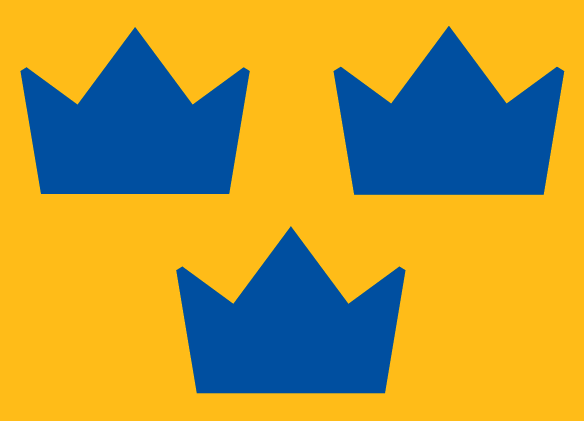
In the late 1970's Sweden abandoned their traditional "tre kronor" (three crowns" cresting for their jerseys in favor of the slogan "tre kronor" above a polar bear logo, which just happened to be the exact same polar bear used by the Polar Caravans brand of RV campers in an early example of corporate sponsorship on a hockey sweater.

The polar bear was gone by late 1981 and the three crowns returned permanently in time for the 1984 Canada Cup.

1977 Sweden jersey

Bonus jersey: Today's bonus jersey is a 1977-78 Minnesota North Stars Per-Olov Brasar jersey as worn during his rookie season in the NHL when he scored 20 goals to place third on the team behind Eriksson and Tim Young.

1977-78 was the final season for this style North Stars jersey which was first adopted in 1975-76.

Minnesota North Stars 77-78

Thursday, June 9, 2011

1976-77 Winnipeg Jets Dan Labraaten Jersey

Swedish left winger Dan Labraaten, born on this date in 1951, played in the Swedish second division for three seasons from 1966-67 to 1968-69.

He moved up to to the top level of Swedish hockey when he joined Leksands IF. During that time period he also skated for Sweden in the European Junior Championships in both 1968 (winning bronze), 1969 (silver) and 1970.

Labraaten continued to skate for the dominant Leksands IF over the course of the next six seasons, with his standout being the 1974-75 season in which he scored 24 goals and 38 points in 30 games while playing with future Minnesota North Stars Per-Olav Brasar and Roland Eriksson.

Labraaten Leksands IF

During Labraaten's time with the Leksands IF from 1970 to 1976, the team were playoff runners up in 1971 and 1972 and winners of the Le Mat Trophy as playoff champions in 1973, 1974 and 1975. Labraaten played for the Sweden National Team at the 1974 World Championships where he came away with a bronze medal.

He also added to his international resume with two more appearances in the World Championships, first in 1975 when he scored nine goals in ten games, and again in 1976 with eight points in ten games, coming home again with bronze medals both times. In September of 1976, Labraaten was a member of the Sweden National Team in the inaugural Canada Cup.

Following the success of Swedish imports Ulf Nilsson and Anders Hedberg, Labraaten joined the Swedish superstars as a member of the high flying Winnipeg Jets of the World Hockey Association for the 1976-77 season. While his 51 points were far and away his career high to date, thanks to a much longer season than in Sweden, it paled in comparison to to the 131 by Hedberg. The playoffs were another matter, as Labraaten was third in team scoring with 24 points in 20 games, just five back of Hedberg and three behind Nilsson but two ahead of the great Bobby Hull.

Labraaten Jets

His second season in Winnipeg proved to be less personally successful, as he was limited to just 47 games, which naturally lowered his final offensive numbers to 34 points, but the Jets would capture the Avco Cup as league champions at the end of the season.

He was not retained by the Jets and signed with the Detroit Red Wings of the NHL for the 1979-80 season. The going was a bit tougher in the NHL, as Detroit was going through the "Dead Wings" era, during which they missed the playoffs 15 of 17 seasons. Despite playing in 31 more games with Detroit, he only scored four more points than he did in with Winnipeg, a reflection of playing with a losing team in a less wide open league. With Detroit missing the playoffs yet again, Labraaten was available for World Championship duty for Sweden in 1979, which resulted in his fourth bronze medal in as many tries.

Labraaten Red Wings

Labraaten then had the best season of his career, setting career highs with 30 goals and 57 points in 1979-80. A poor first half in 1980-81 saw the Red Wings trade him to the Calgary Flames where he was strictly a role player over the next season and a half during which he played in just 70 games and scoring 38 points to close out the NHL portion of his career.

Labraaten returned to Sweden for the 1982-83 season and rejoined Leksands IF, with whom he would play the final six seasons of his professional career. Proving he had not lost his offensive touch, Labraaten had the finest season in Sweden during 1983-84 during which he score 23 goals and 44 points in 36 games to win the Elitserien scoring championship. He had one final 20 goal season in 1985-86.

He also made two more World Championship appearances, the first in 1985 and a final one in 1986 which earned Labraaten a long awaited silver medal to go with his four bronzes.

His combined totals across three leagues and his many international appearances are 786 games, 340 goals and 627 points as well as a fist full of World Championship medals.

Today's featured jersey is a 1976-77 Winnipeg Jets Dan Labraaten jersey as worn during his first season of hockey in North America.

The Jets adopted this style for their second WHA season of 1973-74 and used it throughout the remainder of their six seasons in the WHA. Upon entry into the NHL in 1979-80, they celebrated with a new set of sweaters, retiring their WHA era jerseys which had seen them through three championship seasons.

1976-77 Winnipeg Jets jersey


Bonus Jersey: Today's bonus jersey is a 1979 Sweden National Team Dan Labraaten jersey. This jersey is from a unique period of Swedish hockey in the late 1970's and early 80's when Sweden did not wear their famous three crowns logo which is most closely associated with Swedish hockey, but opted instead for a polar bear crest below the words "tre kronor", Swedish for "three crowns".

1979 Sweden jersey

Saturday, February 26, 2011

2006 Sweden National Team Mats Sundin Jersey

Looking to atone for their shocking defeat in 2002 at the hands of Belarus, Sweden came into the 2006 Olympics in Torino, Italy ranked second in the IIHF world rankings.

They were grouped with Slovakia (ranked 3rd), the United States (6th), Russia (7th) and qualifiers Kazakhstan and Latvia.

The Swedes opened their tournament on February 15th with a strong 7-2 win over Kazakhstan to get themselves off to an important fast start. They ran into a buzzsaw the very next day and were soundly thrashed by the Russians by a score of 5-0.

Fortunately for Sweden, overmatched Latvia was up next two days later and Sweden regained some confidence and momentum with an easy 6-1 victory. 24 hours later they had another one in the win column after a narrow 2-1 defeat of the United States. This set up a final Group B game against Slovakia with first place in the group on the line.

Unfortunately things went as poorly for Sweden as possible, as they went down to defeat 3-0 at the hands of the Slovaks, their second shutout in five games. That, combined with Russia's 5-4 win over the Americans, dropped Sweden down to third place in the final Group B standings and a Quarterfinal matchup with the second place team in Group A, who already had scored surprising defeats of both Canada and the Czech Republic in the preliminary round of group play.

However, Switzerland has also shown themselves to be inconsistent, having allowed winless Germany and Italy to tie them. They also showed they were entirely beatable in their 5-0 loss to Finland.

Sweden answered the challenge in fine style and easily ousted the Swiss from the tournament with a 6-2 win, again giving their confidence a boost when they needed it most. Next up for Sweden was the Czech Republic, who impressed no one in the preliminary round by losing three times, beating only Germany and Italy to do just enough to advance. Given a new life in the Quarterfinals, The Czechs upset Group B winners and rivals Slovakia 3-1 after an empty net goal with three seconds remaining.

Sweden earned their shot at a gold medal with a solid 7-3 trouncing of the Czechs.

Meanwhile in the other half of the bracket, the Russians had eliminated the previous gold medal winning Canadians, while Group A winners Finland ousted the United States 4-3 and then dumped Russia easily by a score of 4-0 to set up the gold medal showdown with their classic rivals Sweden.

Opening faceoff
The gold medal final opening faceoff

The red hot Antero Niittymaki got the start in goal for unbeaten Finland, while Henrik Lundqvist was named the starter for Sweden. Each team survived a penalty in the first period before Jorgen Jonsson was sent off at 14:15 for hooking. 30 seconds later Kimmo Timonen put Finland ahead with an assist from Teemu Selanne when his shot from the point trickled through Lundqvist's legs for a rather soft goal. Sweden was again penalized a little over a minute later, but held fast and the first period concluded with Finland ahead 1-0 on the scoreboard but trailing in shots 9-7.

Timonen scores
Saku Koivu watches the puck squirt through Henrik Lundqvist

The intensity picked up in the second period when Toni Lydman of Finland was penalized at 3:52 which allowed Sweden to equalize at 4:42 when Henrik Zetterberg banked one in off of Niittymaki's leg as he came out from behind the net from Mikael Samuelsson and Christian Backman.

Henrik Zetterberg celebrates
Zetterberg celebrates Sweden's first goal

A trio of Finnish penalties followed and during the third one called at 13:00 on Saku Koivu, Sweden was able to take the lead at 2-1 just 24 seconds later when defenseman Niklas Kronwall pinched in from the point and received a pass from Zetterberg. He temporarily lost the puck when a Finnish defender arrived at the same time, but he was able to recover the puck and fire a quick, hard wrist shot past Niittymaki for the goal.

Finland countered at the 15:00 mark when Jussi Jokinen swooped in behind the net and sent a quick pass to Ville Peltonen who was streaking toward the net. Peltonen was able to direct a backhander past Lundqvist to even the score at 2-2. Olli Jokinen received the second assist for Finland.

Peltonen scores
Ville Peltonen evens the game at 2-2

There was no scoring for the remainder of the second period despite a pair of power plays for Finland, the second of which was cut short by an interference penalty on Jussi Jokinen just 20 seconds into the Finnish power play. As the second period ended, the shots on goal again favored Sweden, this time by a narrow 11-10 margin.

Before the fans could settle into their seats, captain Mats Sundin won the opening faceoff of the third period and Peter Forsberg took the puck and skated over the Finnish blueline to the left side of the ice. Once across the ice he sent a pass back to Sundin trailing him over the line. Sundin then moved along the boards down to the left side of the faceoff circle and sent a backwards pass out to the blueline where a wide open Niklas Lidstrom was arriving with a full head of steam. He put everything he had into his shot which found the back of the net just over Niittymaki's shoulder only ten seconds into the period to regain the lead for Sweden at 3-2.

Lidstrom congratulations
Lidstrom receives congratulations after his goal early in the third period

Sweden killed off penalties at the 3:33 and 11:50 marks as Lundqvist shut the door in goal, as the Finns outshot Sweden 10-8 for the period, to carry Sweden to the gold medal.

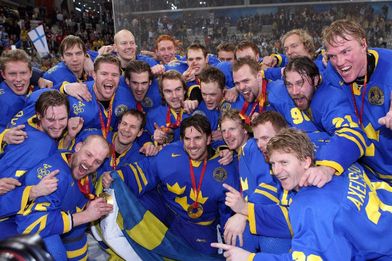
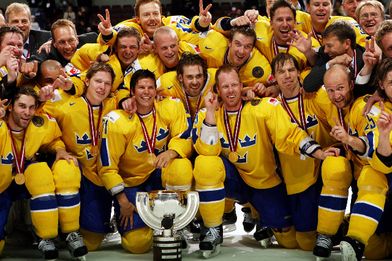
Sweden celebrates gold medal 2006
Sweden celebrates their gold medals

For the tournament, Daniel Alfredsson led Sweden in scoring with 5 goals and 5 assists for 10 points in 8 games, followed by Sundin's 3 goals and 5 assists, good for 8 points. Lundqvist played in 6 of Sweden's 8 games and finished with a 5-1 record and a 2.33 goals against average with a .907 save percentage.

Today's featured jersey is a 2006 Sweden National Team Mat Sundin jersey. 2006 was the year that Nike introduced the brand new Nike Swift jerseys, first seen at the World Junior Tournament on the USA and Canada. Each of the 12 participating countries in the 2006 Olympics wore the new Swift designs, except for Switzerland and the eventual gold medal winning Sweden, who were somehow able to overcome the truck-like weight and aerodynamics of the old style jerseys when compared to the new technologically advanced jerseys the rest of the field was outfitted with.

A unique addition to the Swedish jerseys from their previous sweaters was an attempt to create a "lace up" collar style, which was simply a few slits cut into the existing yoke collar and threading a white elastic threat through it, which did not actually have to be tied, as it was a single continuous piece.

Another unique feature of the jerseys Sweden wore during the 2006 Olympics was the Swedish Olympic logo added to the right shoulders, which was not added to the retail version of this jersey we purchased. After some much appreciated assistance from a friend who created an embroidery file and a helpful embroidery shop, we were able to add this vital detail to our jersey and were quite pleased with the results shown below.

Lundqvist Sweden 2006
The Swedish Olympic logo added to their jerseys at the 2006 games

Given the opportunity, Sweden always opts for their traditional bright yellow jerseys with blue crowns, stripes, names and numbers, but for this contest they captured gold in their road blue sweaters.

Sweden 2006 F
Sweden 2006 B
Sweden 2006 P2

Today's video selection are highlights, including all the goals, from the 2006 Olympic gold medal final between Finland and eventual champions Sweden.


Wednesday, November 17, 2010

2006 Sweden National Team Mats Sundin Jersey

On this date in 1922, the Swedish Ice Hockey Association was founded. The administration of Swedish ice hockey had previously been a part of the Swedish Football Association, which allowed Sweden to gain membership in the International Ice Hockey Federation back in 1912.

Sweden's first international participation came in the 1920 Olympic games, with a 4th place finish. Since then they earned a silver medal in 1928, a bronze 24 years later in 1952 and a silver in 1964. At this point the "Tre Kroner" (Three Crowns), as the team in known, had won three medals in 11 tries spanning 52 years. After skipping the 1976 Olympics, Sweden entered a new era of competitiveness and earned the first of three consecutive bronze medals in 1980, followed by others in 1984 and 1988. They came in 5th in 1992 before finally earning their first Olympic gold medal in 1994 thanks to Peter Forsberg's memorable shootout goal, which was later immortalized on a postage stamp.

Forsberg Stamp

After another pair of fifth place finishes in 1998 and 2002, Sweden once more came home with gold following the 2006 games after defeating their Nordic neighbors and rivals Finland 3-2. Their most recent finish of 5th earlier this year in Vancouver, while not a medal finish, kept alive their streak of never finishing lower than 5th in 20 Olympics dating back 90 years.

Sweden entered the World Championships for the first time in 1931 and won their first medal in 1947 with a silver. Considered one of the World's elite hockey nations, Sweden has never been outside of the Top Division of the World Championships in their history, with medal winning finishes coming more often than not.

The Swedes have captured the World Championship eight times, the most recent being in 2006 in Latvia. That championship victory, coupled with their Olympic gold medal championship three months earlier, made Sweden the first team to ever win both the Olympics and World Championships in the same year. They have also won World Championship silver 16 times and bronze an additional 15 times, including the most recent tournament in 2010.

Considered one of the World's elite teams, Sweden has also participated in the six team Canada Cup tournaments all five times it was held, with a best finish of second in 1984, and the eight team World Cup of Hockey twice, reaching the semi-finals in 1996.

Today's featured jersey is a 2006 Sweden National Team Mat Sundin jersey. Sweden's jerseys adorned with the three crowns are the most traditional of all the national team jerseys, similar to the Montreal Canadiens in that they remain essentially unchanged with only minor tweaks throughout their history and are more resistant to manufacturer trends than other countries. Sweden, in fact, won the last Olympics in 2006 wearing regular style jerseys, while every other country, save Swizterland, was wearing the supposed performance enhancing Nike Swift jerseys for the first time.

While Sweden is best known for their bright yellow home jerseys, and seem to wear them in a disproportionate amount of their games, they won the 2006 Olympic gold medal while wearing today's featured jersey, their blue road jerseys.

Sweden 2006 F
Sweden 2006 B
Sweden 2006 P2

Sweden has a long and illustrious history to draw on for today's video selections, and we begin with a look at several of the gold medals Sweden has won since 1987.


Here is the conclusion of the shootout in the gold medal game at the 1994 Olympics in Lillehammer, Norway, which included Forsberg's famous goal.


In 2006, Sweden became the first country to win both the Olympics and the World Championships in the same season.

Here are highlights of the Gold Medal game against rivals Finland.


And here they celebrate the historic double by winning the World Championships three months later.


Monday, May 24, 2010

1979 Sweden National Team Pelle Lindbergh Jersey

Born on this date in 1959 in Stockholm, Sweden Per-Eric "Pelle" Lindbergh made his debut with Hammarby IF of Stockholm's junior team in 1975 and made his international debut for the Sweden National Team that same season in the European Junior Championships earning the silver medal as well as the award for Best Goaltender. A second season with Hammarby as well as a second European Junior Championship appearance followed in 1976-77, which resulted in a gold medal as well as a second Best Goaltender award at the 1977 EJC.

Pelle LIndbergh Hammarby
Lindbergh in goal for Hammarby. Note the
Flyers logos on his mask even then.

His first season with Hammarby IF in Sweden's Division 1 in 1977-78 was highlighted with four games played at the newly promoted World Junior Championships, backstopping Sweden to a silver medal. At the time, NHL players had begun appearing in the World Championships, beginning in 1976. International Ice Hockey Federation officials began to fear that true amateur and younger players were losing their places they traditionally held with teams at the World Championships, so the Under-20 Junior Championships were elevated to full world championship status in 1977.

A second season with Hammarby IF in Division 1 in 1978-79 saw him named Best Goaltender at the 1979 World Junior Championships, where Sweden would win the bronze medal, followed by making his debut with the Sweden National Team at the senior level at that year's World Championships in Moscow, helping Sweden to a bronze medal finish. He was also drafted by the Philadelphia Flyers 35th overall in the 1979 NHL Entry Draft and the second goaltender and second European taken that year.

1979-80 was a breakthrough season for the young netminder, as he would take over the starting role in goal for AIK Stockholm in the Elitserien, Sweden's highest professional level, appearing in 32 games and being named to the 1980 Swedish Olympic Team. Lindbergh would appear in five of Sweden's seven games as Sweden won the bronze medal.

He would make his NHL debut with the Maine Mariners of the American Hockey League in 1980-81, winning the Hap Homes Award, the Les Cunningham Rookie of the Year Award and the Red Garrett Most Valuable Player Award honors after a stellar 31-14-5 record in the regular season and a 10-7 mark in the playoffs as Maine reached the Calder Cup Finals.

Prior to the next season, Lindbergh was named to the Sweden National Team's roster for the 1981 Canada Cup tournament. He would split time in 1981-82 between the Mariners (25 games) and make his NHL debut with the Flyers with eight games, posting a 2-4-2 record.

The departure of Pete Peeters for the Boston Bruins opened up more time for Lindbergh in 1982-83, as he became the number one goaltender for the Flyers, appearing in 40 games, posting a 23-13-3 record and was named to the NHL All-Rookie Team and played in his first NHL All-Star Game. Following the NHL season Lindbergh played in his second World Championships for Sweden and yet another medal, this time a bronze, his seventh international medal.

Pelle LIndberg
Lindbergh at his first NHL All-Star Game in 1983.

Bob Froese took the majority of the starts in Philadelphia in 1983-84 with 48 games played, with Lindbergh finishing with a 16-13-3 mark in 36 appearances.

The high point of Lindbergh's career came in the 1984-85 season, when Lindbergh saw the bulk of the workload, seeing action in 65 games while going 40-17-7 to lead the league in wins and help the Flyers reach the Stanley Cup Finals. His outstanding play was rewarded with his second NHL All-Star Game appearance as well as being named the recipient of the 1985 Vezina Trophy, the first European goaltender in NHL history to ever win the award.

Pelle LIndberg
Lindbergh with the Vezina Trophy.

Lindbergh also became the first goaltender to bring a water bottle with him on the ice during a game to combat severe dehydration that plagued him, a now accepted and regular practice.

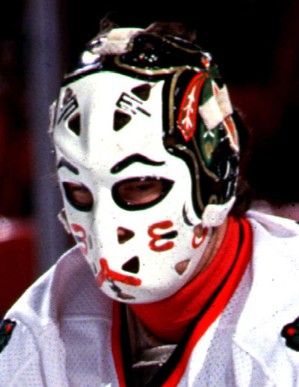
In addition, Lindbergh was also known for his stark white goalie mask used during a period when nearly all goalie masks were adorned with increasingly elaborate paint schemes to reflect either the team's identity or their individual personality. The mask was a replica of his idol and goaltending coach, former Flyer goalie Bernie Parent.

Pelle LIndberg

Following his Vezina Trophy winning season, Lindbergh signed a six year contract with the Flyers and bought himself a 565 horsepower, customized Porsche 930 Turbo. He began the 1985-86 season in good form, winning six of his first eight starts, but tragedy struck when Lindbergh crashed his car while driving impaired on November 10, 1985, leaving him brain-dead and his two passengers seriously injured. Lindbergh was kept on life support long enough for his father to arrive from Sweden to join Lindbergh's mother, who was already in the United States on a visit, to say goodbye and then make the final decision to donate his organs and end life support on November 12th. Lindbergh was just 26 years old.

His death stunned is teammates, the city of Philadelphia and the nation of Sweden. Fans then made Lindbergh the top vote getter for the 1986 NHL All-Star Game, the first time a player was chosen posthumously for an all-team in North American sports.

While Lindbergh's #31 was never officially retired, no Flyer has worn the number since.

The Flyers created the Pelle Lindbergh Memorial Award in 1994, given annually to the Most Improved Player each season.

For more on the life and career of Pelle Lindbergh, we recommend Pelle Lindbergh: Behind the White Mask.


Today's featured jersey is a 1979 Sweden National Team Pelle Lindbergh jersey as worn in the 1979 World Junior Tournament which took place in Sweden. Lindbergh was named the Best Goaltender and helped Sweden earn a bronze medal that year.

This jersey is from a period of time in the late 70's/early 80's when Sweden moved away from their traditional three crowns logo and instead sports the phrase "Tre Kronor", which translates to "Three Crowns".

Sweden 1979 WJC jersey

Bonus Jersey: Today's Bonus Jersey is a 1985-86 Philadelphia Flyers Pelle Eklund jersey which features the #31 memorial to Pelle Lindberg worn following his death in November of that season. Eklund, a fellow Swede, was Lindbergh's rookie teammate for the first eight games of the 1985-86 season and would go on to play nine seasons with the Flyers.

Philadelphia Flyers Eklund jersey
Pelle LIndberg memorial
While there are numerous Lindbergh game highlights, news reports and tributes available, we chose to feature this excellent tribute today.