Showing posts with label Edmonton Oilers. Show all posts

Friday, February 18, 2011

1991-92 Boston Bruins Andy Moog Jersey

While playing for the Wichita Wind of the Central Hockey League, injuries to goaltenders Ron Low and Eddie Mio forced the Edmonton Oilers to call up Andy Moog, who was born on this date in 1960. Moog would play in seven games late in the season and then nine playoff games, which included an opening round sweep of the Montreal Canadiens.

Moog Oilers

With the emergence of Grant Fuhr, Moog spent the majority of the 1981-82 season back in Wichita, but did see action in eight NHL games with the Oilers. Moog established himself as a full time Oiler the following season, playing in 50 regular season games and was the Oilers goalie of choice during their first deep playoff run to the 1983 Stanley Cup Finals. He posted a postseason record of 11-5, but the Oilers fell to the New York Islanders dynasty.

He continued to split time with Fuhr for the next four seasons, playing in 38, 39, 47 and 46 games during that time period as the Oilers won Stanley Cups in 1984, 1985 and 1987. While Fuhr played the majority of the games in the 1984 playoffs, he was injured in Game 3 of the Finals and Moog stepped in and won games 4 and 5 to bring Edmonton their first Stanley Cup championship.

After three more seasons of playing behind Fuhr in the playoffs in particular, Moog asked to be traded and left the Oilers to join the Canadian National Team in 1987-88. After playing 27 games of their pre-Olympic schedule, Moog competed in the 1988 Olympics hosted by Calgary. Although Moog went 4-0, Canada finished 5-2-1 and finished out of the medals in forth.

Moog Canada

Following the Olympics, Moog was sent to the Boston Bruins at the trade deadline. Moog went 4-2 during the final games of the regular season and the Bruins advanced to the Stanley Cup Finals, but were defeated by Edmonton.

The Bruins reliance on Moog grew each season as his games played increased from 41 in 1988-89, to 46, 51 and then a carer high of 62 in 1991-92. The Bruins again made it to the Stanley Cup Finals in 1989-90 as Moog went 13-7 in 20 games. They also had deep playoff runs with appearances in the conference finals in both 1991 and 1992 with Moog handling the bulk of the work with 19 and then 15 postseason games.

Moog Bruins

Still the Bruins number one goalie, he played 55 games in 1992-93, winning a career high 37 games, but following a first round playoff exit after three straight overtime losses, Moog was dealt to the Dallas Stars in time for their first season in Texas.

Moog Stars

For four seasons Moog was the Stars number one netminder, with a high of 28 wins in 1996-97. His final NHL season was with the Montreal Canadiens, a team he had eliminated from the playoffs four times, after signing as a free agent. There he split time with Jocelyn Thibault and made 42 appearances before retiring.

Moog Canadiens

His final NHL totals are 713 games over 18 seasons, 372 wins, 209 losses and 88 ties. He registered 28 shutouts and a career 3.13 goals against average. In the playoffs he saw action in 132 games, a testament to the strong clubs he played for throughout his career, going 66-57 and had his name engraved on the Stanley Cup three times.

He as also known for his goalie mask, which was once named the scariest in NHL history by The Hockey News in 2008.

Moog Bruins mask

Today's featured jersey is a 1991-92 Boston Bruins Andy Moog jersey. The 1991-92 season was the NHL's 75th Anniversary season, and as part of the celebrations, the Original 6 clubs all wore Turn Back the Clock jerseys throughout the season, particularly when they played against other Original 6 teams.

The Bruins jersey was based on their 1934-35 jerseys, the first year the Bruins were black and gold after wearing brown and gold since 1924.

Boston Bruins 91-92 TBTC jersey

Bonus Jersey: Today's bonus jersey is a 1983-84 Edmonton Oilers Andy Moog jersey as worn when Moog was in goal for the clinching Game 5 of the Oilers first Stanley Cup victory to begin their dynasty.

This jersey has been altered for Moog, specifically having the waist and sleeves shortened, which hides the Nike logo at the bottom of the jersey.

This style of Oilers jersey dates back to their entry into the NHL in 1979-80. Two seasons later this particular style arrived with a slightly lighter shade of blue and a new customization package which included three color numbers. This style would become an icon following the success of the Oilers and Wayne Gretzky in particular as it would remain unchanged through 1995-96 until being replaced by a new, darker color scheme. The blue road version would return in 2008-09 as a throwback alternate and was subsequently promoted to the club's primary jersey once again, only this time as the home jersey with the change from wearing light to dark jerseys as home in 2003-04.

Edmonton OIlers 85-86

Today's video is a highlight package of Andy Moog highlights set to "music". It's up to you to decide if this is clever or cheesy. Or Both.


Monday, January 17, 2011

1974-75 Edmonton Oilers Jacques Plante Jersey

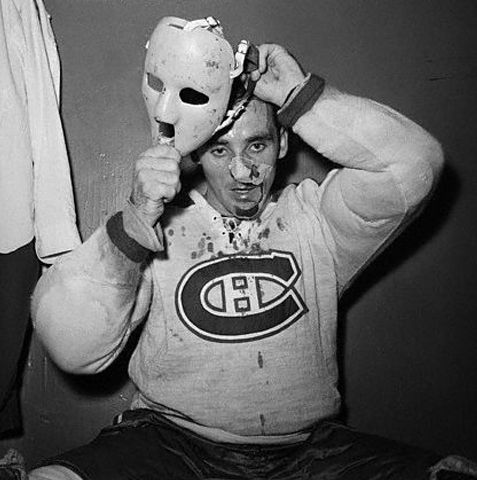
After earning his fame as a member of the Montreal Canadiens beginning in 1952-53, where he won six Stanley Cup championships, six Vezina Trophies and the Hart Trophy, as well as the notoriety of being the innovator of the modern goalie mask in 1959, Jacques Plante, who was born on this date in 1929, began the second phase of his career when a personality conflict between the quirky goaltender and headstrong coach Toe Blake led to Plante being traded to the New York Rangers in 1963.

Plante Rangers

Plante's first season with the Rangers saw him play in 65 of the Rangers 70 games, but the club finished fifth out the six teams and out of the playoffs, a position he was not accustomed to while with the Canadiens, who not only made the playoffs ever year of his time in Montreal, they won the championship six out of his 11 seasons in Montreal.

His second season in New York was not nearly as simple, as he only played 33 games with the Rangers and spent time in the minors with the Baltimore Clippers, playing in 17 games before retiring, as he required surgery on his right knee in addition to his wife's illness at the time.

For the next two seasons Plante was a sales representative for Molson beer and had seemingly left his playing days behind him. All that changed in 1967 when the NHL expanded by six teams, doubling the number of jobs available at all positions, especially the close-knit world of goaltending, which previously was limited to roughly 12 jobs.

With the six new expansion teams looking to fill their rosters, a mix of career minor leaguers and veterans were pressed into service by "the second six", with mixed results. The St. Louis Blues were the most successful of the first year teams, upsetting the first place Philadelphia Flyers in the opening round of the playoffs and eliminating the Minnesota North Stars to become the Western Conference, made up entirely of the expansion clubs, representative in the Stanley Cup Finals, where they were quickly dispatched by the Canadiens.

Pleased with the play of veteran Glenn Hall, the Blues drafted the retired Plante in an effort to strengthen their goaltending tandem, and the rejuvenated Plante accepted the Blues overtures and returned to the NHL. Splitting time with Hall, they posted nearly identical records as the pair led the league with the least number of goals allowed, which earned them a split of that season's Vezina Trophy at the age of 40. The Vezina was Plante's seventh, a new NHL record.

Plante Blues

During the playoffs, the Blues defeated both the Flyers and Los Angeles Kings to return to the finals, only to meet the same fate at the hands of the Canadiens.

St. Louis then traded Plante to the Toronto Maple Leafs for the 1970-71 season where he led the NHL with the best goals against average at just 1.88.

Plante Maple Leafs

He played for the Maple Leafs again in 1971-72, appearing in 34 games, and most of the 1972-73 season before being dealt late in the year to the Boston Bruins where he played the final eight games of his storied NHL career, going 7-1-0 to help the Bruins qualify for the playoffs.

Plante Bruins

Having failed miserably with their choice of Maurice Richard as head coach, who lasted just two games of their debut season, the Quebec Nordiques of the rival World Hockey Association (WHA) signed Plante to a ten year contract to be not only their head coach, but their general manager as well. Plante did manage to improve the team enough in 1973-74 to post a winning record at 38-36-4, but did not qualify for the playoffs and resigned at the end of the season.

Plante then came out of retirement once more at the age of 46 to join the Edmonton Oilers, also of the WHA. The Oilers goaltending position that season was a revolving door of sorts, as Plante appeared in 40 games that season, but his 1592 minutes played was only the equivalent of 26 1/2 games. In all, the three Oilers goalies made 100 appearances in 78 games as their coaches, first Brian Shaw and later Bill Hunter were quick with the hook.

Plante Oilers

Sadly, Plante was attending the Oilers training camp for the 1975-76 season, but retired for good when he learned that his youngest son had passed away.

Aside from his credit for the modern goalie mask, he is also viewed as an innovator for shouting instructions to his teammates, leaving the crease to play the puck, raising his arm to indicate an icing call for his defensemen, cutting down angles and staying square to the shooter. He is also one of the goaltender to write a book on how to play the position and is viewed as the innovator of modern goaltending.

Plante cartoon

In addition to his Stanley Cups and awards, his final NHL totals were 837 games, 434 wins, 82 shutouts and a lifetime goals against average of 2.38.

Plante was inducted into the Hockey Hall of Fame in 1978 and the Canadiens retired his #1 in 1995.

Today's featured jersey is a 1974-75 Edmonton Oilers Jacques Plante jersey from his final season of play, his only one as a member of the WHA.

During the team's inaugural season of 1972-73 the team was known as the Alberta Oilers and to drive home the point, all the jerseys had "ALBERTA" on the back where the players name would customarily have been.

For 1973-74 the team changed their name to the Edmonton Oilers, and with the change in team name, the club then went with the standard player names on the back of their sweaters, only in the unusual, almost handwritten font you see on today's featured jersey, which was actually recycled from the previous year and worn only in the preseason, as the club had a new set of jerseys made for the regular season which featured blue shoulders and a more standard block font for the names.

Edmonton Oilers 74-75 jersey


Tuesday, January 11, 2011

1984-85 Edmonton Oilers Pat Hughes Jersey

Calgary, Alberta's Pat Hughes was originally drafted by the Montreal Canadiens 52nd overall in the 1975 Amateur Draft after his second season with the University of Michigan during which he scored 24 goals and 43 points in 38 games. He would return to Michigan for a third season in 1975-76.

He turned pro with the Nova Scotia Voyageurs of the American Hockey League the following year and played 77 games, scoring 68 points, as well as 144 penalty minutes. In 12 playoff games Hughes scored two goals and two assists a the Voyageurs won their second consecutive Calder Cup as AHL champions.

Hughes played a second season with Nova Scotia in 1977-78, raising his goal total to an even 40, good for fourth overall in the AHL. He would also make his NHL debut on December 14, 1977 with Montreal, one of three games he would play in that season.

He spent the entire 1978-79 season in the NHL with Montreal, seeing action in 41 games, in which he scored his first NHL goal, one of nine he would score that season. He was traded to the Pittsburgh Penguins in time for the next season, a move which proved beneficial for Hughes, as it allowed him to establish himself as an NHL regular. He would play in 76 games for the Penguins and score 18 goals.

After 58 games with the Penguins in 1980-81, his career would take another turn for the better when the Penguins sent Hughes to the Edmonton Oilers in March of 1981. Joining the offensive juggernaut in Edmonton allowed Hughes to set new personal highs in goals (24) and points (46) in 1981-82.

Pat Hughes Oilers

He raised his personal best in goals to 25 in 1982-83, which included setting an NHL record for the fastest two shorthanded goals in league history on this date in 1983 when he score at 15:18 of the second period and then struck again just 25 seconds later in a 7-5 Oilers win over the St. Louis Blues. His two shorthanded goals in 25 seconds broke the record of 27 seconds set on March 25, 1982 by his Oiler teammate Wayne Gretzky, and in doing so, Hughes gained the unique distinction of becoming the first player to ever break a record held by Gretzky.

The next season Hughes again raised offensive numbers, setting career highs in goals, with 27, including the most spectacular game of his career, when he scored five goals on February 3, 1984 against his hometown Calgary Flames. He also set highs for both assists (28) and points, with 55. Hughes would also contribute 13 points in 19 games as the Oilers won the Stanley Cup for the first time in club history.

After winning another Stanley Cup the following season with the Oilers, Hughes was traded twice in the same day, ending up with the Buffalo Sabres for 1985-86. The checking forward's numbers took an understandable drop away from the high flying Oilers. He played 50 games with the Sabres, scoring 13 points, and another 10 games with their AHL affiliate in Rochester, New York.

He was claimed in the waiver draft in 1986 by St. Louis and was with the Blues for 43 games before St. Louis traded him to the Hartford Whalers. His stay with Hartford was brief, consisting of two regular season games and three playoff games to close out his career.

Hughes played 10 NHL seasons and totaled 130 goals and 128 assists for 258 points as well as having his name engraved on the Stanley Cup twice and earning the distinction of becoming the first person to break an offensive record held by Gretzky.

Today's featured jersey is a 1984-85 Edmonton Oilers Pat Hughes jersey as worn during the second championship season of Hughes career. When Hughes arrived in Edmonton, the Oilers were outfitted with jerseys produced by Sandow SK for two seasons before being replaced by Nike's entry into the manufacturing of hockey jerseys.

Edmonton Oilers 84-85 Jersey

In today's video segment, Hughes and the Edmonton Oilers win their first Stanley Cup in 1984.


Tuesday, December 28, 2010

1988-89 Edmonton Oilers Grant Fuhr Jersey

On this date in 1918, Georges Vezina of the Montreal Canadiens became the first goalie in NHL history to be awarded an assist when Newsy Lalonde gathered up the puck after a save by Vezina, skated the length of the ice and scored a goal during a 6-3 Canadiens win over the Toronto Arenas.

Georges Vezina
Georges Vezina

It would take 61 years before a goaltender would be credited with scoring a goal, and he never actually shot the puck. That occurred on November 28, 1979 when Rob Ramage of the hapless Colorado Rockies gathered up the puck after a save by the New York Islanders Billy Smith during a delayed penalty call and passed the puck back out of the corner, which unfortunately for the Rockies sailed by his intended teammates and had enough force to continue all the way down the length of the ice and into the Rockies unmanned goal.


It would take eight more years for an NHL goalie to genuinely shoot the puck into the opposing net when Ron Hextall of the Philadelphia Flyers score against the Boston Bruins on December 8, 1987. Hextall later scored again during the playoffs against the Washington Capitals on April 11, 1989.

Martin Brodeur of the New Jersey Devils is the only other goalie to date to have scored twice with a playoff goal in 1997 and a regular season goal in 2000.

Jeff Reese holds the record for most points by a goaltender in a game with three, which he scored on February 10, 1983 while playing for the Calgary Flames.

It should come as little surprise to find out that an Edmonton Oiler holds the record for most points by a goaltender in a season, as well as the career record for most points by a goalie. Those honors belong to Grant Fuhr of the high powered Oilers. His record of 14 points in 1983-84 set the standard which still remains the one to beat more than 25 years later.

While Fuhr certainly earned a number of assists by simply going behind the net and teeing up a dump-in for Paul Coffey to carry up the ice and set up a Wayne Gretzky goal, Fuhr also earned a number of assists by firing the puck up the ice to an open teammate to initiate a rush.

Fuhr career total of 60 points (which includes regular season and playoffs combined) leads all goalies in career scoring, followed by Patrick Roy's 56, who just barely tops the 55 scored by Tom Barasso. Brodeur ranks fourth all time with 44 points, two of which were goals. Mike Vernon's 41 leads both Hextall and John Vanbiesbrouck at 38, with two of Hextall's points coming from his goals.

The rest of the top ten consist of Ed Belfour at 35, Curtis Joseph's 33 and the tenth spot is occupied by both Sean Burke and Dan Bouchard, who are tied at 30. Honorable mention goes to Kirk McLean (29), Andy Moog (28), Bill Ranford (26) and the duo of Mike Palmateer and Tony Esposito with 25 each. Of the 16 goalies listed, only Broduer remains active.

Today's featured jersey is a 1988-89 Edmonton Oilers Grant Fuhr jersey. Fuhr remains the all-time point scoring leader among NHL goalies with 60, four more than the next closest pursuer, and holder of the most points in a season by a goaltender for over 25 years.

Fuhr played 19 NHL seasons and won 403 games with the Oilers, Buffalo Sabres, Toronto Maple Leafs, Los Angeles Kings, St. Louis Blues and Calgary Flames as well as being the Oilers starting goaltender for Stanley Cup championships with the Oilers in 1984, 1985, 1987 and 1988. He also won the Canada Cup in both 1984 and 1987. He also won the Vezina Trophy in 1988 and was inducted into the Hockey Hall of Fame in 2003. Just to be clear, the Vezina Trophy is awarded for puck stopping ability, not goalie scoring exploits!

Oilers 88-89 jersey Pictures, Images and Photos

Here is footage of Broduer's first goal, which came in the 1997 playoffs.


Our final video today is a tribute to Grant Fuhr and a collection of some of his flashiest saves.


Dasherboard: The World Junior Championships had a light schedule yesterday. Slovakia won in 2-1 overtime in their game against the plucky Germans to pull even with the United States with two points in the Group A standings, one point behind Switzerland.

In Group B, the Czech Republic did what was require by shutting out Norway, but the 2-0 score does little to inspire anyone into believing the Czechs will be strong enough to advance to the Playoff Round in light of Sweden's 7-1 drubbing of Norway the day before.

Today's schedule is a full four games, with Switzerland and Finland battling it out in Group A. With three points for a win in international hockey, a win for Switzerland would all but guarantee them a place in the Playoff Round. The day's second game has the Czech Republic hoping to stifle Canada's scoring attack and come away with at least a point or two in the standings. A win for Canada, even if it comes in overtime, will put them in an excellent position to advance with Norway still on their schedule and a likely three points from that game.

Sweden will be facing Russia at Dwyer Arena in the best matchup the smaller rink will see all tournament. A regulation win for Sweden will certainly put the Russians in a bad spot while a win for the Russians keeps them right in the mix in the "Group of Death".

The final game of the day has the United States looking to improve upon their performance in their opening game which went to overtime. A regulation win could very well see them at the top of the group by the end of the day and in a good position to earn one of the coveted byes directly into the semifinals.

NHL Winter Classic 2011 Apparel at Shop.NHL.com!


Friday, November 19, 2010

1988-89 Edmonton Oilers Jari Kurri Jersey

It was on this date in 1983 at home in Edmonton versus the New Jersey Devils and goaltenders Ron Low and later Glenn Resch that Jari Kurri scored five goals in a single game, still the only Finnish player to ever do so in an NHL game. The five goals in one game is an Oilers record he shares with Wayne Gretzky and Pat Hughes.

Kurri also holds the Oiler record for Most Points in One Period with five, on two goals and three assists versus the Los Angeles Kings on October 26, 1984 against Darren Eliot, and shares the Oiler record for Most Assists in One Period with four in the second period against the Winnipeg Jets and goaltender Bryan Hayward on October 7, 1983, which is also the NHL record as well.

Other Oiler records to Kurri's credit are;
  • Most Points in One Season by a Right Wing - 135
  • Most Goals in One Season by a Right Wing - 71
  • Most Points in One Season by a Rookie - 75
  • Most Assists in One Season by a Rookie - 41
  • Most 20 Goal Seasons - 10
  • Most Consecutive 20 Goal Seasons - 10
  • Most 30 Goal Seasons - 10
  • Most Consecutive 30 Goal Seasons - 10
  • Most Career Playoff Goals - 92
  • Most Playoff Goals by a Rookie - 5
  • Most Playoff Goals in One Game - 4
  • Most Game-Winning Goals in One Playoff Year - 5
  • Most Playoff Points by a Rookie - 12
  • Most Career Playoff Power Play Goals - 22
  • Most Shorthanded Goals in One Playoff Series - 2
  • Most Shorthanded Goals in One Playoff Game - 2
Kurri is second in Oiler history in career goals with 474, third in career assists with 569, second in career points at 1,043.

He is fourth in single season goals with 71, third in career playoff assists with 110, third in career playoff points with 202. His 19 goals in one playoff year is also he NHL record.

Other NHL records Kurri holds are;
  • Most Hat Tricks in One Playoff Year - 4
  • Most Hat Tricks in One Playoff Series - 3
  • Most Goals in One Playoff Series - 12
  • Most Power Play Goals in One Playoff Game - 3
  • Most Shorthanded Goals in One Playoff Period - 2
  • Most Points by a European-born and Trained Player - 1,398
Kurri finished his NHL career with five Stanley Cup Championships the 1985 Lady Byng Trophy, 601 goals, 797 assists and 1398 points in 1251 games.

'Kurri
Kurri shares a moment with an old friend

Internationally, Kurri played in the World Junior Championships twice, in 1979 and again in 1980, earning a silver medal while scoring the most points, the European Junior Championships in 1978 winning gold and being named Best Forward of the tournament. He also competed for Finland in the Canada Cup in 1981, 1987 and 1991, the 1996 World Cup of Hockey where he was team captain, the World Championships in 1982, 1989, 1991 and 1994, when he earned a sliver medal, as well as the Winter Olympics in 1998, earning a bronze medal.

'Kurri
Kurri on his way to winning a bronze medal at the 1998 Olympics

His #17 was retired by Jokerit Helsinki, the Edmonton Oilers and the Finnish National Team. He was inducted into the Finnish Hockey Hall of Fame in 1998, the IIHF Hall of Fame in 2000 and the Hockey Hall of Fame in 2001.

Today's featured jersey is a CCM 1988-89 Edmonton Oilers Jari Kurri jersey and features the Edmonton Oilers 10th Anniversary patch. This is a bit of an odd patch since the Oilers were founded in 1972 as one of the original members of the WHA. This would make 1988-89 the Oilers 16th Anniversary season. This patch was clearly meant to commemorate the Oilers 10th Anniversary of joining the NHL following the demise of the WHA in 1979, a league the NHL chooses to pretend never actually existed.

There is also an image of a single Stanley Cup in the patch, but the Oilers had actually won four cups at that point, something most teams would have probably driven home by putting multiple images of the cup on the patch, as the Islanders would do three seasons later.

Edmonton Oilers 88-89 F
Edmonton Oilers 88-89 B
Edmonton Oilers 88-89 P

Here is a tribute video from the night the Oilers retired Kurri's #17.


Tuesday, September 28, 2010

1988-89 Edmonton Oilers Grant Fuhr Jersey

Grant Fuhr, born on this date in 1952, led the Victoria Cougars to the WHL championship with a 48-9-1 record followed by a trip to the Memorial Cup Finals in 1981, which garnered the attention of the Edmonton Oilers, who drafted him 8th overall later that spring.

As a rookie, Fuhr immediately led the Oilers in games played with 48, compared to 29 for Ron Low and 8 for Andy Moog. While Fuhr rarely lost, he racked up a notable amount of ties, finishing the season with a 28-5-14 record, which set a new team mark for wins by a goaltender.

After a personally disappointing second season, in which the Oilers advanced to the Stanley Cup Finals against the New York Islanders, he bounced back in 1983-84 with a 30-10-4 record while splitting time with Moog. Fuhr also registered a remarkable 14 offensive points that season, setting a record for goaltenders which still stands to this day. He would play in 16 of the Oilers 19 playoff games, posting an 11-4 record on the way to the Oilers first Stanley Cup championship.

Before the next NHL season could begin, Fuhr began his international career when he was a member of Team Canada during the 1984 Canada Cup. His record in two games was 1-0-1.

The Oilers would again return to the finals in 1984-85 following a 26-8-7 record for Fuhr during the regular season. Fuhr would start all of Edmonton's playoff games, as they romped to their second consecutive championship with a 15-3 record in four rounds of playoffs.

Another fine regular season of 29-8-0 for Fuhr came in 1985-86, but the Oilers playoff run would fall short. The Oilers would regain their title the following season as things returned to normal for Edmonton. Fuhr was 22-13-3 during the regular season while still splitting time with Moog, and 14-5 in the playoffs.

Fuhr's international career continued when he was the goaltender for the NHL All-Stars in the two game Rendez-Vous '87 series against the Soviet Union during the season and was later the goaltender for Team Canada in the 1987 Canada Cup, in which he played in all nine Canadian games. Fuhr played brilliantly on his way to a 6-1-2 record as Canada won the tournament with a memorable 2 games to 1 defeat of the Soviet Union, with all three games being decided by one goal, two of which went into overtime. Fuhr was named the goaltender on the tournament All-Star Team.

Following Moog's departure after the season, Fuhr now assumed an unprecedented amount of work, appearing in 75 games and winning 40. The increased work load did not adversely affect Fuhr either, as he posted his lowest goals against average since his rookie season, which earned him the only Vezina Trophy of his career and second place in the voting for the Hart Trophy for the league's MVP.

Grant Fuhr

The Oilers dynasty was confirmed as they marched through the playoffs virtually unimpeded, as they eliminated the Winnipeg Jets 4-1, swept the rival Calgary Flames 4-0, downed the Detroit Red Wings 4-1 and crushed the Boston Bruins 4-0 in the finals to win their fourth Stanley Cup in five years.

Fuhr remained with the Oilers for three more seasons as the team began to be dismantled, beginning with the famous trade of Wayne Gretzky in the summer of 1988. Still, the Oilers regrouped and captured their fifth championship in 1990, but did so without Fuhr, as he was limited to just 21 games that season and did not make a playoff appearance. The next season was similar, as Fuhr made just 13 regular season appearances, but was the Oilers goaltender of choice in the post season, but the Oilers fell short in the Conference Finals.

During this time period, Fuhr made his only World Championships appearance for Canada in 1989.

Prior to the start of the 1991-92 season, Fuhr was dealt to the Toronto Maple Leafs in a seven player trade. He became a workhorse for Toronto, playing 66 games that season. After playing 29 games of the 1992-93 season, Fuhr was dealt in February of 1993 after a season and a half in Toronto to the Buffalo Sabres. He played as many games in three months in Buffalo as he did in five months in Toronto.

With playing time hard to come by due to the presence of Domink Hasek in Buffalo, Fuhr played 32 games in 1994-95 and just 3 the following season before the Sabres moved Fuhr to the Los Angeles Kings for the remainder of the season after Hasek was able to establish himself as the starter following an injury to Fuhr.

His stay in Los Angeles was brief, as Fuhr would sign with the St. Louis Blues as a free agent for the 1995-96 season. In Fuhr, the Blues found their man and Fuhr was given the reins in goal, seeing action in a personal high 79 games, the same amount he played since being traded to the Sabres 2 1/2 seasons earlier.

He again did the heavy lifting in 1996-97 (73 games) and 1997-98 (58 games). While his workload was reduced to 39 games in 1998-99, in part due to a knee injury he suffered in the 1996 playoffs, Fuhr posted his fourth consecutive winning record while with the Blues. Playoff success eluded St. Louis however, and Fuhr was traded to the Calgary Flames for the 1999-00 season.

It was not a good year for the Flames though, as they were to finish last while Fuhr was used in a backup role to Fred Brathwaite. Fuhr was limited to 23 games, but the second of his five victories that season gave him 400 for his career (only the sixth goaltender in NHL history to reach that mark) in what turned out to be the final season, as he announced his retirement on September 6, 2000.

His final record shows 868 games played with 403 wins, 295 losses and 114 ties. His playoff record was 92-50 in 150 games, which led to his winning the Stanley Cup five times. He also played in six All-Star Games, being named the game's MVP in 1986 in Hartford.

Fuhr was both inducted into the Hockey Hall of Fame and had his #31 retired by the Oilers in 2003.

Grant Fuhr

Today's featured jersey is a 1988-89 Edmonton Oilers Grant Fuhr jersey. This jersey features the Oilers 10th Anniversary patch - of being in the NHL, as the Oilers franchise dates back to 1972 when they were a founding member of the defunct World Hockey Association.

Oilers 88-89 jersey

Here is footage from Fuhr's number retirement ceremony in Edmonton.


Here is Fuhr in St. Louis showing why he is considered one of the best.


Finally, a recent interview with Fuhr on shootouts and goaltending styles.


Sunday, June 13, 2010

1978-79 Edmonton Oilers Garnet "Ace" Bailey Jersey

Garnet "Ace" Bailey, born on this date in 1948, first played for the Edmonton Oil Kings in junior hockey from 1964 to 1967, including a Memorial Cup championship in 1966.

He was drafted by the Boston Bruins in the 1966 NHL Amateur draft with the 13th overall pick and started his professional career with the Oklahoma City Blazers of the Central Hockey League followed by further seasoning with the Bruins minor league Hershey Bears in the American Hockey League in the 1968-69 season where he had a nice season with 56 points in 60 games. Bailey excelled in the playoffs with 14 points in 9 games as Hersey won the Calder Cup as AHL champions. He also found the time to make his NHL debut with the Bruins, seeing action in eight games during which he scored his first NHL goal on his way to six points. He even got his first taste of NHL playoff action in one postseason game for Boston.

The 1969-70 season saw him crack the Bruins lineup, appearing in 58 regular season games. While Bailey did not suit up for any of the Bruins playoff games, that season (perhaps due to injury) his name was included among those engraved on the Stanley Cup following the Bruins championship, capped off by Bobby Orr's famous cup winning overtime goal in Game 4.

His next season was split between the Boston and Oklahoma City before finally establishing himself as a full-time NHL regular in 1971-72 when he skated in 73 games for the Bruins as well as 13 playoff games, including scoring the game winning goal in Game 1 of the 1972 Stanley Cup Finals versus the New York Rangers, as Bailey got his name on the Stanley Cup for the second time.

Bailey's next three seasons in the NHL were ones of change, as the Bruins traded him to the Red Wings after 57 games of the 1972-73 season. Half way through the next season, Detroit sent Bailey to the St. Louis Blues. Once more Bailey was on the trading block, when St. Louis dealt him to the Washington Capitals after 49 games of the 1974-75 season despite Bailey having already set a career high with 41 points in 49 games for the Blues. Combined with the 17 points he scored in 22 game for the Capitals, his 58 points would remain the best offensive output of his 10 years in the NHL.

Washington proved to be a good fit of Bailey, and he would see action in 67 games in 1975-76 and 78 the following year, his second highest scoring season with 46 points.

Bailey Capitals

Bailey, who was known for his sense of humor once received a four-inch-manual from Capitals head coach Tom McVie, telling him how to get into condition. Bailey used the manual to prop up a beer keg in his bar. On the first day of training camp, according to theSan Francisco Chronicle, Bailey beat several other players in a footrace, and McVie said approvingly, "Ace, I can see you used your book this summer." Bailey replied, "Coach, I used it every day."

Another story relates how McVie once scheduled a practice for the squad at the ungodly hour of 4 AM. As the sleepy players arrived in their hotel lobby, Bailey, impersonating McVie, had already called and cancelled the bus scheduled to take them to the rink, which eventually led to the cancellation of the practice and some much needed additional sleep for the team.

After one more season in Washington, his fourth, Bailey's career would come full circle, as he would return to the scene of his junior hockey roots in Edmonton, this time with the Oilers of the WHA for 38 games where he would become a roommate and mentor a young Wayne Gretzky, becoming one of the few players to play with both Orr and Gretzky.

His playing days concluded with seven games with the CHL's Houston Apollos in 1979-80, before retiring to become their head coach, and a single game with the Wichita Wind of the CHL (while he was their head coach) in 1980-81.

His final NHL totals were 568 games played, 107 goals and 171 assists for 278 points.

Beginning in 1981, he worked as a scout for the Oilers from 1981 to 1994 and win five Stanley Cup rings during the Oilers dynasty from 1984 to 1990, which included his name engraved on the cup three of those times.

Bailey Gretzky Stanley Cup

Sadly, while working as the director of pro scouting for the Los Angeles Kings, Bailey was a passenger on United Airlines Flight 175 which was crashed into the World Trade Center on September 11, 2001, killing all on board. The Ace Bailey Children's Foundation was established in his memory. To make a donation, simply follow this link.

Today's featured jersey is a 1978-79 Edmonton Oilers "Ace" Bailey jersey as worn during Bailey's only WHA season. The Oilers adopted this style jersey during their third WHA season of 1974-75 and used this version of the logo with the blue lettering on an orange background through their final WHA season of 1978-79. When the Oilers joined the NHL the following season, the logos on both the home and road jerseys were changed to blue letters on a white background, a higher contrast and much more pleasing combination.

1978-79 Edmonton Oilers jersey

Bonus Jersey: Today's bonus jersey is a Koho 2001-02 Los Angeles Kings Glen Murray jersey, which features the "AM" patch in memory of Ace Bailey and Mark Bavis, a fellow scout with the Kings who was also killed on board Flight 175 with Bailey. The jersey also is adorned with the 2002 NHL All-Star Game which was hosted by the Kings that season.

The Kings introduced this purple jersey as an alternate style to their white home and black road jerseys in 1999 and wore it for three seasons. At the time, the all the home jerseys in the NHL were branded as CCM, while the dark and alternate jerseys carried the Koho brand and the practice jerseys were tagged Jofa, as all three brands were part of the same company.

Later, in time for the 2002-03 season, the Kings flipped logos on their jerseys, making the crown logo seen here, the new primary logo for both their white and black jerseys, where it remains in use today, while the purple alternate jersey began to use the coat of arms logo (seen here on the shoulders as a secondary logo) through 2006-07 prior to the purple jersey being discontinued with the change to the new Reebok Edge jerseys, which dictated the temporary elimination of alternate jerseys.

2001-02 Los Angeles Kings alt

Our first video today is a look at the Ace Bailey Got Skills program, created in Bailey's memory.


Our second video is from the Ace Bailey Children's Foundation.


Again, if you'd like to make a donation, simply click on the image below.

Ace Bailey Children's Foundation logo

Sunday, May 30, 2010

1984-85 Edmonton Oilers Wayne Gretzky Jersey

On this date in 1985, the Edmonton Oilers beat the Philadelphia Flyers 8-3 in Game 5 of the Stanley Cup Finals to win their second consecutive championship in their third straight finals, the last time a team would make the finals three consecutive seasons to date.

In the game, Jari Kurri tied a Stanley Cup record that still stands with his 19 goal of the playoffs to tie the record set by Reggie Leach back in 1976.

Also during the game, Wayne Gretzky had a goal and and three assists to set single season records for both assists, with 30, and points, totaling 47, and was also named the winner of the Conn Smythe Trophy as playoff MVP.

The Oilers had smoked the rest of the Campbell Conference, finishing the regular season with 109 points, 13 ahead of their next closest pursuers the Winnipeg Jets. By comparison, the St. Louis Blues won the Norris Division with just 86 points. Gretzky's 73 goals and 208 points and Kurri's 71 goals and 135 points gave them a 1-2 finish in the league scoring race, securing the Art Ross Trophy for Gretzky.

In the playoffs, Edmonton swept both the Los Angeles Kings in three straight and the Jets in four to reach the conference finals were they secured the right to defend their title by knocking out the Chicago Black Hawks 4-2.

Meanwhile, in the east, the Flyers earned the President's Trophy with a 53-10-7 mark for 113 points. They were led by Vezina Trophy winner Pelle Lindbergh in goal and offensively by Tim Kerr (98 points) and Brian Propp (97).

The Flyers route to the finals saw them knock out the New York Rangers 3-0, dispatch the fading New York Islanders 4-1 and then the Quebec Nordiques 4-2.

Game 1 played in Philadelphia went to the Flyers 4-1 before Edmonton struck back to take Game 2 by a 3-1 score on goals by Gretzky, Willy Lindstrom and Dave Hunter.

The series now shifted to Edmonton for three consecutive games, as was the format back then. Gretzky won Game 3 all by himself as he scored twice within the first minute and a half after the opening faceoff and completed a hat trick before the end of the first period as the Oilers held on to win 4-3.

The Flyers came back in Game 4 with a trio of goals, one even strength, one power play and one shorthanded, before the first period even ended. The Oilers demoralized the Flyers and electrified the home fans with four consecutive goals of their own, including a pair from Gretzky, to come from behind and win 5-3.

The Oilers then came out firing on all cylinders in Game 5, scoring four goals in the first period and went on to hammer Philadelphia 8-3 behind two goals by Paul Coffey and Mark Messier, as well as Kurri's record-tying 19th of the playoffs and Gretzky's four point night to set new records for playoff assists and points, which earned him Conn Smythe Trophy honors.

Today's featured jersey is a CCM 1983-84 Edmonton Oilers Wayne Gretzky jersey. Interestingly, each of the four times the Oilers would win the cup with Gretzky as captain, it would be at home in their white jerseys.

This run of success was prior to teams wearing a special patch during the Stanley Cup Finals, which was not introduced until 1989, so this jersey carries no additional patches - a rarity for the Third String Goalie collection.

Edmonton Oilers W 83-88 F
Edmonton Oilers W 83-88 B

Here is Wayne appears in a TV commercial with his younger brother Keith.


Next, Wayne's time with the Oilers is documented in this profile of "The Great One".


Dasherboard: Game 1 of the Stanley Cup Pond Hockey Championships went to the Chicago Blackhawks as they outlasted the Philadelphia Flyers in a goal-fest no one anticipated. The Flyers, who shut out the Montreal Canadiens three times in five games nearly gave up as many goals last night as they did in the entire previous round (7-6).

The Blackhawks were no better defensively for the first 40 minutes as they allowed the Flyers three first period goals, including one with just 27 seconds remaining to take a lead into the first intermission. After fighting all second period to create a lead, Chicago again allowed a late goal, this time with just 1:11 remaining, to allow Philadelphia to enter the third period tied despite giving up three second period goals.

By this point, there should have been little doubt in either team's minds that they were not going to score again based on the opportunities that presented themselves so far, especially since Chicago's top line had yet to contribute anything offensively.

In the end, it was injury replacement Tomas Kopecky who got the storybook game winner, after having sat out the entire semifinals as a healthy scratch, as the Blackhawks line of Jonathan Toews, Patrick Kane and Dustin Byfuglien registered no points and were a -9 combined.

Other noteworthy events from Bizarro World included the rugged Flyers not taking a single penalty during the entire game.

Brian Boucher returned from injury and relieved Michael Leighton after Leighton allowed five goals on 20 shots and played well until being victimized by Kopecky when he committed too early and was caught down as Kopecky simply skated around him an easily shot the winning goal past him into a gaping net.

Antti Niemi played well enough in the third period to keep the Flyers off the board and protect the fragile Chicago lead to get the win in goal.

The Flyers Simon Gagne, Jeff Carter and Mike Richards were also surprisingly held without a point and totalled a -7.

Daniel Briere led the Flyers with 4 points including a goal and the disruptive Scott Hartnell had 3 points for Philadelphia. Troy Brouwer led the Blackhawks with 3 points, which included 2 goals, and Dave Bolland contributed a shorthanded goal.

The win was Chicago's first in the Stanley Cup Finals since 1973 and the series resumes on Monday night.