Showing posts with label Russia. Show all posts

Monday, March 14, 2011

The 2011 Let's Play Hockey Expo & Minnesota State High School Hockey Tournament

As you may have noticed we had no new post yesterday, as on both Friday and Saturday your intrepid reporter spent the entire day at the 2011 Let's Play Hockey Expo and Minnesota State High School Hockey Tournament in St. Paul, Minnesota.

LPH Expo
The Let's Play Hockey Expo

The Expo is billed as the Nation's Premier Consumer Trade Show, and with many exhibitors competing for the attention attention of 40,000 hockey fans, there are many great deals and freebies to be had, and today we are going to share our haul.

Friday the show began at 10 AM and we spent several hours looking for the best bargains and some early giveaways before the popular ones were all gone. Our haul that morning included the following pictured below. Clockwise, a Reebok premier Minnesota Wild jersey for $45, a Minnesota Wild "helmet" fleece hat for $5, from K1 jerseys, a youth size University of Minnesota-Duluth jersey for $10, a "State of Hockey" t-shirt free from Total Hockey won with a lucky scratch-off card, a half price coupon for admission to the United States Hockey Hall of Fame in Eveleth, Minnesota, a banner featuring the logos of all the clubs in the Kontinental Hockey League around the Gagarin Cup from our friends at Lutch Jerseys (pronounced "lootch") who came all the way from Russia for the Expo, and a Minnesota North Stars cap, also for $5 from the same seller as the Wild helmet hat.

2011 Hockey Expo haul
Our Friday haul

Around lunchtime, he had a craving for a Divanni's Pizza and some hockey action, so we moved next door to the Xcel Energy Center to watch the Class A semifinals for the schools with enrollments under roughly 1,200 students. With our ticket and pizza now procured, we moved into the lower bowl of the seating area, which for Class A is general admission, and were treated a cracking game between two northern schools Hermantown (24-3-2), from just outside of Duluth, and Hibbing/Chisholm (18-9-2).

We joined the game with Hibbing leading 1-0 after one. Hermantown lit their fans on fire with 4 goals in the first 7 minutes of the second only to have Adam Johnson single handedly drag Hibbing back into the game with a pair of goals in the final minute of the period to make it 4-3 with 20 minutes remaining.

Johnson completed his hat trick at 2:34 of the third on the power play to tie the game at 4-4 and complete the Hibbing comeback. Hermantown went back on top at 10:50 with a Andrew Mattson rebound goal. Finally, with their goaltender pulled, Hibbing tried desperately to tie the game and force overtime, only to have Jared Kohlquist loft a shot toward the empty Hibbing goal. Johnson, the Hibbing defender leapt to block the shot, only to have it tick off the end of his fingertips and continue down the ice.

Johnson landed, turned and gave the chase of his life after the sliding, yet slowing puck. Johnson and the puck arrived at the goal line at the same time, and he swiped his stick as he dove in a valiant effort to knock the puck sideways before it crossed the line. Agonizingly, he made contact with the puck just after it was over the line to seal the victory for Hermantown, who would advance to the finals the next day.

We stayed for most of the second game, in which St. Thomas Academy overpowered Thief River Falls 5-0 and left to take in more of the of Expo before calling it a day.

Saturday, following an exciting morning of Pinewood Derby racing, we and our Cub Scout returned to the Hockey Expo to take in the proceedings from the viewpoint of a seven year old. Donned in the "State of Hockey" t-shirt won the previous day, his goal was to try out as many stick handling, puck shooting, lucky wheel spinning interactive opportunities as possible.

Many exhibitors obliged, with displays of puck rebound devices, goal net target practice inserts, stick handing drill contraptions, hardest shot radar guns and puck shooting accuracy contests, as well as lucky spinning wheels and hockey stick "putting" contests for prizes.

Saturday's haul for our seven year old included free commemorative patches from the Minnesota Wild won on their lucky spinning wheel, an autographed 8x10 from former Minnesota Gopher and NHLer Paul Broten, a Nikolai Khabibulin McFarlane Sports Pick action figure purchased from the trading card portion of the show, a very nice shot of the two of us in front of a "green screen" with a goal superimposed behind us for free from Total Hockey, a free Easton backpack from their large display area, a free training ball from EZPuck.com, free pencils from USA Hockey, a Goldy Gopher tattoo and a Target Stores bandana for free from the 2011 NCAA Frozen Four booth, a backpack won by our 7 year old at the Shock Doctor booth in a shooting accuracy contest and a free puck from HockeyTrain.com.

2011 Hockey Expo haul
Saturday's swag from the Expo

Following the closing of the Expo at 6 PM, we learned of tickets still being available for the Class AA championship final at 7 PM between the Duluth East Greyhounds (24-5-0) and the Eden Prairie Eagles (23-5-2), and still not having had enough hockey, bought ourselves a pair of seats higher up than planes fly, but darn it, we were in the building for the championship game as part of an announced crowd of 15,078.

Eden Prairie's students cleverly took up three sections in the upper deck to our right, one dressed all in black, the middle one all wearing red and the near section all decked out in white shirts! We even spotted gorillia, banana and chicken suits!

After a scoreless first period, Duluth East struck first at 3:31 of the second period on a perfectly run power play when Trevor Olson buried a perfect cross-ice pass from Jake Randolph into a wide open net that Andrew Ford could do nothing to stop.

Eden Prairie evened the score at 1:43 of the third period when Mark Rath lifted one over JoJo Jeanetta in the Greyhounds goal who was laying prone on the ice after stopping a previous in close attempt.

As the fans continued to chant for their teams and at each other, the intensity continued to rise. with 7:29 remaining in the game, Olson fired a shot at Ford in the Eden Prairie goal. It hit him up high and went off his blocker and bounced up into the air. Floating and tumbling, the puck continued in a lazy arc farther upwards - and backwards. Ford, as well as two of the Eagles all made desperate swipes or reaches for the puck which eventually cleared the goal line and came down inside the net, along with two of the diving Eden Prairie defenders, for the second Duluth East lead of the game.

With just under three minutes remaining in the game, David Rath evened the score when he tucked a rebound of a point shot past Jeanetta to once again tie the game and keep Eden Prairie's hopes alive and make the black, red and white sections, as well as the chicken, the gorilla and the banana go, well, bananas.

The remainder of the period passed scoreless, sending the game into overtime with 22 shots for Eden Prairie to 20 for Duluth East. The periods in high school hockey are 17:00 minutes long and the rules call for a three minute break and followed by a 8:00 overtime. It was the second championship game to go to overtime that day, as St. Thomas Academy prevailed 5-4 in overtime after falling behind 3-0 to Hibbling in the first 7 minutes of their Class A championship game earlier in the day.

The officials did a commendable job, letting the players play and the first overtime concluded with the Eagles holding a 3-2 lead in shots. The teams went to the locker room as the ice was resurfaced before the second overtime, a full 17:00 period.

The Greyhounds easily outshot the Eagles 6-2, but the Eden Prairie defense kept the Duluth East forwards out wide, as nearly every shot was a long way out and easily seen by Ford in goal for the Eagles.

The third overtime, scheduled for 8:00 of time, began with a whiff on a puck by a Eden Prairie defender and a lunging backhand by Duluth East that went just wide. Jeanetta had to deal with another of the unusual number of bouncing dump-ins sent his way during the game, all of which he handled well, any one of which could have gone horribly wrong. Meanwhile, Ford stoned a wraparound attempt by Duluth East, one of the few times he had to deal with a close in shot during what had now become the longest final in state tournament history.

Finally with 3:28 to play, the Greyhounds dumped the puck in deep, where Nick Seeler, who played an excellent game on defense for the Eagles, corralled the puck and sent it up to Des Shavlik at the left blueline. Shavlik made a great cross-ice pass up to Curt Rau who caught up to the puck at the red line and skated it into the Duluth East zone along the right boards. Once over the line he put everything he had into a low, hard shot a Jeanetta.

Jeanetta got a large piece of the puck while just outside of his crease, but the puck somehow got through him, and after deflecting off the inside of his left leg, came out behind him and slowly slithered across the top of the blue paint. Andrew Kerr, seeing the puck sitting loose in the Greyhounds crease took two quick strides and took a swipe at the puck to clear it, but only ticked it with the heel of his stick, leaving it moving to the left but only just outside of the crease.

Kyle Rau arrived on the scene for the Eagles in full flight, and made a desperate, lunging backhand swipe at the puck. In the blink of an eye, he made solid contact with the puck, only to have it rebound off the pipe, back into the crease and off of the unlucky Kerr's skate blade and into the net for the championship winning goal at 3:17 of the third overtime to give Eden Prairie their second State Championship in three years. The goal sent the team and their fans into euphoria that only high schoolers are capable of while the Duluth East players showed the misery and disappointment only high schoolers are capable of.

But what about today's featured jersey you ask? Yes, we have not forgotten about that aspect of Third String Goalie.

Today's featured jersey is a 2011-12 Ak Bars Kazan Alexei Morozov jersey purchased directly from Lutch at the Hockey Expo. This amazing jersey is a change in approach for Lutch, as for the first time, not only are the KHL logo on the neck and the beautifully executed main crest fully embroidered sewn on patches, as their authentics have had before, but the Kazan name on the shoulder, the sleeve and back numbers and the name are all fully sewn on two layers of twill and the "snow leopard" shoulder patch is also fully embroidered into the jersey!

We've long been fans of dye-sublimated jerseys from Tackla, as far back as the late 1980's, and Lutch jerseys, which date back nearly as far in our collection. Their bright colors wash and wear beautifully and are not subject to cracking and peeling like heat sealed or silk screened graphics, but this new level of quality out of Russia rivals anything produced for NHL clubs, if not surpasses it.

For more on Morozov, who was flag bearer for Russia and captain of the Russia National Team at the most recent Winter Olympicsin Vancouver, please see our recent article on him here.

Ak Bars Kazan 11-12 F
Ak Bars Kazan 11-12 B

Bonus Jersey: Today's bonus jersey is a 2007-08 Russia National Team Alexander Ovechkin jersey. This style jersey with the multiple sponsorship patches would have been worn in competitions outside of the World Championships and Olympics when Nike supplies the national team, such as the Super Series of games between the junior teams of Russia and Canada, or the Channel One Cup (formerly known as the Izvestia Cup as it was known from 1969 to 1996) held each December as part of the Euro Hockey Tour.

While we are not certain Ovechkin actually wore this particular style due to his NHL commitments, with Lutch not wanting to bring the jerseys back to Russia with them at the conclusion of the show, the price was simply too good to pass up.

While the previous style of jersey featured all sewn on twill names and numbers, this jersey is a prime example of the more familiar all dye-sublimated jerseys we have grown accustomed to from Lutch. Note in particular the blue pointed spikes which fade from dark blue to light blue across their length, something impossible to do with twill.

Russia 07-08 F
Russia 07-08 B

Here is the 2011 Minnesota High School Hockey Tournament All Hockey Hair Team!


Next is a highlight video showing the color, excitement, enthusiastic fans, crazy costumes, dramatic plays and goal celebrations of the entire 2011 tournament, concluding with the memorable final goal in the third overtime of the Class AA championship final.


Wednesday, February 23, 2011

1992 Unified Team Andrei Kovalenko Jersey

The world outside of hockey was in a time of upheaval as the 1992 Winter Olympic Games in Albertville, France were approaching.

Soviet Union leader Mikhail Gorbachev had ushered in a new era of reforms. The Central Committee of the Communist Party agreed to give up it's monopoly of power in February of 1990 and several Soviet Republics had declared their independence, with Lithuania and Estonia doing so in March of 1990 and Latvia following in May.

Soviet Union Map

In March of 1991 a referendum vote was held and 76.4% was cast in favor of retaining the Soviet Union, but with a level of reforms. Seven republics boycotted the vote however, so the results were far from being as decisive as they sounded. In June of 1991, Boris Yeltsin won the post of President of Russia and took office on July 10, while Gorbachev still led the Soviet Union.

Yeltsin and Gorbachev

Yeltsin's policies favored the the dissolution of the Soviet Union, while Gorbachev attempted to restructure the Soviet Union as still a single entity. The New Union Treaty was set to be signed on August 20, 1991 which would convert the Soviet Union to a federation of independent republics with a common president and military force.

On August 19, 1991, hardliners looking to preserve the Soviet Union, and their own personal power in the process, put Gorbachev under house arrest and attempted to revoke his reforms which had granted unprecedented freedoms. They issued an emergency decree, suspended political activity and shut down most of the newspapers. Yeltsin quickly condemned their actions and the coup organizers attempted to have him arrested but failed.

Three days later the coup failed, it's organizers were arrested and Gorbachev returned to power as president of the Soviet Union, but with his powers now compromised.

On December 1, 1991, 90% of the voters in Ukraine voted for independence from the Soviet Union. Then a week later the leaders of Russia, Ukraine and Belarus met to discuss how to proceed and signed an agreement to dissolve the Soviet Union and replace it with the Commonwealth of Independent States (CIS), which Gorbachev described as an unconstitutional coup.

On December 12th, Russia ratified the Belavezha Accords and on December 21, 1991 representatives of all the member republics of the Soviet Union signed the Alma-Ata Protocol, confirming the dissolution of the Soviet Union. The same day, all of the former Soviet republics agreed to join the CIS with the exception of Georgia and the three Baltic States, Lithuania, Estonia and Latvia.

Gorbachev resigned on December 25th and transferred any remaining powers of his office to Yeltsin and the Soviet hammer and sickle flag was lowered for the final time over the Kremlin on December 26th. By December 31, 1991, all official Soviet government operations had ceased and the individual republics assumed governmental control.

Soviet Union flag

This greatly affected their World Junior Hockey Team, as they had left for Germany as the Soviet Union, which ceased to exist midway through the tournament, which they eventually won, only to return home to find their country no longer existed!

The Olympics began on February 8, 1992 with a joint team consisting of players from six of the former 15 Soviet republics, Russia, Ukraine, Kazakhstan, Belarus, Uzbekistan and Armenia competing as The Unified Team.

The Unified Team was placed in Group B and completed their schedule with a 4-1 record with dominant wins over Switzerland, Norway, France and a one goal victory over Canada and their only loss coming to Czechoslovakia, who would also cease to exist as a nation at the end of the year when it divided into the Czech Republic an Slovakia.

The Unified Team's second place finish in Group B saw them matched up against Finland, who finished third in Group A, on February 18th. The Unified Team won easily by a score of 6-1 to advance to the semifinals against the United States, who they easily dispatched 5-2 to earn a place in the gold medal game on this date in 1992.

There was no score after the first period of play, despite the first power play for Canada and three subsequent ones for the Unified Team, including a brief 5-on-3 for 12 seconds. The shots on goal were tied at 10-10 after one.

The game continued on and the tension grew as the second period also passed with no scoring. The Unified Team had the only power play of the period, but failed to convert. The Unified Team clearly carried the play in the second period, outshooting the Canadians 15-6.

Finally one minute and one second into the third period, Vyacheslav Butsayev solved Canadian goaltender Sean Burke with an assist from Evgeny Davidov. The game remained close for the next 14 minutes until Igor Boldin added to the Unified Team's lead when he scored from Nikolai Borschevsky and Vitali Prokhorov at 15:54, leaving the Canadians just four minutes to do what they had failed to do in the previous 56, score on goaltender Mikhail Shtalenkov.

1:26 later they did just that, giving them hope that a comeback was in progress when Chris Lindberg scored with assists from Joe Juneau and Jason Woolley to reduce the Unified Team's lead back to one.

Vyacheslav Bykov sealed the gold for the Unified Team with their third goal of the period with just 1:09 remaining from Andrei Khomutov.

Unified Team celebrates

Surprisingly, none of the four goals in the period came on the power play despite two penalties for Canada and four for the Unified Team, which included 25 seconds of 5-on-3 midway through the period and 59 seconds more beginning at the 13:06 mark which Canada failed to convert. Despite the edge in powerplay time, the Canadians were outshot 12-6 in the third period for a final edge of 37-22 for the Unified Team, which consisted of 19 Russians, 2 Ukrainians, a Belorussian and a Lithuanian.

Unified Team celebrates

By the time the next Winter Olympics game just two years later, in an effort to separate them from the Summer Olympics, the political situation in the former Soviet Union had had a chance to stabilize, as did the world of hockey, which saw the creation of many new national teams, including those of Lithuania, Latvia, Estonia, Belarus, Ukraine and Kazakhstan which were former republics of the Soviet Union, but now had their own national teams competing in international hockey, as well as the additions of Slovakia, Croatia and Slovenia, which were created as a result of the divisions of Czechoslovakia and Yugoslavia.

Russia, now fielding it's own team, placed fourth, out of the medals for the first time since they joined the Olympics as the Soviet Union in 1956.

Today's featured jersey is a 1992 Unified Team Andrei Kovalenko jersey as used in the 1992 Winter Olympics in Albertville, France. With the upheaval of the political situation in the Soviet Union in 1991, there was little time to sort out what kind of identity the brand new team made up of six of the 15 former Soviet republics would compete with. Mind you, the Unified Team was not the Commonwealth of Independent States (CIS) Team, which was comprised 12 of the 15 Soviet republics and acted more like an association like the European Union, rather than a country, such as the Soviet Union had.

The Unified Team competed under the Olympic flag, and with just five weeks before the games were to commence, the jersey supplier to all the Olympic teams, Tackla of Finland, made up a set of the usual Soviet Union jerseys, only without the "CCCP" lettering across the chest. Note they did not even continue or even alter the chest stripes, which were still notched on the left hand side for the curvature of the "P"!

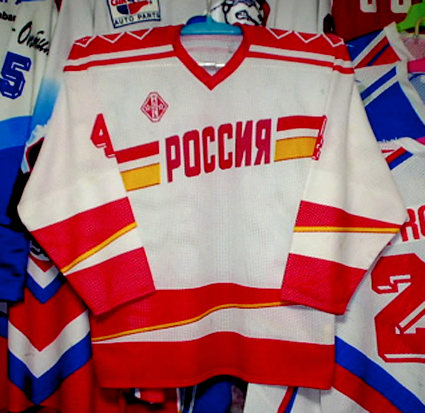
This was the one and only appearance for these stop-gap jerseys, as Russia competed in a new set of jerseys in time for the 1992 World Championships two months later in April with "Россия" now across the front in rushed, simple one color block letters rather than the fancier two color, drop shadowed letters used during the 1991 season prior to the fall of the Soviet Union.

Russia 1992 Olympics Unified Team

Today's video selection is the gold medal game from the 1992 Olympics, as the Unified Team, wearing their jerseys without any national identity, captures the gold medal against Canada, followed by a brief clip of the medal ceremony.


This next clip begins with the Unified Team's Group B game against Czechoslovakia and is of superior video quality compared to the previous clip of the gold medal game. It turned out to be their only loss of the tournament. The video continues with the Czechs playing against Sweden, Canada and finally the United States in the bronze medal game.


Thursday, January 6, 2011

2010-11 Team Canada Brayden Schenn Jersey

The Kardiac Kids (Сердечная детей) from Russia pulled off the third and most spectacular comeback of the 2011 World Junior Championship last night. Not only was it their most spectacular comeback of this year's tournament, but it was also the greatest comeback in a gold medal final in the history of the World Juniors.

Russia opened their tournament looking outgunned as they hung with Canada through two periods before Canada pulled away convincingly with three goals in the third period to win 6-3. Things did not get any easier for Russia when they gave up two first period goals to Sweden and had no answer for the Swedish defense, which held them scoreless to win 2-0, leaving Russia halfway through their Group B schedule tied with Norway at exactly zero points.

Fortunately for Russia, outmanned Norway was next on their schedule and an 8-2 win was an opportunity to get some much needed points in the standings and regain some needed confidence. With Sweden and Canada stealing the headlines with their matchup for the bye that came with winning Group B, Russia faced off against the Czech Republic to determine who would advance to the playoff round and an all-important chance to wipe their slate clean.

Russia took care of business for the second game in a row, building an 8-2 lead after two periods to escape the Preliminary Round and head into a quarterfinal matchup with the second place team in Group A, Finland.

Although Russia scored first half way through the first period, Finland equalized in the first period, added a second in the second and built their lead to 3-1 with a goal 2:24 into the third. When the Finns took their third penalty of the period with five and a half minutes remaining, Russia got the opportunity they needed. Or at least the opportunity Yevgeni Kuznetsov needed.

The Washington Capitals draft pick simply took the game into his own hands and crammed in a shot that appeared to be under the Finnish goaltender Joni Ortio. A minute later Kuznetsov skated into the Finnish zone and through the defense to put a solid shot on goal, which Ortio could not corral and Maxim Kitsyn converted the rebound into a tie score, which would last through the end of regulation.

KuznetsovFinland
Kuznetsov celebrates Russia's comeback against Finland

After trading chances, Kuznetsov received the puck from Kitsyn along the boards, cut toward the middle of the ice and fired a laser past a screening defenseman and over Ortio's shoulder to pull one out of the fire for Russia and advance them a quarterfinal rematch against Group B winner Sweden.

Russia scored the first two goals, but found themselves in peril when Sweden came back to tie the game 1:20 into the third period and scored with 3:19 remaining in the third period to put themselves in position to advance to the gold medal game. The Russians were not done, however, as Sergei Kalinin rammed in a loose puck with a dramatic diving stab with 1:27 remaining to keep the Russians alive and send the game into overtime.

The overtime settled nothing despite Sweden outshooting Russia 5-1 and the contest moved to a shootout. Denis Golubev scored on Russia's second shot and Dimitri Shikin made all three saves Russia needed to win the shootout and advance to the finals to meet Canada, who overpowered the United States 4-1.

Golubev Sweden
Golubev celebrates his shootout goal

Canada, backed by a thousands and thousands of red-clad Canadian fans from just over the border from Buffalo, opened the scoring at 4:50 with a power play goal and extended their lead at the end of the first period when Carter Ashton scored with just 13.5 seconds remaining.

Canada again had their way in the second period, holding Russia off the board and also adding to their lead when Brayden Schenn hammered a one-timer past a helpless Shikin at 6:27 to tie the Canadian record for most points in a World Junior tournament with 18 from 8 goals and 10 assists. It was to be his last point of the tournament.

And Canada's.

Shikin was pulled in favor of Igor Bobkov, who's only prior action was letting in 6 goals to Canada in their opening game of the tournament. At this point Canada had outscored Russia 6-0 over the last three periods of play against each other heading into the third period, which had all the feeling of a victory lap for Canada on their way to the gold medal.

Russia broke the shutout at 2:33 on a goal by Artemi Panarin on a wrist shot over Canadian goaltender Mark Visentin's glove to make it 3-1, but no cause for alarm. The Canadian fans sat up straight however when Russia caught everyone off guard when Kitsyn squeezed a shot through Visentin's pads to make a game of it for the first time all night.

In a development worthy of a Hollywood movie, Russian captain Vladimir Tarasenko, who had left the game in the second period after taking a hard blow from a Canadian player's shin while he was prone on the ice, took a great pass from Kuznetsov to tie the game at 7:29, their third goal in less than 5 minutes, and fully energize the Russian squad.

Tarasenko celebrates
Tarasenko gets up off the mat to take part in the shocking Russian comeback

The tables were fully turned when the Russians refused to let the Canadians repeatedly clear the zone and Tarasenko worked a perfect give-and-go with Panarin, who buried the puck deep into the back of the net for the first Russian lead with 4:16 to play.

Nikita Dvurechenski put the game out of reach when he easily scored the fifth even strength goal of the period for Russia when he easily won a race to a loose puck in the Canadian zone and put it between Visentin's legs at 18:44 to begin the Russian celebration and leave the Canadian faithful in stunned silence.

Panarin finished with two goals and Kuznetsov had three assists in the third period turnaround to lead the Russians to a shocking gold medal, completing their third consecutive come from behind victory and become the first team to win the World Juniors after losing their first two games.

Russia team photo
2011 World Junior gold medal champions Russia

Today's featured jersey is a 2010-11 Team Canada Brayden Schenn jersey. Schenn led all tournament scorers with 8 goals, 10 assists and 18 points and was named to the tournament All-Star Team, was named the Best Forward of the tournament and the tournament's Most Valuable Player. Despite all the personal awards he gathered, he came away without the one he really wanted, the gold medal.

Schenn's jersey worn in Canada's game on December 28th against the Czech Republic is currently up for bid on ebay, and had 42 bids, the highest of which is for $2,383.86 at the time of this writing.

Canada 2011 WJC jersey

Here are highlights of the gold medal game of the 2011 World Junior Championship and Russia's historic come back against Canada.


Thursday, November 4, 2010

Another World Leader Goes Under the Knife

Putin in a photo taken earlier this year
Putin wearing make-up recently

Not too long ago I blogged about North Korea's Kim Jong-Un's possible plastic surgery procedure. Rumors are now circulating that Russian Prime Minister, Vladimir Putin, may have undergone a facelift or other procedure when he was seen sporting a swollen face, black eye and tons of make-up to cover it up. Who knows? Perhaps it was the result of a judo match gone wrong.

Thursday, September 9, 2010

1991 Soviet Union Vitali Prokhorov Jersey

On this day in 1991 the end of an era arrived as the Soviet Union National Team played the final game in it's history.

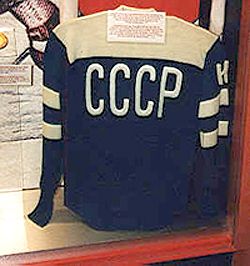
The Soviets announced their arrival on the international hockey scene in fine style (while wearing blue jerseys!), taking the gold medal home from the 1954 World Championships in their first attempt. The Soviets had only started playing ice hockey in 1946 and stunned the hockey world with their 7-2 victory over Canada in the final.

After a silver medal in the 1955 World Championships, the Soviet Union claimed it's first Olympic gold medal in 1956 with a perfect 7-0 record.

After a string of silver and bronze medals from 1957 to 1961, the era of Soviet dominance swung into high gear with ten consecutive gold medals from 1963 to 1972, which included a trio of consecutive Olympic golds in 1964, 1968 and 1972. Their run was interrupted by a silver at the 1972 World Championships before reeling off another four straight from the 1973 World Championships to the 1976 Olympics.

Five more World Championship titles followed from 1978 to 1983 and their sixth Olympic gold in eight tries in 1984. The final chapter of the Soviet National team saw them win the World Championships in 1986, the Olympics in 1988 and their final two Worlds in 1989 and 1990, the last gold medal for the Soviet Union National Team.

With the political landscape at home undergoing a historic upheaval, the Soviet Union was unsure if they would even send a team to compete in the 1991 Canada Cup, but they eventually took part. Having suffered the loss of young star Alexander Mogilny to defection and players such as Slava Fetisov, Vyacheslav Bykov, Andrei Khomutov, Pavel Bure and Vladimir Konstantinov all unavailable due to commitments with professional clubs in the NHL and Europe, Evgeny Davydov left off the squad for refusing to sign a contract with the Red Army club team, and the refusal of Latvian goaltender Arturs Irbe to play for the Soviet National Team any further for personal political reasons, the Soviets did eventually decided to field a team just a few weeks before the tournament.

The Soviets set the tone for their tournament with an opening 5-2 loss to Czechoslovakia. A 3-2 loss to Sweden followed before showing signs of life when they pounded Finland 6-1. A 2-1 loss to the United States put their participation in peril.

With one playoff round berth remaining up for grabs, Czechoslovakia, Sweden and the Soviet Union were tied at 2 points apiece with a single game remaining. Before the Soviets could even take to the ice, Sweden defeated Czechoslovakia, knocking the Soviet Union out of the upcoming playoff round.

In their final game, the best they could hope for was to deny Canada the top seed going forward. Ravil Khaidarov scored for the Soviets at 3:13 of the first, but the period ended even when Canada scored at 14:47 on the power play.

Andrei Kovalenko scored unassisted at 7:46 followed but Canada's Bill Ranford stopped Vitali Prokhorov from converting a penalty shot less than a minute to give Canada a boost by keeping the score at 2-1.

Steve Larmer evened the score for Canada at 7:15 of the third following a penalty to Soviet goaltender Mikhail Shtalenkov. Alexander Semak put the Soviet Union back on top with under seven minutes to play, but Canada's Brent Sutter tied the game with 5:18 to play.

The game would remain tied at the end, giving Canada the top spot in the Round Robin stage and bring a quiet end to the history of the Soviet Union National Team following 37 years of excellence.

From 1954 to the 1991 Worlds, the Soviet Union took home a medal in every World Championship and Olympic Games, a streak of 39 out of 40. The only time they do not appear on the podium is 1962 when they did not participate due to international politics outside of the sporting world.

In addition to the World Championships and Olympics, the Soviets won the championship in 1981, placed second in 1987 and third in 1976, lost in the semifinal in 1984 in the first four Canada Cup tournaments.

Today's featured jersey is a 1991 Soviet National Team Vitali Prokhorov jersey. This style was a huge departure from the minimalist Soviet designs of the past. Prior to the 1991 Canada Cup, the vast majority of Soviet jerseys were simple red jerseys with a few simple white stripes and one color white numbers adorned with "CCCP" across the chest in a very basic font.

Just the addition of some yellow accents and running the CCCP logo at an upwards diagonal by Tackla in recent years was considered flashy by Soviet standards.

The addition of the bold use of black, the stylized font used for the CCCP logo and the full length sleeve stripes made for an arresting look which seemed more at home in the NHL, while still retaining the intimidating look of The Big Red Machine, even if the team's roster had changed.

There was an early prototype of this jersey made with an even more arresting hammer and sickle logo, but that style was never used in competition but remains available in replica versions, and is in fact much more commonly found that the actual game version featured here.

Soviet Union 1991 jersey

Our video section today begins with a tribute to Soviet hockey history and their many successes.


Next, classic Soviet hockey footage is shown as Igor Larionov's daughters Alyonka and Diana sing Ave Maria prior to a legends game outdoors in Moscow's Red Square.