Showing posts with label Canada. Show all posts

Monday, October 10, 2011

2004 Team Canada Mario Lemieux "Winnipeg Falcons" Jersey

Although it has been an annual celebration since 1879, following a parliamentary declaration in 1957, the second Monday in October has been celebrated as Thanksgiving Day in Canada. In honor of this long standing Canadian tradition, we present the oldest Canadian National Team sweater we could find, which also happens to belong to the world's first Olympic hockey champions, dating back to 1920.

The Winnipeg Falcons were founded in 1911 with a roster of players of Icelandic decent because they were not welcomed on other teams due to racial prejudice. The Falcons orginally played until 1917 and the team was then reorganized in 1919 after a number of their players returned from service in World War I.

The Falcons were chosen to represent all of Canada at the Olympic Games by virtue of having won the Allan Cup as the 1920 Canadian National Senior Amateur Champions.

Photobucket

During the 1920 Olympics the Falcons defeated Czechoslovakia 15-0, the United States 2-0 and Sweden 12-1 to capture the gold medal.

Photobucket

On their return to Canada, they were honored with a parade, given gold pocket watches and honored with several banquets.

On April 29th, 2006 the Winnipeg Falcons were inducted into Canada's Olympic Hall of Fame and there is now an exhibit in honor of the Falcons at the MTS Center in Winnipeg.

For further reading, there are now several books available about the Falcons, When Falcons Fly, Long Shot and Falcons Gold. We also recommend WinnipegFalcons.com, which proved invaluable in researching this entry.

When the North American pool of the World Cup of Hockey began in 2004, the United States travelled to Montreal to take on Team Canada, who wore 1920 Winnipeg Falcons throwback jerseys. Team Canada won the contest by a 2-1 score on goals by Martin St. Louis and Joe Sakic. It would be the only time Team Canada's senior team would wear the Falcons jerseys.

The jerseys were worn one once more, in an exhibition game between Canada's World Junior Team and Team Finland on December 20th, 2004 at the MTS Center in Winnipeg, which ended in a 6-0 win for Canada before they would go on to dominate the 2005 World Junior Tournament in Grand Forks, North Dakota with a team that included Sidney Crosby. The full roster of players from the exhibition game can be found here.

Sidney Crosby Winnipeg Falcons
Crosby the only time he ever wore the Winnipeg Falcons jersey

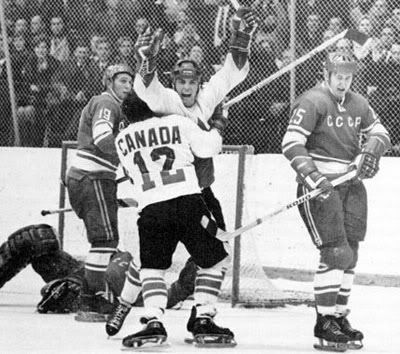
Today's featured jersey is a 2004 Team Canada Mario Lemieux "Winnipeg Falcons jersey as worn on August 31st, 2004. One unique aspect of the Falcons throwbacks is that all the jerseys had "CANADA" on the back instead of each individual player's name, similar to the 1972 Canada Cup jerseys.

The jersey also features the 2004 World Cup of Hockey logo patch on the upper left chest, along with Mario Lemieux's captain's "C".

While the Falcons normally wore blue and green "barberpole" striped jerseys, it's uncertain why the Falcons' Olympic jerseys were old gold and black, a choice of colors that proved unpopular with fans in 2004 and earned them a spot in Third String Goalie's "Curious, Weird and Ugly" Collection.

Canada Alt 2004WC F
Canada Alt 2004WC B
Canada Alt 2004WC P

Here is Team Canada in action wearing their Falcons jerseys in the 2004 World Cup of Hockey versus the United States.


Sunday, July 3, 2011

1955 Team Canada George McAvoy Jersey

July by the Numbers continues with jersey #3, a vintage Canadian National Team jersey.

From 1920 until 1952 Canada was used to having it's way at the World Championships, having won 15 titles in 18 tries, with the other three being silver medals, split between the World Championships and the Olympics, which counted as that year's World Championships during the years it was played.

Canada skipped the 1953 tournament but was back for the 1954 edition in the form of the East York Lyndhursts of Toronto. Waiting for them was a newcomer to the World Championships in the form of the Soviet Union, who had only been competing in international hockey since 1951. Both Canada and the Soviet Union had strong tournaments and entered the final game undefeated, with Canada sitting at 6-0 and the Soviets at 6-0-1, the only blemish being a 1-1 tie against Sweden.

The Soviets shocked the Canadians with a 7-2 pounding to take the World Championship in their first try.

Back in Canada, the Penticton Vees had captured the Allan Cup as the National Senior Champions of Canada, earning the right to represent Canada at the 1955 World Championships in Krefeld, West Germany, as the Canadians did not assemble a national team made up of players from all across the country, but sent the national senior championship club to represent the nation internationally at the time.

1955 world champions
The 1955 Canadian Olympic Team

The tournament began on February 25th, and both the Canadians and Soviets won easily to open their schedules, with Canada winning 12-1 over the United States while the Soviet Union won 10-2 over Finland.

Tougher competition awaited both teams the next day, but they both prevailed as the Soviets won 2-1 over Sweden while Canada defeated Czechoslovakia 5-3.

Both teams posted shutouts the next day, Canada 8-0 over Poland and the Czechs fell to their rival Soviets 4-0.

Unbelievable by today's standards, both teams played their fourth game in four days on the 28th, as the Soviet Union cruised to an 8-2 win over Poland and Canada demolished Finland 12-0 to maintain both team's perfect marks.

Following a well earned day off, both clubs hit the ice on March 2nd, Canada again winning by double digits, 11-1 over Switzerland while the Soviets shut out the Americans 3-0. March 3rd saw Canada get by the Swedes 3-0 and the Soviet Union kept pace with their 5-1 win over the host West Germans.

They swapped opponents the next day, with Canada dominating West Germany 10-1 and the Swiss falling 7-2 to the Soviets, setting up their final match for the title on March 6th with both clubs sporting perfect 7-0 records.

Canada led 1-0 after one period on a goal by Mike Shabaga before adding a pair of goals in the second by Bill Warwick on a deflection off of a stick and another goal from Shabaga.

1955 world championships

Still leery of a Soviet comeback, Canada added two more goals in the third when Warwick got his second before team captain and defenseman George McAvoy blasted one from the point to finish off the scoring to wrap up a 5-0 shutout victory by goaltender Ivan McLelland to reclaim hockey supremacy for the nation of Canada.

McAvoy handshake
Bunny Ahearne, IIHF president, congratulates the captains of both clubs, Vsevolod Bobrov of the Soviet Union and George McAvoy of the victorious Canadians following the game

Today's featured jersey is a 1955 Team Canada George McAvoy jersey as worn in the 1955 World Championships when Canada, in the form of the Penticton Vees, reclaimed Canada's status as champions of the world.

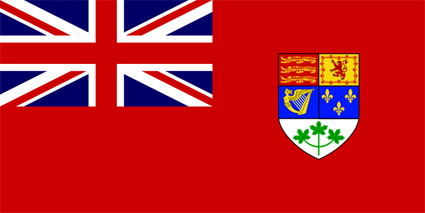
This jersey features an unusual amount of blue when compared to a modern Canadian jersey, but Canada's flag prior to 1965 did contain a Union Jack and coat of arms which did contain a fair amount of blue.

Canada 1955 jersey

Here is brief footage of a monument to the Penticton Vees featuring a quote from goaltender McLelland.


Here is action from the final game of the 1955 World Championships when Canada defeated the Soviet Union 5-0 to avenge Canada's surprising loss to the Soviets the previous year.


Friday, June 10, 2011

1990-91 New York Islanders Brent Sutter Jersey

Louis and Grace Sutter's first son Gary was born first in 1954 and chose not to pursue a hockey career. Brian, the oldest of the six to make it to the NHL arrived in 1956 and was followed by Darryl in 1958 and Duane in 1960.

Brent Sutter was born on this date in 1962 and was followed by twin brothers Rich and Ron who arrived on the scene in 1963.

The Sutter family
Louis and Grace Sutter with their seven sons

While the six younger brothers all had lengthy NHL careers, putting tiny Viking, Alberta on the map, they remember Gary as being the best skater in the bunch. Brian played 12 seasons, all with the St. Louis Blues. Darryl spent eight seasons with the Chicago Black Hawks and had his career shortened by injuries and went into coaching and is currently the general manager of the Calgary Flames. Duane spent eight years with the New York Islanders and closed out his career with three seasons in Chicago.

Brent followed the familiar Sutter path, first playing for the Red Deer Rustlers of the Alberta Junior Hockey League, and scored an amazing 171 points in 59 games prior to being drafted 17th overall in the 1980 NHL Entry Draft by the New York Islanders, who had already drafted Duane the year before. He then continued the established Sutter path of moving up to the Lethbridge Broncos of the Western Hockey League as Brian, Darryl and Duane had done before him.

He made his NHL debut in the 1980-81 season with three games with the Islanders, scoring 2 goals and 2 assists. He began the 1981-82 season between Lethbridge, scoring 46 goals and 80 points in just 34 games before getting called up to play 43 regular season games with New York, averaging a point a game in addition to racking up 114 penalty minutes, as he established himself as an NHL regular while displaying the trademark Sutter toughness. Once in the playoffs, Sutter scored 8 points in 19 games as the Islander dynasty marched on to it's third consecutive Stanley Cup championship.

Sutter played in all 80 Islander games in 1982-83 and had 21 points in 20 playoff games to earn his second Stanley Cup in a row.

1983-84 saw Sutter raise his personal goal scoring high to 34. In the playoffs, the Islanders again reach the finals and Sutter registered another 14 points in 20 games.

By far the greatest offensive season of Sutter's career arrived in 1984-85, when he reached 40 goals for the only time in his career with 42, while adding 60 assists, remarkable because it was the only time in his career he would have more than 36. His 102 points were second on the club behind only Mike Bossy's 117 and good for 10th overall in the league. It would also be the highest scoring season for any of the Sutter brothers ever and the only one to top 100 points in a season.

While he would return to Earth with 55 points the following season, it would start a run of consistency in the four subsequent seasons when Brent would score between 24 and 29 goals and 60 and 68 points each year between 1987 and 1990. He was also named as the Islanders captain from 1987-88 to 1990-91.

Duane and Brent Islanders
Duane and Brent played together for the Islanders from 1980-81 to 1986-87 - note the one color name on Duane's jersey while Brent's was two colors!

After another season on Long Island, Sutter would be traded to the Chicago Blackhawks early in the 1991-92 season. His 50 points in Chicago, combined with his 10 scored in New York, gave him 60 for the fifth time in six years and he would return to the Stanley Cup Finals for the first time since 1984. After a 20 goal, 54 point season in 1992-93, in which he was coached by his older brother Darryl, a changed role with the Blackhawks saw him limited to 9 goals and 38 points, ending a streak of at least 20 goals and 40 or more points dating back 12 years to the beginning of his professional career.

Brent would finish his career with four more seasons in Chicago, concluding at the end of the 1997-98 campaign. Although he did not score as often as he once did, he was quoted as saying, "I might not score as often as I once did but other areas of my game are better than when I was younger."

His final NHL totals were 1111 games played, 363 goals, 466 assists and 829 points as well as 1054 penalty minutes. Additionally, he played in 144 playoff games, scoring 30 goals and 44 assists for 74 points, made four trips to the finals, winning two Stanley Cups.

Internationally, Brent skated for Team Canada in the 1984 Canada Cup, contributing 4 points in eight games as Canada won the gold medal. 1985 saw him help Canada to a silver medal in the World Championships with 11 points in 8 games. Two more gold medals would follow at both the 1987 and 1991 Canada Cup tournaments, giving Brent an impressive three golds and one silver in four tries.

Rich and Ron Sutter both debuted in the 1982-83 season and played together for the Philadelphia Flyers in 1983-84 through 1985-86 and again with the St. Louis Blues in 1991-92 and 1992-93. Rich would play 13 seasons until 1995, while Ron's career spanned 19 seasons, lasting until 2001. For five seasons all six brothers played in the league at the same time, four of them became team captains and Ron's final season of 2000-01 was the 25th consecutive season a Sutter brother played in the NHL.

The Sutter display @ HHOF
The Sutter family display at the Hockey Hall of Fame

Brent is currently the head coach of the Calgary Flames.

Today's featured jersey is a CCM 1990-91 New York Islanders Brent Sutter jersey. This jersey is from Brent's final full season as an Islander while he was serving as team captain. It lacks his first initial "B", as his brother Duane had moved on to the Blackhawks by this time.

1990-91 Islanders jersey

Bonus Jersey: Today's bonus jersey is a CCM 1991 Team Canada Brent Sutter jersey. as used in the 1991 Canada Cup tournament. While the name and number of this jersey are sewn on twill, the main crest and sleeve logos are screen on, which has resulted in the cracking and wear displayed here. The 1991 Canada Cup jerseys featured the Labatt Canada Cup patch, which is sewn on the upper right chest.

1991 Canada Cup Team Canada

Here is footage of the Islanders celebrating their Stanley Cup victory in 1982, the first of Brent's career.


Here is a four part story on the Sutter brothers.


We conclude with Brent, then coach of the Devils, in a light-hearted moment talking about his mother dancing with broadcaster Chico Resch.


Monday, May 9, 2011

1989 Team Canada Steve Yzerman Jersey

Steve Yzerman, born on this date in 1965, began his international hockey career skating for Canada in the 1983 World Junior Championships wearing the unfamiliar number of 14. The tournament, played in what was then known as Leningrad, saw a Canadian lineup which featured future NHLers Dave Andreychuk, Mario Lemieux, Pat Verbeek and Mike Vernon. Yzerman finished 9th in team scoring with 2 goals and 3 assists in 7 games as Canada earned a bronze medal with a record of 4-2-1.

Yzerman Canada 1983
Yzerman in the 1983 World Juniors jersey

Following his rookie season in the NHL during which he scored 39 goals and 87 points, Yzerman would get his next opportunity to play for Team Canada in the 1984 Canada Cup, a prestigious honor for a 19-year-old considering the importance of the tournament to Canada and the stellar lineup of names they had to choose from. Yzerman, wearing #8, had an understandably smaller role with the squad, appearing in just four of the eight games and was held without a point. Still, it was a great experience to be on a team with the greatest players in Canada at the time.

Yzerman Canada 1984
Yzerman on the left, next to Michel Goulet and Randy Gregg during the 1984 Canada Cup

With Detroit at the end of the "Dead Wings" period, where they missed the playoffs 15 of the previous 18 seasons, Detroit did qualify for the 1985 Stanley Cup playoffs, but their quick first round exit freed Yzerman up to join Team Canada for the World Championships for the first time.

Now wearing his familiar #19, Yzerman scored 3 goals and 7 points in 10 games, 6th on the team, as Canada with an overall record of 6-3-1 and took home a silver medal.

Detroit began to show long-waited improvement and began to regularly qualify for the NHL playoffs, which delayed Yzerman's next appearance for Canada until the 1989 World Championships in Sweden. Now established as an NHL captain since 1986, was also named as one of three Canadian captains, along with Dale Hawerchuk and Kirk Muller. Yzerman was limited to just eight of Canada's ten games but still came second in scoring with 5 goals and 12 points. After a preliminary round record of 5-2 to advance to the final round, Canada beat Sweden, lost to Russia and then beat Czechoslovakia to earn another silver medal.

A setback in Detroit in 1989-90 meant the Red Wings missed the playoffs, which made Yzerman once again available for World Championship duties. Again named team captain, along with defenseman Paul Coffey, led Canada through the preliminary round undefeated with a record of 6-0-1. The Final Round saw a complete reversal of fortune, as Canada lost to the Czechs, the Soviets and the Swedes to fall flat and miss out on the medals. Yzerman led the team in scoring with 10 goals and 20 points in 10 games, an average of two points per game.

It would prove to be Yzerman's final World Championship, mainly due to the rise of the Red Wings, who qualified for the Stanley Cup playoffs in 1991, beginning a streak which would last for the remainder of his NHL career through 2006.

When the World Cup of Hockey debuted in 1996 prior to the start of the NHL regular season, Yzerman was free to participate, and scored a pair of goals and an assist in six of Canada's eight games.

Yzerman Canada 1996
Yzerman during the 1996 World Cup of Hockey

With the rules changed and the NHL now agreeing to suspend it's regular season to allow the best NHL players to participate in the Olympics, Yzerman's next Team Canada appearance came in Nagano, Japan in 1998. Canada went 3-0 in the Preliminary Round and defeated Kazakhstan before losing to both eventual champions the Czech Republic in a shootout and then Finland to finish just short of a medal. Yzerman finished with 2 points in 6 games.

Yzerman Canada 1988
Yzerman's first Olympic experience came in the 1998 games in Japan

The final international opportunity of Yzerman's career came with the 2002 Olympics in Salt Lake City. It all came right for Canada as they won their first Olympic gold medal in 50 years by defeating the United States 5-2 in the final. During the tournament Yzerman tied for second in Canadian scoring with 2 goals and 6 points, one back of Joe Sakic, which tied him for 5th in tournament scoring.

Yzerman Canada 2002
Yzerman in the gorgeous throwback jersey worn by Canada in their opening game against Sweden

When he announced in 2005 that he would not be going to participate in the 2006 games in Italy, Wayne Gretzky announced that no Canadian player would be allowed to wear Yzerman's #19, a roster which included regular wearers of #19 in the NHL Shane Doan (who wore #9 in Italy), Brad Richards (#39), Joe Sakic (#91), Jason Spezza (#10) and Joe Thornton (#97).

Yzerman himself, in his role as Executive Director of Team Canada for the 2010 Olympics, unretired #19 which was worn by Thornton.

With 57 games played, Yzerman's international carer concluded with 25 goals and 55 points, a bronze medal, two silvers and a pair of gold medals.

Today's featured jersey is a 1989 Team Canada Steve Yzerman jersey as worn in the 1989 World Championships when Canada won the silver medal. Yzerman also wore the same jersey in the 1990 World Championships when he led Canada with 20 points in 10 games.

Of note, Canada was also scheduled to wear this same style jersey made by Tackla in the 1988 Olympic games in Calgary but defied the contract the Olympic organizers had with Tackla to supply all the jerseys, opting to wear the same design produced by the Canadian manufacturer CCM instead, which earned them a $100,000 fine for their actions.

Canada 1989 #19 F
Canada 1989 #19 B

Today's video section is highlights of Yzerman and Team Canada winning the gold medal at the 2002 Olympics.


Friday, May 6, 2011

2005 Team Canada Martin Brodeur Jersey

Born on this date in 1972, Martin Brodeur followed in his father's footsteps and began his international hockey career at the 1996 World Championships, seeing action in three games and posting a record of 0-1-1 as Canada won the silver medal.

Brodeur Canada
Dennis Brodeur in goal for Canada during the 1956 Olympics

Later that same year he played for Canada in the inaugural World Cup of Hockey, playing in a pair of games with a record of 0-1-0.

Brodeur Canada
Brodeur wearing the unfamiliar #1 during the 1996 World Cup of Hockey due to Bill Ranford wearing #30

Internationally, Brodeur was a next member of the 1998 Canadian Olympic team in Nagano, Japan, but did not see any game action during the tournament.

Brodeur Canada
Brodeur wearing the 1998 Team Canada Olympic jersey

When the Olympics arrived again four years later in 2002, following an opening game loss for the Canadians, Brodeur became the starting goaltender for the Canadians as they beat Germany and tied the Czech Republic before getting on a roll in the Final Round, where they defeated Finland 2-1, destroyed Belarus 7-1 and captured the gold medal, Canada's first in fifty years, with a 5-2 defeat of the United States.

Brodeur Canada
Brodeur celebrates Canada's first gold medal in 50 years

Brodeur was again Canada's number one goaltender for the 2004 World Cup of Hockey, leading them to the championship with a 5-0 record and victories over the United States, Slovakia, Russia, Slovakia again and Finland in the championship final.

Brodeur Canada
Canada began the 2004 World Cup by wearing the 1920 Winnipeg Falcons throwbacks

Brodeur Canada
Brodeur lifts the 2004 World Cup trophy

Thanks to the 2004-05 NHL season being lost due to the lockout, Brodeur was available to play for Canada in the 2005 World Championships, an event he had not competed in for nine years due to his annual NHL playoff responsibilities with the New Jersey Devils. Brodeur put up a 5-2 record in 7 starts for Canada, defeating Latvia and the United States in Group B play, a loss to Sweden and a narrow 2-1 win over Ukraine in Group F before eliminating Slovakia in the quarterfinals and Russia in the semi-finals before losing 3-0 to the Czech Republic in the gold medal game, leaving Canada with the silver.

Brodeur Canada
Brodeur wearing the same jerseys as the 2004 World Cup, but with the addition of sponsorship patches on the shoulders, a regular feature of jerseys worn during the World Championships

Brodeur was once more back on Olympic ice, this time in 2006 in Torinio, Italy. Canada began the tournament in good form, defeating Italy 7-2 with Brodeur in goal before defeating Germany 5-1. Brodeur was back in net for the surprising 2-0 upset at the hands of Switzerland. Canada next lost a second consecutive game to Finland before Brodeur got Canada back on track with a 3-2 defeat of the Czech Republic to finish Group A in third place. Canada's tournament ended in the quarterfinals with Broduer in goal, as they lost to Russia 2-0. Brodeur finished his tournament with a 2-2 record in four starts, as Canada failed to score a single goal in both of Brodeur's losses.

Brodeur Canada
Brodeur wearing Nike's new Swift jersey at the 2006 Olympics

His most recent international experience came in the 2010 Olympics in Vancouver. Brodeur was in goal for Canada's 3-2 shootout win over Switzerland, avoiding a repeat of their 2006 upset at the hands of the Swiss. They then lost 5-3 in a scintillating game against the United States. Seeking a change after their lackluster group play, Canada went with Broduer's several time international backup Roberto Luongo (2004 World Cup of Hockey, 2005 World Championships and 2006 Olympics), who guided Canada to another Olympic gold medal, Brodeur's second.

Brodeur Canada
Brodeur and Luongo after receiving their gold medals in 2010

Brodeur's record in senior international games now stands at 29 games played, 17 wins, 7 losses and 2 tiesand a goals against average of 2.25, two World Championship silver medals, a World Cup championship and a pair of Olympic gold medals.

Today's featured jersey is a 2005 Team Canada Martin Brodeur jersey as worn by Brodeur in the 2005 World Championships which took place during the NHL lockout season of 2004-05. Brodeur traditionally has been competing in the Stanley Cup playoffs since first breaking into the NHL, as the Devils have made the playoffs ever year of Brodeur's lengthy NHL career, save for 1995-96, the only other time he competed in the World Championships.

This jersey features the traditional sponsorship patches on the shoulders as seen during the World Championships.

Canada 2005 WC F
Canada 2005 WC B
Canada 2005 WC P1

Here, Broduer speaks during in advance of the 2010 Olympics in Vancouver.


Wednesday, April 20, 2011

1991 Team Canada Steve Larmer Jersey

Beginning his junior career with his hometown Peterborough Petes in 1977-78, Steve Larmer then became a member of the Niagara Falls Flyers for the 1978-79 season. He more than doubled his 41 points from the previous season with 84. That total jumped to 114 in 1979-80 after which Larmer was drafted in the 6th round by the Chicago Black Hawks. He returned for one final season with Niagara Falls during which he scored 55 goals and 133 points.

At the conclusion of the Flyers season, Larmer made his NHL debut with the Black Hawks for four games at the end of the season, scoring his first NHL point with an assist. Chicago assigned him to the New Brunswick Hawks of the AHL where he averaged more than a point per game with 82 in 74 games, good for second on the club. New Brunswick would not only win their division, but defeat Adirondack, Nova Scotia and Binghamton on their way to the Calder Cup championship. Additionally, Chicago called him up for three NHL games during the season.

Larmer Blackhawks 91

For the 1982-83 season, Larmer made the Black Hawks roster out of training camp and immediately established himself as an NHL regular, playing in all 80 of Chicago's games on a line with Denis Savard and Al Secord, which led to him scoring an impressive 43 goals and 90 points on his way to being named the recipient of that season's Calder Trophy.

The following season Larmer again played in all 80 games for Chicago, a feat he duplicated again and again and again over the course of five seasons as his consecutive games streak reached 400, all the while producing an amazingly consistent offensive output, as his point totals were always between 75 and 90 points each of those seasons.

His games played streak continued to march on unabated as well as his offensive production. Now named one of Chicago's assistant captains, he narrowly missed equalling his career best of 90 points with 89 in 1987-88, and after scoring 87 the next season reached 90 once more in 1989-90 thanks in part to a career best 59 assists as his consecutive games streak now reached 640. During the playoffs, his eight consecutive postseason in a row, Larmer tied for the team lead in scoring with 22 in 20 games as the Blackhawks reached the conference finals. (Of note, Chicago formally changed their name from "Black Hawks" to "Blackhawks" with the start of the 1986-87 season.)

Showing no signs of slowing down, Larmer set a career high with 101 points in 1990-91 to lead Chicago in scoring for the third consecutive season as he registered second highest goal total of his career with 44, just two back of the 46 he tallied in 1984-85, as well as 57 assists.

Following Chicago's early exit from the playoffs, Larmer skated for Team Canada at the 1991 World Championships, scoring 8 points in 19 games. Later that same year, he competed for Canada again at the 1991 Canada Cup tournament in August prior to the start of the NHL season where he led all players in goals scored with 6, including the game winner in the decisive final game, and finished second in points with 11 in eight games.

Larmer Canada

Over the course of the next two years, Larmer extended his games played streak by playing in all 80 of Chicago's games in 1991-92 despite losing 16 pounds due to an ulcer, and then 84 in 1992-93 thanks to a newly expanded schedule which included the short-lived experiment of teams playing a pair of regular season neutral site games. It was the highest scoring regular season in NHL history at the time, but the Blackhawks were one of only two teams to allow less than three goals per game, thanks in part to Larmer's noteworthy defensive contributions.

Larmer Blackhawks 92

After 13 seasons with Chicago, including playing in every game for 11 consecutive seasons, 884 games in a row, Larmer sat out training camp in 1993, demanding a trade from Chicago, citing a need for a "change of scenery", and threatened to retire if a trade was not worked out.

Eventually, after missing the first month of the season and ending his streak 30 games behind second place Gary Unger and 80 behind record holder Doug Jarvis, Larmer was traded to the New York Rangers in early Novemer. At the time of his departure from Chicago, Larmer ranked #3 all time in goals, #5 in assists and #4 in points.

Playing in his first game the day after the trade, Larmer scored his first goal as a Ranger. In early January, Larmer missed the first games of his career due to injury, sitting out three games with a broken hand. In all, he competed in 68 games for the Rangers and contributed 60 points. During the playoffs, his 12th of 13 consecutive years in the playoffs, he was a solid contributor to the Rangers eventual Stanley Cup championship, the first of his career and the Rangers first in 54 years.

Rangers 1993-1994

In the lockout shortened 1994-95 season, milestones arrived in the form of his 1,000th NHL point on March 8 and his 1,000th NHL game on this date in 1995. He would finish the season with 1,006 games played, 441 goals and 571 assists for 1,012 points prior to retiring due to chronic back pain.

Larmer Rangers

Today's featured jersey is a 1991 Team Canada Steve Larmer jersey as worn during the 1991 Canada Cup, one of only two appearances for Larmer for Team Canada during his career, both of which came during a four month span in 1991, which resulted in a silver followed by a gold medal.

The half maple leaf design of the jersey mimics the shape of the Canada Cup trophy, which clearly was not a "cup" in the traditional sense like the NHL's Stanley Cup.

Canada 91 jersey

Bonus Jersey: Today's bonus jersey is a 1981-82 New Brunswick Hawks Steve Larmer jersey from the only minor league season of Larmer's entire career during which his club captured the league championship.

The jersey follows the design of the Toronto Maple Leafs jerseys of the time period, down to the Maple Leaf logos on the shoulder, as the Hawks shared their affiliation with both the Maple Leafs, who inspired their look, and the Black Hawks, who provided the inspiration for their name in a unique combined identity.

The franchise existed from 1978 to 1987, which included two name changes.

New Brunswick Hawks 81-82 jersey

Today's videos begin with the conclusion of the 1991 Canada Cup. Larmer scored the game winning goal and was MVP of the game.


Another highlight of Larmer's career was Larmer's Stanley Cup championship in 1994 with the Rangers.


Saturday, March 12, 2011

2007 Team Canada Kirby Law Jersey

Not every player can enjoy a career like that of Steve Yzerman, who played 22 seasons with just one club, yet there are many players who carve out long careers in hockey yet are virtually unknown to many. One such player is Kirby Law, who was born on this date in 1977.

Law, a winger, began his junior hockey career at the age of 16 with the Saskatoon Blades of the Western Hockey League in 1993-94. His second season saw him play 46 games with Saskatoon before joining the Lethbridge Hurricanes for the final 24 games of the season. He returned to Lethbridge for two more years and in 1996-97 averaged more than a point per game for the first time with 39 goals and 52 assists for 91 points, as well as 200 penalty minutes, in 91 games. Law also scored 18 points in 19 playoff contests as Lethbridge advanced all the way to the Memorial Cup Final.

He was traded to the Brandon Wheat Kings prior to the start of the 1997-98 season where he played an injury shortened 49 game season, but still put up impressive averages, scoring 34 goals and 44 assists for 78 points and 153 penalty minutes in the rough Western League.

Undrafted by the NHL, Law found employment with the Orlando Solar Bears of the International Hockey League for the 1998-99 season, where he played 67 games before joining the Adirondack Red Wings of the American Hockey League for 11 regular season games and the first round of their playoffs.

That summer Law was signed as a free agent by the Atlanta Thrashers and played the majority of the year with the short-lived Louisville Panthers of the AHL. His rights were traded by Atlanta to the Philadelphia Flyers who assigned Law to their top minor league affiliate, the Philadelphia Phantoms of the AHL for the remainder of the season.

He finished the next season fourth in scoring for the Phantoms with 61 points in 78 games and continued to play his usual rough and rugged style so common in WHL graduates with 150 penalty minutes. He also had the thrill of making his NHL debut with the Philadelphia Flyers when he was called up for a single game.

The pattern was now set, as Law played 71 games for the Phantoms without a call-up in 2001-02, 74 games in the AHL and two games for the Flyers in 2002-03 and 74 games for the Phantoms, scoring 73 points in 74 games, and six games for the Flyers, which included an assist, Law's first and only NHL point, in 2003-04 season.

Law Flyers

Law was then signed by the Minnesota Wild organization and assigned to the Houston Aeros of the AHL. With the NHL season cancelled that season, there was no possibility of a call-up.

While Law finished the season with 49 points in 80 games in 2004-05, his offensive game exploded the next season as he scored 43 goals, his first season of 40 goals or more at any level. Additionally, he was credited with 67 assists for 110 points to earn the Aeros team captain captured the Sollenberger Trophy as the leading scorer in the AHL.

Law Aeros

Despite leading the AHL in scoring, it was not enough to earn even a single game with the offensively challenged Wild (24th out of 30 in NHL scoring). Law then began the European phase of his career when he joined Geneve Servette Eagles of the Swiss National League A for 2006-07. He returned to Servette for a second season and averaged more than a point per game his two seasons with the club, 91 in 80 games over the two seasons.

Law Geneve

He moved even farther east in 2008-09 with ten games in the Kontinental Hockey League for Nizhnekamsk Neftekhimik before returning to Switzerland and joining HC Fribourg-Gotteron for the reminder of the season.

Law Fribourg

2009-10 was yet another new club for Law, HC Ambri Piotta, also of the Swiss NLA.

Law Ambri Piotta

Despite only registering a single NHL point during his career, Law has played 1,165 games, scoring 409 goals and 546 assists for 955 points and 1,852 penalty minutes.

While playing in Switzerland in 2007-08, Law was named as a member of Team Canada for the annual Spengler Cup tournament, held annually between Christmas and New Year Eve since 1923, which featured not only Team Canada, mainly comprised of Canadians playing professionally in Europe each season, but club teams from the Czech Republic, Germany, Russia and the hosts HC Davos. During their four games in the round robin portion of the competition, Canada won 3 in regulation and another in overtime to finish first and qualify for the finals against HC Salavaat Yulaev Ufa of the KHL, whom Canada defeated 2-1, with Law scoring the first goal for Canada 7 minutes into the second period to help Canada earn their first Spengler Cup since 2003.

Law Canada

Today's featured jersey is a 2007 Team Canada Kirby Law jersey as worn during the Spengler Cup tournament. Canada's Spengler Cup jerseys regularly feature the "speeding leaf within a leaf" logo, which has otherwise not been used on Canadian jerseys since 1995 when the black and red Hockey Canada logo with the silhouette of a player was first introduced.

Team Canada 2007 Spengler Cup jersey

Today's video segment has Law earning some of his many penalty minutes while with the Phantoms in the AHL.


Monday, February 28, 2011

2010 Team Canada Sidney Crosby Jersey

After their failure to medal at the 2006 Olympics, there could not have been more pressure on Canada to win gold as hosts of the 2010 Olympics in Vancouver.

The 12 teams in the tournament were divided into three groups of four teams each based on their IIHF World Rankings. Following the completion of group play, the group winners, plus the fourth ranked team, were given byes into the quarterfinals where they would await the winners of elimination games among the eight remaining teams.

Group A was won by the United States following an exciting 5-3 win for the Americans what was in doubt until the final minute before an empty net goal provided the final margin.

Hard fought Group B belonged to Russia while defending gold medalists Sweden went undefeated in Group C. Finland advanced as the fourth ranked team with 6 points in their group, the same as the Czech Republic, but earned the bye thanks to a better goal differential thanks to big wins over Belarus and Germany.

In the Elimination Round, Switzerland defeated Belarus 3-2 in overtime, the Czech Republic downed feisty Latvia 3-2, also in overtime, Slovakia beat plucky Norway 4-3 and Canada dominated Germany 8-2.

The Quarterfinals had the United States advancing with a 2-0 win over the Swiss, Finland shutout the Czechs 2-0, Slovakia upset Sweden 4-3 to end their hopes of a repeat and Canada dominated Russia 7-3.

The Semifinals paired the United States with Finland and Canada and Slovakia. In the first game, the United States streaked out to a shocking 6-0 lead a little over half way through the first period on their way to a 6-1 win and a place in the final.

Canada got two first period goals by Patrick Marleau and Brendan Morrow and then at 16:54 of the second period Ryan Getzlaf's goal gave the Canadians a 3-0 lead, which was enough to defeat the Slovaks, who scored two goals three and a half minutes apart midway through the third period to make for a tense finish. Canada was able to hold on to earn a rematch with the United States in the final with gold on the line at home and on an NHL sized ice sheet.

2010 Olympics in Canada

The dream matchup between the two North American rivals was a tense affair with both teams getting their chances to score until Jonathan Toews beat US goalie Ryan Miller on the short side to take a 1-0 lead at 12:50 of the first, the only goal of the period and the first time the United States had trailed in a game the entire tournament.

Toews goal
Jonathan Toews opens the scoring for Canada

The second period was more of the same, with hard hits, great saves and little scoring as the tension in the arena rose. Finally Corey Perry coming down the slot fired a loose puck past Miller for a 2-0 Canadian lead at 7:13.

Perry goal
Corey Perry puts Canada up by two

The Americans responded with a goal from Ryan Kesler that squeaked between Roberto Lunogo's body and arm at 12:44. The remainder of the second period was played even, as the shots on goal finished at 15-15.

Kesler goal
Ryan Kesler's goal gets the US on the board

Again, the third period wore on as the two teams punched and counterpunched, yet both failed to yield a goal. With no penalties called, waiting for a power play proved futile. With time running out and desperation setting in, the United States pulled Miller from their goal with 1:27 remaining for an extra attacker. With time now running out on the Americans, Patrick Kane hurled the puck at the Vancouver goal. It bounced off of Lunongo and was banged in by Zach Parise with 25 seconds remaining to send the game into overtime.

Pairse celebrates
Parise's late goal puts the party on hold and gives the US hope of stealing the gold

After seven minutes of play, during which many hoped someone, anyone, would score as to avoid having the gold medal decided by a shootout, Canada was leading 6-4 in shots, Jarome Iginla passed the puck off the boards to Sidney Crosby, who had a clear path to the goal. He took a few strides before shooting the puck, which went under Miller's pads before he could close the gap, ending one of the most memorable games in the history of the sport.

Crobsy golden goal
Crosby beats Miller to win gold

The goal sent the arena, and all of Canada, into a delirious celebration.

Crosby celebrates golden goal
Crosby begins the celebration of his golden goal

The gold medal was the eighth for Canada and their second in three tries after a 50 year drought.

Canada gold medals
Canada poses for a team picture after receiving their gold medals

Today's featured jersey is a 2010 Team Canada Sidney Crosby jersey as worn during the gold medal final in which Crosby scored the gold medal winning goal in overtime. Crosby had worn the assistant captain's "A" earlier in the tournament but for the final it was worn by Iginla and Chris Pronger.

With the ruling that countries could not carry the logos of their national organizations as their main crest, the usual Hockey Canada logo was replaced by a maple leaf which contained an intricate design full of symbols of Canadian culture and heritage, including an eagle, thunderbird, moose, beaver, maple leafs representing past gold medals and fleur-de-lis as well as a hockey player.

This jersey was a big improvement over the Nike Swift jerseys introduced in 2006 where each team wore essentially the exact same jersey only with their countries colors changed. By 2010, the designs began to diverge, with each country having it's own unique designs once again, although with certain elements shared, which is natural when they all come from the same source.

Canada 2010 F
Canada 2010 B

This jersey is adorned with several logos, including the Vancouver 2010 Olympic logo on the left sleeve, the controversial Hockey Canada logo on the right sleeve and finally the Canadian Olympic Committee logo on the bottom right of the back of the jersey in the location formerly occupied by the IIHF logo.

Canada 2010 P1aaaCanada 2010 P2aaaCanada 2010 P3

Today's video selections begin with the Top 10 plays of the tournament, followed by highlights from the gold medal final.