Showing posts with label Yzerman. Show all posts

Monday, May 9, 2011

1989 Team Canada Steve Yzerman Jersey

Steve Yzerman, born on this date in 1965, began his international hockey career skating for Canada in the 1983 World Junior Championships wearing the unfamiliar number of 14. The tournament, played in what was then known as Leningrad, saw a Canadian lineup which featured future NHLers Dave Andreychuk, Mario Lemieux, Pat Verbeek and Mike Vernon. Yzerman finished 9th in team scoring with 2 goals and 3 assists in 7 games as Canada earned a bronze medal with a record of 4-2-1.

Yzerman Canada 1983
Yzerman in the 1983 World Juniors jersey

Following his rookie season in the NHL during which he scored 39 goals and 87 points, Yzerman would get his next opportunity to play for Team Canada in the 1984 Canada Cup, a prestigious honor for a 19-year-old considering the importance of the tournament to Canada and the stellar lineup of names they had to choose from. Yzerman, wearing #8, had an understandably smaller role with the squad, appearing in just four of the eight games and was held without a point. Still, it was a great experience to be on a team with the greatest players in Canada at the time.

Yzerman Canada 1984
Yzerman on the left, next to Michel Goulet and Randy Gregg during the 1984 Canada Cup

With Detroit at the end of the "Dead Wings" period, where they missed the playoffs 15 of the previous 18 seasons, Detroit did qualify for the 1985 Stanley Cup playoffs, but their quick first round exit freed Yzerman up to join Team Canada for the World Championships for the first time.

Now wearing his familiar #19, Yzerman scored 3 goals and 7 points in 10 games, 6th on the team, as Canada with an overall record of 6-3-1 and took home a silver medal.

Detroit began to show long-waited improvement and began to regularly qualify for the NHL playoffs, which delayed Yzerman's next appearance for Canada until the 1989 World Championships in Sweden. Now established as an NHL captain since 1986, was also named as one of three Canadian captains, along with Dale Hawerchuk and Kirk Muller. Yzerman was limited to just eight of Canada's ten games but still came second in scoring with 5 goals and 12 points. After a preliminary round record of 5-2 to advance to the final round, Canada beat Sweden, lost to Russia and then beat Czechoslovakia to earn another silver medal.

A setback in Detroit in 1989-90 meant the Red Wings missed the playoffs, which made Yzerman once again available for World Championship duties. Again named team captain, along with defenseman Paul Coffey, led Canada through the preliminary round undefeated with a record of 6-0-1. The Final Round saw a complete reversal of fortune, as Canada lost to the Czechs, the Soviets and the Swedes to fall flat and miss out on the medals. Yzerman led the team in scoring with 10 goals and 20 points in 10 games, an average of two points per game.

It would prove to be Yzerman's final World Championship, mainly due to the rise of the Red Wings, who qualified for the Stanley Cup playoffs in 1991, beginning a streak which would last for the remainder of his NHL career through 2006.

When the World Cup of Hockey debuted in 1996 prior to the start of the NHL regular season, Yzerman was free to participate, and scored a pair of goals and an assist in six of Canada's eight games.

Yzerman Canada 1996
Yzerman during the 1996 World Cup of Hockey

With the rules changed and the NHL now agreeing to suspend it's regular season to allow the best NHL players to participate in the Olympics, Yzerman's next Team Canada appearance came in Nagano, Japan in 1998. Canada went 3-0 in the Preliminary Round and defeated Kazakhstan before losing to both eventual champions the Czech Republic in a shootout and then Finland to finish just short of a medal. Yzerman finished with 2 points in 6 games.

Yzerman Canada 1988
Yzerman's first Olympic experience came in the 1998 games in Japan

The final international opportunity of Yzerman's career came with the 2002 Olympics in Salt Lake City. It all came right for Canada as they won their first Olympic gold medal in 50 years by defeating the United States 5-2 in the final. During the tournament Yzerman tied for second in Canadian scoring with 2 goals and 6 points, one back of Joe Sakic, which tied him for 5th in tournament scoring.

Yzerman Canada 2002
Yzerman in the gorgeous throwback jersey worn by Canada in their opening game against Sweden

When he announced in 2005 that he would not be going to participate in the 2006 games in Italy, Wayne Gretzky announced that no Canadian player would be allowed to wear Yzerman's #19, a roster which included regular wearers of #19 in the NHL Shane Doan (who wore #9 in Italy), Brad Richards (#39), Joe Sakic (#91), Jason Spezza (#10) and Joe Thornton (#97).

Yzerman himself, in his role as Executive Director of Team Canada for the 2010 Olympics, unretired #19 which was worn by Thornton.

With 57 games played, Yzerman's international carer concluded with 25 goals and 55 points, a bronze medal, two silvers and a pair of gold medals.

Today's featured jersey is a 1989 Team Canada Steve Yzerman jersey as worn in the 1989 World Championships when Canada won the silver medal. Yzerman also wore the same jersey in the 1990 World Championships when he led Canada with 20 points in 10 games.

Of note, Canada was also scheduled to wear this same style jersey made by Tackla in the 1988 Olympic games in Calgary but defied the contract the Olympic organizers had with Tackla to supply all the jerseys, opting to wear the same design produced by the Canadian manufacturer CCM instead, which earned them a $100,000 fine for their actions.

Canada 1989 #19 F
Canada 1989 #19 B

Today's video section is highlights of Yzerman and Team Canada winning the gold medal at the 2002 Olympics.


Monday, November 22, 2010

1991-92 Detroit Red Wings Steve Yzerman Jersey

On this date in 1927, the Detroit Olympia hosted it's first NHL contest when the Detroit Cougars welcomed the Ottawa Senators in front of a standing room crowd of 14,000 fans as Johnny Sheppard of the Cougars scored the first goal in the history of the arena only to have the Senators come back for a 2-1 win.

Detroit Olympia Stadium

The arena was built at a cost of $1.3 million with a seated capacity of 11,563 with room for another 5,000 standing room patrons. The Victoria Cougars of the WHL were purchased by Charles Hughes, a member of the Detroit Athletic Club and played their first season across the Detriot River in Windsor, Ontario prior to moving into the brand new Olympia for the 1927-28 season.

Detroit_Cougars_1927-28
The 1927-28 Detroit Cougars

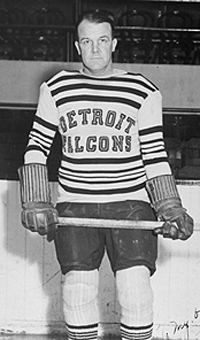
The Cougars would later change their name to first the Falcons in 1930 and then the Red Wings in 1932, but would remain tenants of the Olympia, nicknamed "The Old Red Barn", until December 15, 1979, a span of 52 years. While calling the Olympia home, the Red Wings would win the Stanley Cup seven times in 1936 and 1937, 1943 and, led by "The Production Line" of Sid Abel, Ted Lindsay and Gordie Howe, in 1950 and 1952. Alex Delvecchio replaced Abel in 1952 and the Red Wings would win two more Stanley Cups in 1954 and 1955.

1950 Stanley Cup Lumley and Babando
Harry Lumley and Pete Babando celebrate Babando's Game 7 double overtime cup winning goal in 1950 at the Olympia

As defending champions, the Red Wings would host the NHL All-Star Game at the Olympia four times in 1950, 1952, 1954 and 1955.

In addition to the Red Wings, the Detroit Olympics played minor league hockey at the Olympia from 1927 to 1936, which included winning the Calder Cup as champions of the International Hockey League in 1935 and 1936. Despite winning the championship in 1936, the Olympics would move to Pittsburgh the very next season to become the Hornets.

Detroit Olympics Jersey
A Detroit Olympics jersey, handed down from the Cougars

The NCAA college hockey Frozen Four was also held near the end of the Olympia's run in 1977 and 1979.

The Detroit Pistons of the NBA spent four seasons at the Olympia which included hosting the NBA All-Star game in 1959.

In addition to hockey and basketball, the Olympia was a major venue for boxing as well as wrestling, ice shows and concerts, which included The Beatles, Elvis Presley, The Rolling Stones and Frank Sanatra.

Beatles Olympia ticket
A ticket from The Beatles 1964 concert at the Olympia. Note the $5 price!

At the end of the Olympia's run as home of the Red Wings, it had become the smallest building in the NHL. Once the Red Wings moved to Joe Louis Arena, the final hockey game at the Olympia was a Red Wings old timers game on February 21, 1980 to commemorate the arena, which was torn down in July of 1986.

Olympia farewell

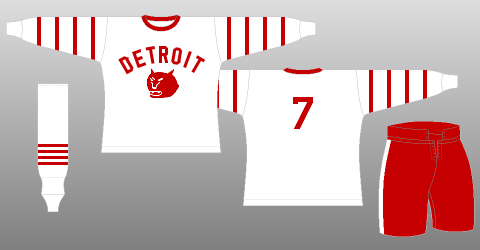
Today's featured jersey is a 1991-92 Detroit Red Wings Steve Yzerman jersey. To celebrate the NHL's 75th anniversary, the Original 6 clubs all wore throwback jerseys to mark the occasion, with the Red Wings wearing the jerseys worn by the 1927-28 Detroit Cougars.

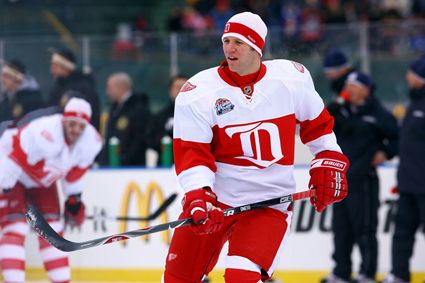
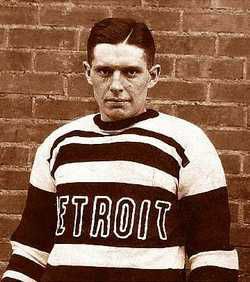
After wearing a jersey with an old English "D" on the front for their first season, which was revived for the 2009 Winter Classic, the Cougars changed to the original version of today's featured jersey for their inaugural season in the Olympia of 1927-28. This style lasted only one season before being replaced by a white jersey with a cougar head below the word "Detroit" for one season prior to a return to the 1927-28 template for 1929-30, only now with the word "Detroit" on the front in red outlined in white. The jerseys changed once again for 1930-31 to a similarly designed white jersey with multiple horizontal red stripes with "Detroit Falcons" in yellow outlined in red for two seasons, giving the club two names and five different jerseys in six seasons.

All that would change in 1932 when the team adopted the name "Red Wings" and wore a solid red jersey with simple white stripes around each arm and around the waist, which has remained essentially unchanged for nearly 80 years.

Detroit Red Wings 91-92 TBTC F
Detroit Red Wings 91-92 TBTC B

In today's video section, here are highlights of Game 7 of the 1950 Stanley Cup Finals played at the Olympia.


Once more the Stanley Cup Finals comes down to Game 7 at the Olympia, where the Red Wings again prevailed.


Our final video todays is a melodramatic photo tribute to the Detroit Olympia.


Sunday, May 9, 2010

1997-98 Detroit Red Wings Steve Yzerman Jersey

Steve Yzerman, born on this date in 1965, first joined the Red Wings in 1983 after being drafted fourth overall in the 1983 NHL Entry Draft. At the time, the "Dead Wings" were lost in the hockey wilderness, having missed the playoffs 15 of the previous 17 seasons, dating back to the 1966-67 season. After the arrival of Yzerman, the Red Wings qualified for the playoffs in 20 of Yzerman's 22 seasons in the NHL.

His arrival coincided with a change in ownership for the Red Wings, as Mike and Marian Illitch had purchased the franchise in the summer of 1982.

Yzerman scored 39 goals and 87 points in his rookie season, played in his first of 10 NHL All-Star Games and got his first taste of playoff experience as the Red Wings were eliminated by the St. Louis Blues in the first round 3 games to 1.

Prior to the 1986-87 season, Detroit coach Jacques Demers named Yzerman captain of the Red Wings, making him the youngest captain in team history. Yzerman would respond with his third 30 goal season and the Red Wings would reach the third round of the playoffs that season, their deepest run into the playoffs since reaching the finals back in 1966.

His offensive production began to take off during this time period when Yzerman hit the 50 goal mark, as well as topping the 100 points, for the first time in 1987-88. It would be the first of six consecutive seasons with 45 goals or more for Yzerman. The playoffs would see another deep run by the Red Wings, as they once again reached the conference finals for the second year in a row.

The 1988-89 season would see Yzerman reach the pinnacle of his offensive numbers, with 65 goals and 90 assists for 155 points, all career highs and still Red Wings records, as well as being named the winner of the Lester Pearson Award.

The following seasons would see goal totals of 62, 51, 45 and 58 in 1992-93 when he also had 79 assists for 137 points, the second highest season point total of his career. His 65, 62 and 58 goal seasons are the top three in franchise history. Despite the personal success, the Red Wings would fail to advance past the second round of the playoffs from 1989 to 1993.

All that changed with the arrival of new Red Wings coach Scotty Bowman in 1993, who had already won five Stanley Cups with the Montreal Canadiens and one with the Pittsburgh Penguins. He pushed Yzerman to be more responsible defensively and is credited for turning Yzerman into one of the best two-way players in the game, as proven by Yzerman winning the Selke Trophy in 2000.

After trips to both the Finals in 1995 and the Conference Finals in 1996, the Red Wings would capture the Stanley Cup in both 1997 and again emotionally in 1998, their first titles since 1955. Yzerman would be named the winner of the Conn Smythe Trophy following the 1998 playoffs.

The Red Wings would return to the finals again in 2002, defeating the Carolina Hurricanes for the third championship of Yzerman's career.

Three more seasons followed before Yzerman retired following the 2005-06 season with 1514 games played, 692 goals and 1063 assists for 1755 points. In addition, he played in 196 playoff games and is Detroit's all-time leader in goals (70), assists (115) and points (185) and won three Stanley Cups.

Internationally, Yzerman played in the 1983 World Junior Tournament, the 1984 Canada Cup, earning a gold medal, the World Championships in 1985 (silver), 1989 (silver) and 1990 when not busy with the NHL playoffs. He also skated for Canada in the 1996 World Cup of Hockey (silver) and the Olympics in 1998 and 2002, where Canada won the gold medal in Salt Lake City, their first since 1952.

His number #19 was retired by the Canadian National Team in 2005 and on this date by the Detroit Red Wings in 2007, joining Terry Sawchuk, Alex Delvecchio, Ted Lindsay, Sid Abel and Gordie Howe as the only players in Red Wings history with their numbers hanging from the rafters and the first one retired since 1995. During his career Yzerman was also named the winner of the Bill Masterton Trophy in 2003 and the Lester Patrick Award in 2006 and was the longest serving team captain in Red Wings history with 20 seasons of having the "C" adorn his sweater. He was inducted into the Hockey Hall of Fame in 2009.

Today's featured jersey is a Nike 1997-98 Detroit Red Wings Steve Yzerman jersey as worn during the 1998 Stanley Cup Finals.

Following the Red Wings 1997 Stanley Cup championship, teammate Vladimir Konstantinov and team masseur Sergei Mnatsakanov were seriously injured in a limousine accident, which ended Konstantinov's career. For the 1997-98 season, the Red Wings would wear the "Believe" patch on the right chest of their jerseys in support of the pair. Once the Red Wings reached the Stanley Cup Finals, the "Believe" patch was relocated to the left shoulder and the 1998 Stanley Cup Finals patch was put in it's traditional location on the right chest.

The Red Wings, inspired by Konstantinov, would defend their title and capture their second consecutive Stanley Cup, the last team to date to win two consecutive championships.

Detroit Red Wings SCF 97-98 F
Detroit Red Wings SCF 97-98 B
Detroit Red Wings SCF 97-98 P2 Detroit Red Wings SCF 97-98 P1


To this day Konstantinov still needs a walker to assist him in getting around, but he has made remarkable progress from where he once was. His number 16, while not officially retired by the Red Wings, has not been worn since.