Showing posts with label Detroit Red Wings. Show all posts

Wednesday, October 5, 2011

1932-33 Detroit Red Wings John Roach Jersey

When the Western Hockey League ceased operations following the 1926 Stanley Cup finals, the new Detroit franchise in the then nine-year-old National Hockey League purchased the players of the Victoria Cougars.

In recognition of the source of their players, the expansion franchise was christened the Detroit Cougars. They actually played their first season across the river in Windsor, Ontario before moving into the newly completed Detroit Olympia, which would remain their home for over 50 years.

After four seasons as the Cougars, the club was renamed the Detroit Falcons for the 1930-31 season, but after just one more season as the Falcons, the team was sold to James Norris, who renamed his new purchase the Detroit Red Wings, which resulted a new set of sweaters with a new logo, which debuted on this date in 1932.

The new logo for the club, a winged wheel, originated from Norris' days as a player himself with the Montreal Hockey Club, which was affiliated with the Montreal Amateur Athletic Association and commonly referred to as "Montreal AAA", whose logo was was a winged wheel and were the first ever club to hold the newly donated Stanley Cup.

Montreal AAA 1893
The 1893 Montreal AAA, the first Stanley Cup champions

The Red Wings newly designed sweaters were red with a white band at the bottom and a simple white stripe around each arm and was adorned with a new version of the winged wheel, only in a modernized version with a spoked automobile wheel and tire with the wings now going to the right rather than vertically. The numbers on the back were two colors at first, red outlined in white. As was the norm in that era, each team in the league had but one sweater, save the Toronto Maple Leafs who employed a white alternate which was worn against the New York Rangers.

1932-33 Detroit Red Wings
The newly renamed 1932-33 Detroit Red Wings

The Red Wings would not introduce their white sweaters (which were a simple color reversal of the red ones, only with the waist stripe moved up from the very bottom a few inches) until the 1934-35 season and would only wear it against the red-clad Montreal Canadiens.

The red sweaters would be worn for the first pair of Stanley Cups in franchise history in 1936 and 1937 and remain unchanged until the 1937-38 campaign, when the red numbers on the back would switch to a single color white numbers for greater visibility. During this era Detroit would win five more championships in 1943 and in 1950, 1952, 1954 and 1955 following the arrival of the legendary Gordie Howe.

There would be no further changes to either sweater until the 1961-62 season, a span of 23 years, when the white jerseys would now sport red sleeves for the first time and both the home and road jerseys would see their first use of sleeve numbers.

11 years on, the white jerseys saw their first use of names on the back in 1973 and the red jerseys received theirs in 1977.

The names on the back became vertically arched for the first time in 1982, the same season the font for the numbers changed to a fancy retro font for one season before reverting to a block font again in 1983, which also saw the white stripe on the red jerseys move up a few inches from the bottom to mimic the placement on the white jerseys.

The following season saw the colors on the crest reverse and in 1986 the white stripe on the red jerseys would be moved back to the bottom of the torso, the final change to date for a jersey which would survive the change to the Reebok Edge style in 2007. Prior to the change to the Reebok jerseys, Detroit added Stanley Cups in 1997, 1998 and 2002 led by captain Steve Yzerman as well as their most recent one in 2008, their first season in the Edge jerseys.

2008 Detroit Red Wings
The 2008 Stanley Cup champion Detroit Red Wings

Aside from the detail changes documented here, the basic red jersey has remained virtually unchanged from their introduction in 1932, and the only noteworthy change to the white jerseys, which were introduced in 1934, was the change to red sleeves in 1961.

Today's featured jersey is a 1932-33 Detroit Red Wings John Roach jersey as worn on the debut of one of the NHL's most legendary sweaters following the change of the club's name from Falcons to Red Wings following the sale to James Norris in 1932.

The diminutive Roach (just 5' 5" and 130 lbs.!) played 14 seasons in the NHL, first with the Toronto St. Patricks, with whom he won a Stanley Cup during his rookie season, for seven seasons through the change in name to the Maple Leafs in 1926, followed by four with the New York Rangers and finally three with the Red Wings to close out his career. Of note, Roach was also the St. Patricks team captain for the 1924-25 season

Detroit Red Wings 32-33 jersey

Today's featured video is a brief look at the history of the Red Wings. Hold on tight, it moves pretty fast!


Monday, May 9, 2011

1989 Team Canada Steve Yzerman Jersey

Steve Yzerman, born on this date in 1965, began his international hockey career skating for Canada in the 1983 World Junior Championships wearing the unfamiliar number of 14. The tournament, played in what was then known as Leningrad, saw a Canadian lineup which featured future NHLers Dave Andreychuk, Mario Lemieux, Pat Verbeek and Mike Vernon. Yzerman finished 9th in team scoring with 2 goals and 3 assists in 7 games as Canada earned a bronze medal with a record of 4-2-1.

Yzerman Canada 1983
Yzerman in the 1983 World Juniors jersey

Following his rookie season in the NHL during which he scored 39 goals and 87 points, Yzerman would get his next opportunity to play for Team Canada in the 1984 Canada Cup, a prestigious honor for a 19-year-old considering the importance of the tournament to Canada and the stellar lineup of names they had to choose from. Yzerman, wearing #8, had an understandably smaller role with the squad, appearing in just four of the eight games and was held without a point. Still, it was a great experience to be on a team with the greatest players in Canada at the time.

Yzerman Canada 1984
Yzerman on the left, next to Michel Goulet and Randy Gregg during the 1984 Canada Cup

With Detroit at the end of the "Dead Wings" period, where they missed the playoffs 15 of the previous 18 seasons, Detroit did qualify for the 1985 Stanley Cup playoffs, but their quick first round exit freed Yzerman up to join Team Canada for the World Championships for the first time.

Now wearing his familiar #19, Yzerman scored 3 goals and 7 points in 10 games, 6th on the team, as Canada with an overall record of 6-3-1 and took home a silver medal.

Detroit began to show long-waited improvement and began to regularly qualify for the NHL playoffs, which delayed Yzerman's next appearance for Canada until the 1989 World Championships in Sweden. Now established as an NHL captain since 1986, was also named as one of three Canadian captains, along with Dale Hawerchuk and Kirk Muller. Yzerman was limited to just eight of Canada's ten games but still came second in scoring with 5 goals and 12 points. After a preliminary round record of 5-2 to advance to the final round, Canada beat Sweden, lost to Russia and then beat Czechoslovakia to earn another silver medal.

A setback in Detroit in 1989-90 meant the Red Wings missed the playoffs, which made Yzerman once again available for World Championship duties. Again named team captain, along with defenseman Paul Coffey, led Canada through the preliminary round undefeated with a record of 6-0-1. The Final Round saw a complete reversal of fortune, as Canada lost to the Czechs, the Soviets and the Swedes to fall flat and miss out on the medals. Yzerman led the team in scoring with 10 goals and 20 points in 10 games, an average of two points per game.

It would prove to be Yzerman's final World Championship, mainly due to the rise of the Red Wings, who qualified for the Stanley Cup playoffs in 1991, beginning a streak which would last for the remainder of his NHL career through 2006.

When the World Cup of Hockey debuted in 1996 prior to the start of the NHL regular season, Yzerman was free to participate, and scored a pair of goals and an assist in six of Canada's eight games.

Yzerman Canada 1996
Yzerman during the 1996 World Cup of Hockey

With the rules changed and the NHL now agreeing to suspend it's regular season to allow the best NHL players to participate in the Olympics, Yzerman's next Team Canada appearance came in Nagano, Japan in 1998. Canada went 3-0 in the Preliminary Round and defeated Kazakhstan before losing to both eventual champions the Czech Republic in a shootout and then Finland to finish just short of a medal. Yzerman finished with 2 points in 6 games.

Yzerman Canada 1988
Yzerman's first Olympic experience came in the 1998 games in Japan

The final international opportunity of Yzerman's career came with the 2002 Olympics in Salt Lake City. It all came right for Canada as they won their first Olympic gold medal in 50 years by defeating the United States 5-2 in the final. During the tournament Yzerman tied for second in Canadian scoring with 2 goals and 6 points, one back of Joe Sakic, which tied him for 5th in tournament scoring.

Yzerman Canada 2002
Yzerman in the gorgeous throwback jersey worn by Canada in their opening game against Sweden

When he announced in 2005 that he would not be going to participate in the 2006 games in Italy, Wayne Gretzky announced that no Canadian player would be allowed to wear Yzerman's #19, a roster which included regular wearers of #19 in the NHL Shane Doan (who wore #9 in Italy), Brad Richards (#39), Joe Sakic (#91), Jason Spezza (#10) and Joe Thornton (#97).

Yzerman himself, in his role as Executive Director of Team Canada for the 2010 Olympics, unretired #19 which was worn by Thornton.

With 57 games played, Yzerman's international carer concluded with 25 goals and 55 points, a bronze medal, two silvers and a pair of gold medals.

Today's featured jersey is a 1989 Team Canada Steve Yzerman jersey as worn in the 1989 World Championships when Canada won the silver medal. Yzerman also wore the same jersey in the 1990 World Championships when he led Canada with 20 points in 10 games.

Of note, Canada was also scheduled to wear this same style jersey made by Tackla in the 1988 Olympic games in Calgary but defied the contract the Olympic organizers had with Tackla to supply all the jerseys, opting to wear the same design produced by the Canadian manufacturer CCM instead, which earned them a $100,000 fine for their actions.

Canada 1989 #19 F
Canada 1989 #19 B

Today's video section is highlights of Yzerman and Team Canada winning the gold medal at the 2002 Olympics.


Wednesday, March 23, 2011

1997-98 Detroit Red Wings Brendan Shanahan Jersey

Brendan Shanahan played his junior hockey with the London Knights of the OHL in 1985-85 and 1986-87 prior to being drafted second overall by the New Jersey Devils in the 1987 NHL Entry Draft.

Shanahan Knights
Shanahan while captain of the London Knights in 1986-87. Note the Cooperalls!

He scored 7 goals during his first season and more than tripled that to 22 during his second. 1989-90 saw him reach the 30 goal mark for the first time, as well as recording 42 assists for 72 points in 73 games. During his final season with the Devils, Shanahan just missed the 30 goal mark with 29.


Shanahan Devils

He signed with the St. Louis Blues for the 1991-92 season as a free agent and once more reached the 30 goal mark with 33. Following the conclusion of his fifth season in the NHL, Shanahan was averaging 24 goals, 32 assists and 139 penalty minutes a season, making him a threat for a Gordie Howe Hat Trick each and every night with his goal scoring capabilities, playmaking skills and tough and rugged style.

His offensive game would reach another level during the 1992-93 season when Shanahan would become the 69th player in NHL history to record a 50 goal season when he totaled 51 goals. His 43 assists gave him a then career high of 94 points, all while topping his highest penalty minute total with 174.

Shanahan Blues

Shanahan would set career highs across the board in 1993-94 when he scored 52 goals and 50 assists for his only 100 point season with 102 to lead the Blues in scoring, which did not happen often with sniper Brett Hull on the roster. Additionally, he topped 200 penalty minutes in the process with 211 for the season, also a career high.

After briefly playing in Germany during the NHL lockout of 1994, Shanahan returned to St. Louis to score 41 points in 45 games to close out his time in St. Louis.

Shanahan was then dealt to the Hartford Whalers for the 1995-96 season, where he led the club in goals with 44 and points with 78 while serving as the team captain.

Shanahan Whalers

Unhappy with the situation in Hartford, Shanahan asked to be traded, a request which was granted two games into the 1996-97 season, which sent him to the Detroit Red Wings, a move which would pay immediate dividends.

The Red Wings had been a team on the rise with the arrival of head coach Scotty Bowman in 1993. The Red Wings kept adding vital pieces and solid role players and reached the Stanley Cup Finals first in 1995. After losing in the conference finals in 1996, Shananan's arrival early in the 1996-97 season had an immediate impact on the team, as he led the club in scoring with 46 goals and 87 points and provided another gritty player to a lineup filled with rough, hard hitting players. After besting rivals the Colorado Avalanche in the conference finals, the Red Wings easily swept the Philadelphia Flyers in four straight for Shanahan's first Stanley Cup championship as well as the Red Wings first since 1955.

Shanahan's point total decreased by 30 points the following season as the NHL entered a new, more defensive era, leaving the days of 150 point scorers in the rear view mirror. For the remainder of his career, Shanahan would only top 80 points once more and never again reach the 46 goals he scored in 1996-97. Still, he remained a consistent, tough as nails two way player who remained in the top for in scoring annually for Detroit.

Shanahan Red Wings

After scoring 28 goals in 1997-98, as the Red Wings repeated as Stanley Cup champions, Shanahan reeled of five consecutive 30 goal seasons, including a high of 41 in 1999-00. He led the Red Wings in scoring in both 2000-01 and 2001-02, which included his 500th career goal on this date in 2002, making him the 30th player in the history of the NHL to achieve that lofty status, which he did with the game winning goal in a 2-0 win over heated rivals the Avalanche and Hall of Fame Goaltender Patrick Roy in his 1,100th game.

Even better, Shanahan also recored his 1,00oth career point that season and Detroit capped off the campaign with their, and Shanahan's, third Stanley Cup championship in six seasons when they defeated the Carolina Hurricanes in five games.

Shanahan Red Wings

Following that championship, Shanahan would play three more seasons with Detroit, including a 40 goal, 81 point 2005-06 season, his final year in Detroit, prior to moving on to the New York Rangers as a free agent for two seasons.

Shanahan Rangers

He returned to where it all started when he signed with New Jersey for the second half of the 2008-09 season after sitting out the first three months of the season. During the second half of the season, he would play the final 34 games of his career before retiring just prior to the 2009-10 season.

His final career NHL totals are 1,524 games played with 656 goals and 698 assists for 1,354 points and 2,489 penalty minutes, three Stanley Cups and what is believed to be a record 17 Gordie Howe Hat Tricks.

Today's featured jersey is a 1997-98 Detroit Red Wings Brendan Shanahan jersey as worn during the Super Skills Competition at the 1998 NHL All-Star Game in Vancouver. The 1998 NHL All-Star Game was the first to feature the World vs. North America format to promote the participation of the best NHL players in the upcoming Olympics in Nagano, Japan.

For the Super Skills Competition, each player wore their regular club team jerseys only with the addition of a patch from each player's country of origin to tie into the theme of the World vs. North America format for the following day's All-Star Game.

While the World vs. North America format would continue for four more years, 1998 would be the only occasion that the flags would be added to the player's club team jerseys for the Super Skills Competition.

Shanahan, and teammates Slava Fetisov, Igor Larionov and Nicklas Lidstrom, who all wore white Red Wings jerseys for the World team, had the flags placed above the "Believe" patch worn in support of teammate Vladimir Konstantinov and team masseur Sergei Mnatsakanov who were seriously injured in a limousine crash in the days following their 1997 Stanley Cup championship.

During the competition, Shanahan would tie for the win in the Accuracy Shooting contest with Ray Bourque and Peter Forsberg hitting all four targets in six shots while wearing today's featured jersey.

Detroit Red WIngs 97-98 F
Detroit Red WIngs 97-98 B
Detroit Red WIngs 97-98 P1aaaDetroit Red WIngs 97-98 P2

Today's video section begins with a well done tribute to Shanahan, which highlights various eras and aspects of his game.


While he was a fearsome competitor on the ice, he had a great sense of humor off the ice, evidenced by the following.


Here footage of Shanahan's first NHL goal, scored while with the Devils.


Fast forward to goal #500, scored on this date in 2002.


For more on Shanahan, we recommend the following profile on Shananan from the MSG Network in four parts.


Wednesday, March 16, 2011

1946-47 Detroit Red Wings Billy Taylor Jersey

While playing for the Oshawa Generals of the Ontario Hockey League, Billy Taylor began his junior career with 19 goals in 12 games during the 1937-38 season. During the Generals run to the Memorial Cup Finals, Taylor scorched the ice with 17 goals and 19 assists for 36 points in just 13 playoff games, a 2.77 points per game average as a rookie.

He picked up where he left off during the following season, scoring 22 goals and 53 points in 14 games. He helped lead Oshawa to their first Memorial Cup championship with 11 goals and 28 points in nine games, topping the 3 point per game average this time out.

Taylor competed for the Pittsburgh Hornets of the International-American Hockey League prior to making his NHL debut with 29 games with the Toronto Maple Leafs during the 1939-40 season. Over the course of the next three seasons, Taylor's scoring totals continued to rise, going from 35 to 38 in 1941-42, a season during which he won the Stanley Cup, and then finally 60 points from 18 goals and 42 assists during the 1942-43 season, good for sixth in the NHL scoring race.

Taylor Maple Leafs

His NHL career was interrupted by performing military service from 1943 to 1945, although he found the time to play for the Newmarket Army team as well as the Toronto Army Shamrocks in 1944-45, with his NHL quality talent scoring 29 points in 8 regular season games and topping that with 32 points in 8 playoff contests, a four point per game average.

Back in the NHL in 1945, Taylor did not miss a beat, as he set a career high in goals with 23 on his way to 41 points in 48 games.

Just prior to the start of the 1946-47 season, he was traded to the Detroit Red Wings where he immediately led the team in scoring with a career best 63 points from 17 goals and league leading 46 assists, which included an NHL record seven assists in a 10-6 Detroit win against Chicago on this date in 1947, a record which still endures today,

Despite leading the Red Wings in scoring, Detroit traded Taylor to the Boston Bruins for the 1947-48 season. He skated for the Bruins for 39 games until being traded to the New York Rangers on February 6th of that season. Taylor would only play two games for New York until being suspended for life by NHL President Clarence Campbell for violating the league's rules on gambling. Taylor's suspension was eventually lifted on August 25, 1970.

His career concluded with 323 games played, 87 goals and 180 assists for 267 points during a career interrupted by World War II and cut short by his suspension.

Today's featured jersey is a 1946-47 Detroit Red Wings Billy Taylor jersey as worn during his only season with the Red Wings. Detroit first wore their classic red jersey in 1932 when the club's name was changed from the Falcons to the Red Wings.

The jerseys were originally worn with red numbers trimmed in white for the first four seasons prior to changing to single color white numbers, which remain in use nearly 75 years later.

Of note, is the unusual treatment of the assistant captain's "A", which is contained in a diamond shape, something the Red Wings reprized in 1991-92 with their Turn Back the Clock jerseys worn during the NHL's 75th anniversary season.

Detroit Red Wings 46-47 jersey

Tuesday, March 8, 2011

1996-97 Detroit Red Wings Larry Murphy Jersey

Born on this date in 1961, Larry Murphy, played in 1,615 games over 20 NHL seasons and currently ranks 8th in career games played despite having retired 10 years ago.

After being drafted fourth overall in 1980, Murphy began his career with the Los Angeles Kings in 1980-81 scoring 16 goals and set NHL records with 60 assists and 76 points for a rookie defenseman.

Murphy Kings

After posting 66 and 62 point seasons in Los Angeles, Murphy would be traded early in the 1983-84 season to the Washington Capitals where he would continue to put up strong numbers, the best of which was in 1986-87 when he set a career high with 23 goals plus 58 assists for 81 points.

Murphy Capitals

Murphy was dealt to the Minnesota North Stars along with Mike Gartner in a blockbuster deal for Dino Ciccarelli and Bob Rouse in March of 1989 after six seasons with the Capitals. After finishing up the 1988-89 season with Minnesota, he would play one full season with the North Stars, scoring 68 points, and then a half a season in 1990-91 before once more being traded, this time to the Pittsburgh Penguins.

Murphy North Stars

The move to Pittsburgh would allow Murphy to experience a deep run into the playoffs for the first time in his career, never having made it past the second round during his ten previous seasons. As the Penguins progressed through the 1991 playoffs, they first defeated the New Jersey Devils in seven games, the Capitals in five and Boston Bruins in six, giving Murphy the chance to skate for the Stanley Cup against his former club, the North Stars. The Penguins dispatched Minnesota in six games, earning him the first Stanley Cup of his career as he contributed 23 points in 23 games.

Murphy Penguins

In his first full season in Pittsburgh, Murphy scored 77 points in 77 games, thanks in part to the fourth 20 goal season of his career. He would add another 16 points in 21 playoff games as the Penguins would capture their second consecutive Stanley Cup.

The following season Murphy had his career best offensive season with 85 points and another 20 goal season with 22. After two more seasons with the Penguins, Murphy was dealt to the Toronto Maple Leafs for the 1995-96 season. His stay was not a long one however, as he was shipped to the Detroit Red Wings at the trading deadline during his second season with Toronto.

Murphy Maple Leafs

Murphy ended up playing more playoff games with Detroit than regular season games as the Red Wings charged through the playoffs that season and defeated the Philadelphia Flyers for the 1997 Stanley Cup, the third of Murphy's career.

Motivated by the injuries suffered by Vladimir Konstantinov while still celebrating their Stanley Cup victory in 1997, the Red Wings followed up that success with another championship in 1998, giving Murphy four Stanley Cup championships, and making Murphy the only player to win four Stanley Cups in the decade of the 1990's.

Murphy Red Wings

He would close out his career with three additional seasons with the Red Wings, which included playing 57 games in his final season of 2000-01, one of which was the 1,600th game of his 21-year career, only the second player to reach that mark after Gordie Howe. His final total of 1,615 games was an NHL record for defensemen at the time. He would complete his career with 287 goals and 929 assists for 1,216 points, third all time for defensemen when he retired behind only Ray Bourque and Paul Coffey.

In addition to his four Stanley Cup titles, Murphy also won a Memorial Cup in Canadian junior hockey with the Peterborough Petes.

Internationally, Murphy played for Canada in the 1980 World Junior Tournament and the 1985, 1987 and 2000 World Championships, earning a silver medal in 1985.

Murphy scored a goal and two assists in the final game of the 1987 Canada Cup as Canada took the championship. He was also a member of the championship winning Team Canada squad in the 1991 Canada Cup as well.

Today's featured jersey is a 1997-98 Detroit Red Wings Larry Murphy jersey. If this particular one stands out as being different or "off", it's because of the font used for the name on the back. The Red Wings use vertically arched tall, thin letters without serifs during the regular season, but have a tradition of using short, thick letters with serifs during the preseason, such as the name on the back of today's featured jersey, a policy unique to the Red Wings. Once the season begins, those who make the team have the honor of wearing the jerseys reserved for the regular season.

Detroit Red Wings 97-98 jersey

Today's first video is the Red Wings emotional Stanley Cup victory in 1998. While the audio and video are not the greatest, it's still one of the most memorable moments in NHL history.


Next, Murphy teaches you how to properly kill a penalty in a session of "Lessons with Larry".


Monday, November 22, 2010

1991-92 Detroit Red Wings Steve Yzerman Jersey

On this date in 1927, the Detroit Olympia hosted it's first NHL contest when the Detroit Cougars welcomed the Ottawa Senators in front of a standing room crowd of 14,000 fans as Johnny Sheppard of the Cougars scored the first goal in the history of the arena only to have the Senators come back for a 2-1 win.

Detroit Olympia Stadium

The arena was built at a cost of $1.3 million with a seated capacity of 11,563 with room for another 5,000 standing room patrons. The Victoria Cougars of the WHL were purchased by Charles Hughes, a member of the Detroit Athletic Club and played their first season across the Detriot River in Windsor, Ontario prior to moving into the brand new Olympia for the 1927-28 season.

Detroit_Cougars_1927-28
The 1927-28 Detroit Cougars

The Cougars would later change their name to first the Falcons in 1930 and then the Red Wings in 1932, but would remain tenants of the Olympia, nicknamed "The Old Red Barn", until December 15, 1979, a span of 52 years. While calling the Olympia home, the Red Wings would win the Stanley Cup seven times in 1936 and 1937, 1943 and, led by "The Production Line" of Sid Abel, Ted Lindsay and Gordie Howe, in 1950 and 1952. Alex Delvecchio replaced Abel in 1952 and the Red Wings would win two more Stanley Cups in 1954 and 1955.

1950 Stanley Cup Lumley and Babando
Harry Lumley and Pete Babando celebrate Babando's Game 7 double overtime cup winning goal in 1950 at the Olympia

As defending champions, the Red Wings would host the NHL All-Star Game at the Olympia four times in 1950, 1952, 1954 and 1955.

In addition to the Red Wings, the Detroit Olympics played minor league hockey at the Olympia from 1927 to 1936, which included winning the Calder Cup as champions of the International Hockey League in 1935 and 1936. Despite winning the championship in 1936, the Olympics would move to Pittsburgh the very next season to become the Hornets.

Detroit Olympics Jersey
A Detroit Olympics jersey, handed down from the Cougars

The NCAA college hockey Frozen Four was also held near the end of the Olympia's run in 1977 and 1979.

The Detroit Pistons of the NBA spent four seasons at the Olympia which included hosting the NBA All-Star game in 1959.

In addition to hockey and basketball, the Olympia was a major venue for boxing as well as wrestling, ice shows and concerts, which included The Beatles, Elvis Presley, The Rolling Stones and Frank Sanatra.

Beatles Olympia ticket
A ticket from The Beatles 1964 concert at the Olympia. Note the $5 price!

At the end of the Olympia's run as home of the Red Wings, it had become the smallest building in the NHL. Once the Red Wings moved to Joe Louis Arena, the final hockey game at the Olympia was a Red Wings old timers game on February 21, 1980 to commemorate the arena, which was torn down in July of 1986.

Olympia farewell

Today's featured jersey is a 1991-92 Detroit Red Wings Steve Yzerman jersey. To celebrate the NHL's 75th anniversary, the Original 6 clubs all wore throwback jerseys to mark the occasion, with the Red Wings wearing the jerseys worn by the 1927-28 Detroit Cougars.

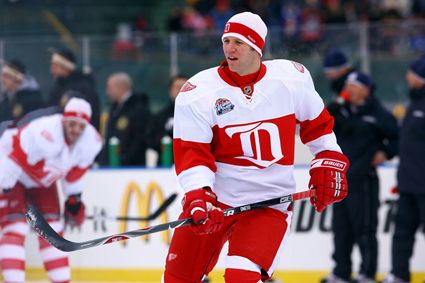
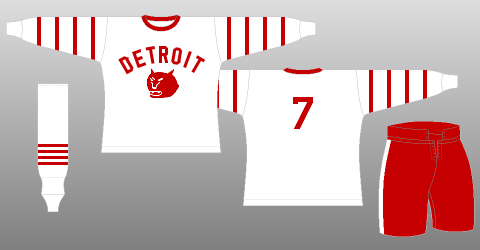
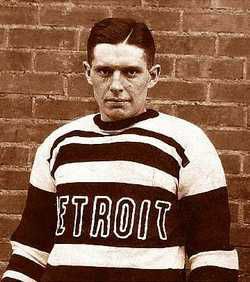
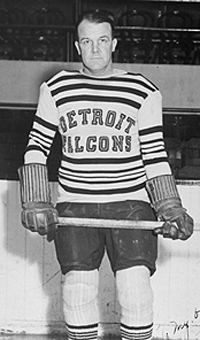
After wearing a jersey with an old English "D" on the front for their first season, which was revived for the 2009 Winter Classic, the Cougars changed to the original version of today's featured jersey for their inaugural season in the Olympia of 1927-28. This style lasted only one season before being replaced by a white jersey with a cougar head below the word "Detroit" for one season prior to a return to the 1927-28 template for 1929-30, only now with the word "Detroit" on the front in red outlined in white. The jerseys changed once again for 1930-31 to a similarly designed white jersey with multiple horizontal red stripes with "Detroit Falcons" in yellow outlined in red for two seasons, giving the club two names and five different jerseys in six seasons.

All that would change in 1932 when the team adopted the name "Red Wings" and wore a solid red jersey with simple white stripes around each arm and around the waist, which has remained essentially unchanged for nearly 80 years.

Detroit Red Wings 91-92 TBTC F
Detroit Red Wings 91-92 TBTC B

In today's video section, here are highlights of Game 7 of the 1950 Stanley Cup Finals played at the Olympia.


Once more the Stanley Cup Finals comes down to Game 7 at the Olympia, where the Red Wings again prevailed.


Our final video todays is a melodramatic photo tribute to the Detroit Olympia.


Wednesday, November 10, 2010

1968-69 Detroit Red Wings Alex Delvecchio Jersey

On this date in 1991, the Detroit Red Wings held a pregame ceremony where they retired Ted Lindsay's #7 sweater as well as the #10 of Alex Delvecchio.

Red_Wings_retired_numbers
Delvecchio's #10 hangs in the rafters of Joe Louis Arena with the other Red Wings honored greats

Delvecchio left no doubt that he was ready to play in the NHL following his first and only season in junior hockey when he led the Ontario Hockey Association in assists with 72 in just 54 games. Not only a playmaker, the talented Delvecchio also scored nearly a goal a game for the Oshawa Generals as well. His 49 goals added to his league leading 72 assists gave him an impressive 121 points for the season and second place in the scoring race.

Delvecchio Generals
Delvecchio while a member of the Oshawa Generals

He made his NHL debut that same season with a single game for Detroit.

The following season of 1951-52 could not have gone any better for Delvecchio. After six games in the minors, in which he scored nine points, he was called up to Detroit. He scored his first NHL goal, as one of the 15 he would score that season, and played 65 games with the Red Wings before advancing to the playoffs, where they would sweep eight straight games to earn Delvecchio his first Stanley Cup in his first full season of play.

"That was a great team we had and I felt proud to be among so many players that were true stars of the game. Terry Sawchuk was in goal and in those eight playoff games against Toronto and Montreal, he only gave up six goals. We had Ted Lindsay, Sid Abel, Gordie Howe, Glen Skov, Tony Leswick, Metro Prystai and Marty Pavelich up front. Marcel Pronovost, Red Kelly and Bob Goldham were three of our defensemen," Delvecchio remembered.

His point total would jump from 37 to 59 in his second season, powered by 43 assists as he was paired with none other than Lindsay and team leader Gordie Howe on the second version of "The Production Line" following the trade of line member Sid Abel. The 59 points would stand as his career high for seven seasons. While his personal point totals would drop in 1953-54, greater things were in store for Delvecchio than personal glory, as the Red Wings would win the second Stanley Cup of Delvecchio's career. He would contribute 9 points in 15 games in the postseason.

Delvecchio may have began to think that winning was easy following the 1954-55 season, as the Red Wings again marched through the playoffs to win their third championship in Delvecchio's four seasons as he chipped in 7 goals and 8 assists in 11 games for third in team playoff scoring.

Delvecchio Red Wings
Alex Delvecchio in action

It would prove to be the final Stanley Cup of what would eventually stretch to a 24 year career.

The 1955-56 season saw him record the first 20 goal season of his career when he netted 25 . The Red Wings would once more reach the finals that season, but fell short against the Montreal Canadiens, who were just beginning a dynasty that stretch for five seasons.

1956-57 was cut short by injury, one of the rare seasons Delvecchio would play less than 70 games, although he was still productive while healthy, scoring 41 points in 48 games. Aside from 1956-57, Delvecchio would play in 1,050 out of 1,054 possible games between 1952-53 and 1967-68.

Following the 1958-59 season, Delvecchio would be named the winner of the Lady Byng Trophy following his 54 point season which saw him whistled for just 6 penalty minutes.

1960-61 was the beginning of six consecutive 20 goal seasons for Delvecchio. He was then named team captain of the Red Wings for the 1962-63 season, a post he would retain for 12 years, the longest in team history until eventually surpassed by Steve Yzerman.

The 1965-66 season was a memorable one for Delvecchio, highlighted by the only 30 goal season of his career, when he scored 31. That season would also be the fourth return to the Stanley Cup Finals in six seasons for Detroit. His season was capped off by being named the recipient of his second Lady Byng Trophy.

Three seasons later Delvecchio set a career high in points with 25 goals and 58 assists for 83 points, including the 1,000th point of his career on February 16, 1969, only the third player in league history after Howe and Jean Beliveau to achieve that feat. His efforts were recognized with the 1969 Lady Byng Trophy, the third of Delvecchio's career.

The final four seasons of his career were as productive as any that came before, with the final full season seeing his second highest point total of his career. Although it was one of the rare seasons in which he did not score 20 goals, coming up just short at 18, he had his second highest assist total with 53 for 71 points.

Delvecchio retired as a player following 11 games of the 1973-74 season when he was chosen as coach of the team. At the time of his retirement, he had established an NHL record for the most games played in a career with only one team at 1,549. In those games, he scored 456 goals and 825 assists for 1,281 points. Additionally, he played in 13 All-Star Games, a total only five players have ever surpassed.

He was inducted into the Hockey Hall of Fame in 1977 and His #10 was retired on this date in 1991.

Today's featured jersey is a 1968-69 Detroit Red Wings Alex Delvecchio jersey. This jersey features the captain's "C", which Delvecchio wore longer than any other player at the time and still remains the second longest tenure of any captain in Red Wings history.

This style of Red Wings jersey was first adopted in 1932 when the team changed their name from the Falcons to the Red Wings and remains essentially unchanged to this day.

Red Wings 68-69 jersey

Here are highlights of the 1954 Stanley Cup, when the Detroit Red Wings battled the Montreal Canadiens as well as a lively panel discussion with members of both teams hosted by the great Curt Gowdy.


Sunday, July 25, 2010

2007-08 Flint Generals Darren McCarty Jersey

July by the Numbers returns to Michigan once again for jersey #25.

When one thinks of the minor leagues, the mental image is generally that of a young hopeful hoping to make it to the NHL for the first time. There are however, other reasons for players to find themselves on minor league rosters. Such was the case of then three time Stanley Cup champion Darren McCarty.

McCarty began his NHL career in 1993 with the Detroit Red Wings and was a vital part of the powerful Red Wings lineup for the next 11 seasons, which included Stanley Cup championships in 1997, 1998 and 2002. While not a flashy goal scorer, his contributions were his toughness, tenacity and team first approach, best recalled by his attack on Claude Lemeiux in retribution for Lemieux's savage hit on teammate Kris Draper.

McCarty did not play in the 2004-05 season of the NHL lockout when many players found jobs in European leagues or North American minor leagues. Following the lockout, a new salary cap system was instituted in the NHL and the Red Wings chose to buy out McCarty's contract as a result of the new financial structure in the post-lockout NHL.

McCarty then signed with the Calgary Flames as a free agent for 2005-06 and played in 67 games, scoring 13 points and registering 117 penalty minutes. McCarty went through some personal issues at the time and in 2006-07 he appeared in just 32 games for the Flames without registering a single point.

At the start of the 2007-08 season, he was without a team. A meeting with Draper in November started his return to hockey when Draper encouraged him to get back in shape and arranged for him to get a tryout with the Flint Generals of the International Hockey League, a team in which Draper is a part owner.

To clarify, this version of the IHL is not the one that existed from 1495 to 2001, but a new league founded in 1991 as the Colonial Hockey League with teams in Michigan and Ontario. As the league expanded eastward, it was renamed the United Hockey League in 1997 before resurrecting the International Hockey League name in 2007, as the original IHL had a strong presence in the Great Lakes area.

This league however was not at the same level as being one step below the NHL, and is considered the fourth rung on the ladder below the NHL, AHL and ECHL.

Nor was this version of the Flint Generals the same franchise which existed from 1969 to 1985 in the original IHL and won the Turner Cup in 1984. That club relocated to Saginaw, Michigan in 1985 and changed their name to the Saginaw Hawks in 1987 before folding in 1989.

McCarty then joined the Generals by signing a contract on December 31, 2007 and played in 11 games, scoring six points and adding 30 penalty minutes.

McCarty Generals

A little over a month later McCarty was signed by the Red Wings top minor league affiliate, the Grand Rapids Griffins of the AHL, and immediately impressed with a hat trick plus an assist in his first game for the Griffins.

After 13 games with Grand Rapids, McCarty was signed by the Detroit Red Wings and was called up by Detroit on March 7, 2008 in time to play three regular season games prior to the playoffs. The top-seeded Red Wings defeated the Nashville Predators 4 games to 2, swept the Colorado Avalanche in 4 and advanced to the Stanley Cup Finals by eliminating the Dallas Stars 4-2. They then captured the fourth Stanley Cup of McCarty's career by downing the Pittsburgh Penguins in six games to complete McCarty's comeback from being out of hockey six months earlier.

McCarty 2008 Stanley Cup

McCarty played one more season, splitting time between the Red Wings and the Griffins (while recovering from an injury and subsequent surgery) before ending his season and career back with Detroit to finish the season following the Griffins elimination from the playoffs.

The new version of the Flint Generals that McCarty began his comeback with came into being in 1993 and took the name of the previous club based on a vote of the fans. The team won the Colonial Cup in 1996 and again in 2000 before folding in 2010.

Even the IHL has ceased to exist, as the remaining five teams are set to join the Central Hockey League for the 2010-11 season as part of a merger between the leagues which will be known as the CHL.

Today's featured jersey is a 2007-08 Flint Generals Darren McCarty jersey worn during the start of McCarty's comeback attempt after starting the season without a job. The Generals wore an attractive jersey in the original Generals blue and gold colors in keeping with the dignity associated with the Generals name, unlike many minor league teams who have gaudy jerseys to go with their cartoonish logos and often ridiculous names, especially in the lower minors.

Flint Generals jersey

Today's video section begins with a look at McCarty's first game with the Generals and the postgame press conference.


Here is McCarty's comeback story as told by the CBC.