Showing posts with label New York Islanders. Show all posts

Friday, October 7, 2011

1972-73 New York Islanders Craig Cameron Jersey


Born as a result of a hasty effort by the National Hockey League to prevent the rival upstart World Hockey Association from placing a team at the Nassau Veterans Memorial Coliseum, the New York Islanders played their first game on this date in 1972.

Nassau Coliseum
The Nassau Coliseum

Located less than 20 miles from New York City on Long Island, the Coliseum originally held roughly 13,000 for hockey and slightly more for basketball, as the arena was also home to the New York Nets of the American Basketball Association from 1972 until 1977, who brought two ABA championships to New York behind the play of "Dr. J" Julius Irving.

Julius Irving
Dr. J, Julius Irving

Some of the other teams to have called the Coliseum home have been the New York Arrows of the Major Indoor Soccer League (1978-1984), the New York Express, also of the MISL (1986-1987), the New York Saints of the National Lacrosse League (1989-2003) and the New York Dragons of the Arena Football League (2001-2008).

The Coliseum saw it's seating capacity expanded in the early 1980's to 16,250 for hockey and up to 18,100 for concerts. The arena has also hosted some of the World Wrestling Federation's biggest events as well as boxing and NCAA basketball regional round games.

In addition, some notable concerts have also been held there, including David Bowie, Queen, Bruce Springsteen, Billy Joel and was one of only two venues in the United States to host Pink Floyd's live show of "The Wall".

The motivation to quickly create the Islanders came about due to the new WHA planning on placing it's flagship franchise, the New York Raiders, in the brand-new Coliseum, a plan which was met with rejection by Nassau County officials, who wanted nothing to do with the new league which they did not consider to be major league. With the only way to legally keep the WHA out of the Coliseum being to place an NHL team there, and despite the fact the New York Rangers did not think highly of a competing team just 19 miles down the road, a hastily awarded team was given to Long Island in November of 1971, along with a second new club, the Atlanta Flames, to keep the league balanced.

While the plan cost the Islanders a $4 million territorial rights fee paid to the Rangers, it cost the Raiders even more, as they were forced to play in Madison Square Garden as tenants of the Rangers! Needless to say, the Rangers were less fans of the Raiders, who belonged to the rival WHA, than they were of the Islanders, who at least were members of the same NHL.

New York Raiders
The WHA's New York Raiders

The unfavorable terms of the Raiders lease was a burden on the club, and when very few fans showed up to buy tickets, the original owners defaulted before the first season was even complete. WIth the league now owning the club, it was then sold to a new owner for the second WHA season and renamed the Golden Blades.

New York Golden Blades
Andre Lacroix of the short-lived New York Golden Blades

The Golden Blades saw as few as 500 people show up, and 20 games into year two, the franchise once more became property of the league, who moved them to Cherry Hill, New Jersey, a suburb of Philadelphia for the remainder of the 1973-74 season where they had to play in a tiny arena (capacity 4,416) so awful it has achieved legendary status as the visiting teams not only had to put on their gear back at their hotel, but also skate uphill for two out of three periods thanks to a slope in the ice surface! Following the conclusion of the season, the franchise was moved to San Diego, California, seemingly as far from New York as possible! The formation of the Islanders had ultimately had the desired effect the NHL had hoped for.

The Islanders started slowly, preferring to build their club through the draft and passed on the temptation to sign veteran players, especially in light of the rapidly increasing size of player contracts due to competition from the WHA. The first year Islanders were led in scoring by Billy Harris, who managed 28 goals and 50 points in 78 games. For comparison, Phil Esposito led the league with 55 goals and 130 points.

The Islanders lost their first game at home 2-3 to the Flames on this date in 1972, but won their second game 3-2 over the Los Angeles Kings to earn their first victory in front of their home fans in their new arena.

It was not something the fans should have gotten used to however, as the Islanders dropped their next four games at home before a tie with the Chicago Black Hawks ended their inaugural homestand with a 1-5-1 record. For the remainder of the season, they would win 9 more games at home and only 2 on the road. Losing streaks of 12, 8, 7 games, as well as another winless streak of 12 doomed the Islanders to a distant last place with a 12-60-6 record for just 30 points, 18 back of the California Golden Seals and 35 back of fellow first year club the Flames!

However, their roster included not only Harris, but center Lorne Henning (63 games), wingers Bob Nystrom (11 games) and Gary Howatt (8 games) plus goaltender Billy Smith (37 games) who would remain with the team and achieve the heights of hoisting the first of four consecutive Stanley Cups just seven years later.

Islanders Stanely Cup 1980
The Islanders hoist the first of four consecutive Stanley Cups

Bill Torrey, general manager of the Islanders tells his version of the competition with the Raiders and the rise of the Islanders. "The WHA originally wanted to get into the Nassau Coliseum but once the NHL made the commitment to put the Islanders there, I sensed we were in a situation that my club would be a target for the new league. The WHA put a team in New York at Madison Square Garden. THe Raiders wanted to weaken us as best as they could. I let them do it in a way. There were six or seven players that signed with the WHA that I had offered two-way, short-term contracts. I had a hunch they wouldn't accept my offer, but that was okay because I felt by building with younger players that we would draft, the Islanders would develop quicker and be better off in the long run.

At the time, the NHL was a two-division league. There really wasn't much chance for us to finish anywhere but where we finished, be it with a handful of wins and points. That wasn't important at the time. The WHA signed three or four players who I didn't care about and a couple of others who would have helped our organization. Still, we established a policy where our drafts, in '72, '73 and '74, would be all great ones. WE had a chance to let our future players mature faster. In the short term, it was tough. But in the big picture, things worked out well for us."

Their last place finish in 1972-73 allowed them to select franchise cornerstone Denis Potvin with the first overall pick in the 1974 NHL Draft. The following year the Islanders picked Clark Gilles fourth overall and Bryan Trottier in round two and the Islanders had the foundation for their dynasty of the early 1980's.

Nassau Coliseum

Time has passed the Coliseum by however, as it is now the second oldest building in the NHL with the lowest capacity (not to mention the lowest average attendance) and is viewed as an unsuitable building in the modern NHL, mainly due to it's lack of private suites and other modern features which provide essential money making opportunities for the club. Despite repeated attempts to replace it, none have come to fruition and the club is in real danger of having to relocate in the coming years.

Today's featured jersey is a 1972-73 New York Islanders Craig Cameron jersey. The first season of play for the Islanders saw them wear what would become the jersey the club would return to over and over again, despite a number of attempts to change to something different.

The orange numbers were unique to the first year Islanders jerseys, as they would be changed to white for the 1973-74 season and remain so on their dark jerseys ever since. The white sleeve ends and lace up collar would remain for the first five seasons before both disappeared in 1977-78, the same season names arrived on the back for good.

New York Islanders 72-73 jersey

Our video section today takes a look at the history of the New York Islanders.


Thursday, June 30, 2011

1993-94 New York Islanders Jamie McLennan Jersey

No other path through a hockey career can match that of goaltender Jamie McLennan, born on this date in 1971, who made stops in Canada, the United States, England, Russia and Japan with a stop at death's door for good measure.

His journey though the world of hockey began in 1988-89 with first the Spokane Chiefs followed by a move to the Lethbridge Hurricanes of the WHL. He returned to Lethbridge the following season and posted a stellar 20-4-2 record. He became the #1 goaltender for the Hurricanes in 1990-91, going 32-18-4 which led to his being taken 48th overall by the New York Islanders at the 1991 NHL Entry Draft, the second goaltender selected in the draft.

He began his climb to the NHL with the Richmond Renegades of the East Coast Hockey League in 1991-92 before a promotion to to the Capital District Islanders of the American Hockey League. After spending a second season with Capital District in eastern New York in 1992-93, McLennan trekked west to compete for the Salt Lake Golden Eagles of the International Hockey League before making his NHL debut with a 6-2 win over the Calgary Flames on January 7, 1994. By playing in the NHL, McLennan had now competed in five different leagues in four seasons.

McLennan spent the next season divided between the Islanders and their top AHL affiliate, which was the Denver Grizzlies in 1994-95. In 1995-96, he tended goal for a trio of clubs, the Islanders of the NHL for 13 games, the Grizzlies, who had relocated to Salt Lake City and were now known as the Utah Grizzlies for 14 games as well as playing the majority of his season with the Worcester Ice Cats of the AHL in 22 games, making in three different leagues in one season for the hockey vagabond.

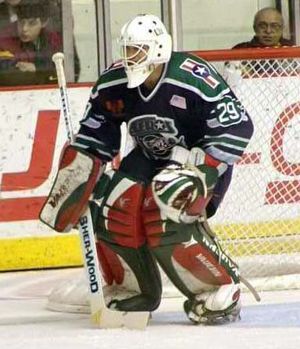
McLennan Islanders
McLennan had the misfortune of having to wear the "fisherman" jersey while on Long Island

At the conclusion of the season, McLennan drove from Salt Lake City to Lethbridge, Alberta on his way home to Edmonton. While in Lethbridge visiting relatives, he became ill with what he believed was the flu. After feeling ill for some time and his symptoms becoming worse, he went to a hospital now believing he was suffering from food poisoning after a night of fever and vomiting.

Once at the hospital he was diagnosed with bacterial meningitis and went into a coma, but not until a doctor noticed the black spots on his arms and legs and declared "We better call your parents. You might not make it." Luckily enough, he had arrived at the hospital early enough to receive proper treatment, but not before spending the next five days in a delirious state due to the inflammation of the membrane around his brain and spinal cord.

He still required three weeks in intensive care, ended up losing 30 pounds and needed to learn how to walk again following the ordeal.

Due to his medical setback, McLennan spent the entire 1996-97 season with the Ice Cats returning to form as a professional hockey player after signing a contract with the St. Louis Blues organization.

McLennan returned to the NHL with the Blues for the 1997-98 season, playing in 30 games and finishing with a 16-8-2 mark.

McLennan Blues

His brush with death and subsequent return to the NHL earned McLennan the 1998 Masterton Trophy for perseverance and dedication to hockey.

McLennan Masterton

He played two more seasons with St. Louis, but saw his number of games decline from 30 and 33 down to 19 which made him available in the 2000 Expansion Draft where he was selected by the new Minnesota Wild, where he saw plenty of ice time, but dreadful goal support whenever he started, far less than teammate Manny Fernandez, which doomed him to a 5-23-9 record despite a 2.64 goals against average.

McLennan Wild

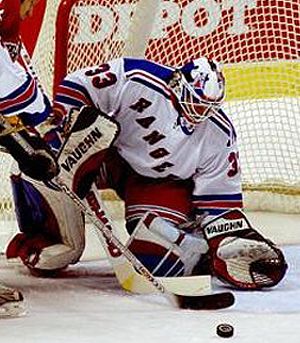
After the Wild signed Dwayne Roloson for 2001-02, McLennan was relegated to the Houston Aeros of the AHL for the entire season. At the following NHL Draft, McLennan was dealt to the Calgary Flames as a backup to Roman Turek for 2002-03 and found himself a part of a crowded crease in 2003-04 with the arrival of Miikka Kiprusoff before being dealt late in the season to the New York Rangers with whom he played just four games during the final month of the season.

McLennan Flames

During the summer of 2004, McLennan was signed by the Florida Panthers as a free agent, but remained mostly inactive during the NHL lockout of 2004-05, he signed with the Guildford Flames of the British second division for three regular season games and seven playoff contests.

With the labor issues now settled, he made his Panthers debut during the 2005-06 season, but was limited to just 17 games behind workhorse Roberto Luongo.

McLennan Panthers

With his contract now expired, McLennan returned to Calgary for the 2006-07 season to again back up Kiprusoff, now himself an entrenched #1 as well as another workhorse, which saw McLennan limited to a mere nine games. He did make one infamous playoff appearance, during which he came into the game in relief of Kiprusoff, and lasted a mere 18 seconds before slashing Detroit forward Johan Franzen, which earned him a game misconduct and a match penalty and a later five game suspension.

McLennan Flames

To start the 2007-08 season, McLennan played five weeks for Metallurg Magnitogorsk of the Russian Superleague.

McLennan Metallurg
McLennan while with Metallurg Magnitogorsk - note the Calgary Flames mask

McLennan later signed in late November with the Japanese Nippon Paper Cranes of the Asia Hockey League, his seventh different league as a professional, after he and former Blues teammate Tyson Nash were recruited by a friend already on the roster, giving them a unique opportunity to continue playing hockey and experiencing the Japanese culture for an extended period of time. To read more about McLennan's experiences in Japan, check out his blog at The Hockey News here.

McLennan & Nash in Japan
Jamie McLennan and Tyson Nash experiencing Japan

It was to be his final season as a professional, as he announced his retirement following the season, bringing to an end a career which saw him play in 254 NHL games and finishing with a record of 80-109-36 along with a career goals against average of 2.68.

Today's featured jersey is a 1993-94 New York Islanders Jamie McLennan jersey worn during McLennan's rookie season. While the basic basic blue Islanders jersey underwent some detail changes since it's introduction in 1972 up until it was first discontinued in 1995 in favor of the controversial "Fisherman" style, the fans demanded it's return, which came in an updated version of the original in 1998 which used a considerably darker shade of blue.

With the introduction of the Reebok Edge jerseys in 2007, the Islanders began to stray too far from the originals once more, which resulted in a new lighter blue alternate jersey being introduced in 2008 which replicated their 1973 jersey as much as possible with the Reebok Edge cut. It was so well received that it became the primary home jersey just two years later and a new white version was created to complete the set.

New York Islanders 93-94 jersey

Bonus Jersey: Today's bonus jersey is a 2002-03 Calgary Flames Jamie McLennan jersey. This alternate debuted in 1998 and featured a flaming horse head logo in honor of the famous Calgary Stampede rodeo. After two seasons of use this style was promoted to being the Flames primary road jersey.

Unusually, when the NHL declared that dark jerseys would now be the primary home jerseys beginning in 2003, the Flames introduced a new red primary home red, yet the black jersey survived by once again returning to alternate status for three additional seasons. There has never been another instance of an alternate jersey being promoted to primary status and then returned to duty as an alternate once again, as they are generally retired when replaced by a brand new style.

Calgary Flames 02-03 jersey

For a looking into the wacky personality of the man called "Noodles", check out this funny video poking fun at his lack of playing time while backing up Luongo while with the Panthers.


Here is McLennan is interviewed in two parts, which includes him talking about his battle with meningitis.


Friday, June 10, 2011

1990-91 New York Islanders Brent Sutter Jersey

Louis and Grace Sutter's first son Gary was born first in 1954 and chose not to pursue a hockey career. Brian, the oldest of the six to make it to the NHL arrived in 1956 and was followed by Darryl in 1958 and Duane in 1960.

Brent Sutter was born on this date in 1962 and was followed by twin brothers Rich and Ron who arrived on the scene in 1963.

The Sutter family
Louis and Grace Sutter with their seven sons

While the six younger brothers all had lengthy NHL careers, putting tiny Viking, Alberta on the map, they remember Gary as being the best skater in the bunch. Brian played 12 seasons, all with the St. Louis Blues. Darryl spent eight seasons with the Chicago Black Hawks and had his career shortened by injuries and went into coaching and is currently the general manager of the Calgary Flames. Duane spent eight years with the New York Islanders and closed out his career with three seasons in Chicago.

Brent followed the familiar Sutter path, first playing for the Red Deer Rustlers of the Alberta Junior Hockey League, and scored an amazing 171 points in 59 games prior to being drafted 17th overall in the 1980 NHL Entry Draft by the New York Islanders, who had already drafted Duane the year before. He then continued the established Sutter path of moving up to the Lethbridge Broncos of the Western Hockey League as Brian, Darryl and Duane had done before him.

He made his NHL debut in the 1980-81 season with three games with the Islanders, scoring 2 goals and 2 assists. He began the 1981-82 season between Lethbridge, scoring 46 goals and 80 points in just 34 games before getting called up to play 43 regular season games with New York, averaging a point a game in addition to racking up 114 penalty minutes, as he established himself as an NHL regular while displaying the trademark Sutter toughness. Once in the playoffs, Sutter scored 8 points in 19 games as the Islander dynasty marched on to it's third consecutive Stanley Cup championship.

Sutter played in all 80 Islander games in 1982-83 and had 21 points in 20 playoff games to earn his second Stanley Cup in a row.

1983-84 saw Sutter raise his personal goal scoring high to 34. In the playoffs, the Islanders again reach the finals and Sutter registered another 14 points in 20 games.

By far the greatest offensive season of Sutter's career arrived in 1984-85, when he reached 40 goals for the only time in his career with 42, while adding 60 assists, remarkable because it was the only time in his career he would have more than 36. His 102 points were second on the club behind only Mike Bossy's 117 and good for 10th overall in the league. It would also be the highest scoring season for any of the Sutter brothers ever and the only one to top 100 points in a season.

While he would return to Earth with 55 points the following season, it would start a run of consistency in the four subsequent seasons when Brent would score between 24 and 29 goals and 60 and 68 points each year between 1987 and 1990. He was also named as the Islanders captain from 1987-88 to 1990-91.

Duane and Brent Islanders
Duane and Brent played together for the Islanders from 1980-81 to 1986-87 - note the one color name on Duane's jersey while Brent's was two colors!

After another season on Long Island, Sutter would be traded to the Chicago Blackhawks early in the 1991-92 season. His 50 points in Chicago, combined with his 10 scored in New York, gave him 60 for the fifth time in six years and he would return to the Stanley Cup Finals for the first time since 1984. After a 20 goal, 54 point season in 1992-93, in which he was coached by his older brother Darryl, a changed role with the Blackhawks saw him limited to 9 goals and 38 points, ending a streak of at least 20 goals and 40 or more points dating back 12 years to the beginning of his professional career.

Brent would finish his career with four more seasons in Chicago, concluding at the end of the 1997-98 campaign. Although he did not score as often as he once did, he was quoted as saying, "I might not score as often as I once did but other areas of my game are better than when I was younger."

His final NHL totals were 1111 games played, 363 goals, 466 assists and 829 points as well as 1054 penalty minutes. Additionally, he played in 144 playoff games, scoring 30 goals and 44 assists for 74 points, made four trips to the finals, winning two Stanley Cups.

Internationally, Brent skated for Team Canada in the 1984 Canada Cup, contributing 4 points in eight games as Canada won the gold medal. 1985 saw him help Canada to a silver medal in the World Championships with 11 points in 8 games. Two more gold medals would follow at both the 1987 and 1991 Canada Cup tournaments, giving Brent an impressive three golds and one silver in four tries.

Rich and Ron Sutter both debuted in the 1982-83 season and played together for the Philadelphia Flyers in 1983-84 through 1985-86 and again with the St. Louis Blues in 1991-92 and 1992-93. Rich would play 13 seasons until 1995, while Ron's career spanned 19 seasons, lasting until 2001. For five seasons all six brothers played in the league at the same time, four of them became team captains and Ron's final season of 2000-01 was the 25th consecutive season a Sutter brother played in the NHL.

The Sutter display @ HHOF
The Sutter family display at the Hockey Hall of Fame

Brent is currently the head coach of the Calgary Flames.

Today's featured jersey is a CCM 1990-91 New York Islanders Brent Sutter jersey. This jersey is from Brent's final full season as an Islander while he was serving as team captain. It lacks his first initial "B", as his brother Duane had moved on to the Blackhawks by this time.

1990-91 Islanders jersey

Bonus Jersey: Today's bonus jersey is a CCM 1991 Team Canada Brent Sutter jersey. as used in the 1991 Canada Cup tournament. While the name and number of this jersey are sewn on twill, the main crest and sleeve logos are screen on, which has resulted in the cracking and wear displayed here. The 1991 Canada Cup jerseys featured the Labatt Canada Cup patch, which is sewn on the upper right chest.

1991 Canada Cup Team Canada

Here is footage of the Islanders celebrating their Stanley Cup victory in 1982, the first of Brent's career.


Here is a four part story on the Sutter brothers.


We conclude with Brent, then coach of the Devils, in a light-hearted moment talking about his mother dancing with broadcaster Chico Resch.


Thursday, May 5, 2011

1997-98 New York Islanders Ziggy Palffy Jersey

Born on this date in Czechoslovakia in 1972, Zigmund "Ziggy" Palffy came of age at the ideal time, just after the fall of the Iron Curtain.

After a season in the Czechoslovakian Extraliga with HK Nitra, scoring 34 goals and 50 points in 50 games and earning a bronze medal in the 1991 World Junior Championships, scoring 7 goals and 13 points in 7 games, Palffy was drafted in the second round of the 1991 NHL Entry Draft by the New York Islanders.

Palffy Czechoslovakia
Palffy as a member of the Czechoslovakia National Team

He remained in Czechoslovakia for two more seasons with Dukla Trencin, leading the club in points in 1991-92 with 47 points and adding another 26 points with an amazing 18 goals and 26 points in just 13 playoff games to lead Trencin to the league championship, their first championship since their founding in thirty years of trying. If that were not enough, the following season Palffy not only led Trencin in scoring with 38 goals and 79 points just 43 games, but won the league scoring championship in the process.

Now clearly ready to make the move to North America after dominating his domestic league, Palffy began his path to the NHL with a season with the Salt Lake Golden Eagles of the IHL in 1993-94, where he averaged exactly a point per game with 57 points in 57 games. He also made his NHL debut with the Islanders, seeing action in five games, but failed to impress by being held pointless. He did have a better showing at the 1994 Olympics, skating for the now independent nation of Slovakia following the breakup of Czechoslovakia at the start of 1993.

Palffy began the 1994-95 season with 33 games as a member of the Denver Grizzlies of the IHL, and after putting up 43 points in 33 games, he was recalled by the Islanders after the season began late due to the labor issues which delayed the start of the season. He would play in 33 games which included his first NHL points, finishing with 10 goals and 17 points.

Palffy hit his stride in 1995-96, which included a change in jersey number from 68 to 16, when he led the Islanders in scoring with 87 points and his first 40 goal season with 43. Following the season, as the lowly Islanders failed to make the playoffs, Palffy competed for Slovakia at the 1996 World Championships.

Palffy Islanders
Palffy in the controversial "fishsticks" jersey. Note the italicized assistant captain's "A" used in the second half of the 1996-97 season.

Prior to the start of the following NHL season, Palffy once again skated for Slovakia in the 1996 World Cup of Hockey. The next season saw more of the same as Palffy reached 48 goals and 90 points to once more lead the Islanders in scoring as well as making his first NHL All-Star Game appearance. His final season on Long Island saw him limited to just 50 games, during which he scored 50 points. Following the season, the sixth in a row during which the once great Islanders would miss the playoffs, Palffy was again free to compete at the World Championships for Slovakia.

In a move that was unpopular with the already disgruntled Islanders fans, Palffy was traded to the Los Angeles Kings. His first three seasons with the Kings saw Palffy continue at a point per game average, including nearly equalling his career high, falling just one point short in 2000-01 with 89.

The 2001-02 season was particularly busy for Palffy, as he played in 63 games for the Kings, made a single appearance for Slovakia in the 2002 Olympics, although too little too late to help Slovakia escape the Preliminary Round due to a scheduling flaw that forced Slovakia to compete without the vast majority of it's NHL players for most of the round, and was a contributor to Slovakia's greatest hockey moment when they rebounded a few months later when they captured the gold medal at the 2002 World Championships after the Kings were eliminated in seven games in the first round of the NHL playoffs. Palffy assisted on Peter Bondra's gold medal clinching goal with less than two minutes remaining in the championship final.

Photobucket
Palffy celebrates Slovakia's gold medal in 2002

Another strong season in 2002-03 with the Kings saw him total 85 points as well as having a strong World Championships with 15 points in 9 games.

During the NHL lockout of 2004-05, Palffy split his time between HK 36 Skalica in Slovakia and HC Slavia Prague in the Czech Republic as well as making yet another appearance at the World Championships. For the 2005-06 season, Palffy signed as a free agent with the Pittsburgh Penguins, but retired unexpectedly halfway through the season due to a shoulder injury.

Palffy Penguins

To the surprise of many, Palffy returned to active play after sitting out the rest of the 2005-06 season and all of the 2006-07 season when he rejoined HK 36 Skalica.

Palffy Skalica

Now once more in top form after his year and a half away from the game, Palffy scored 75 points in 46 games in 2007-08 and added 24 more in 13 playoff games to lead Skalica to an appearance in the championship finals.

Ziggy Palffy

He raised his game once more in 2008-09, leading the league in goals with 52, 21 more than his next closest competitor! With his 47 assists added on, his 99 points in 53 games easily gave him the league scoring title.

One final season with HK Skalica had Palffy in top form with 53 points, although his was limited to 36 games. He also made his first appearance for the Slovakia National Team in five years when he participated in the 2010 Olympics in Vancouver.

His final NHL totals were 329 goals and 713 points in 684 games. Internationally, he played in 18 games for Czechoslovakia and later 49 games for Slovakia, scoring a combined 86 points during two World Juniors and a Canada Cup for the Czechs and five World Championships, a World Cup and three Olympics for the Slovaks.

Today's featured jersey is a 1997-98 New York Islander Ziggy Palffy jersey. This style jersey was first introduced in 1995-96 with the notorious and much ridiculed "fisherman" logo. The Islanders were in a state of turmoil at the time, having had a steep decline in competitiveness and several controversial personnel moves.

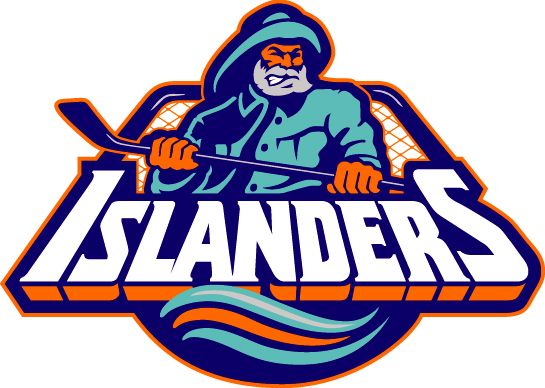
islanders fisherman
The Islanders "fisherman" logo

The fisherman jersey had the unfortunate double whammy against it, of not only replacing the jersey worn during the team's Stanley Cup dynasty, but arriving during a period of fan discontent with ownership and management, which led to the jersey and logo becoming the lightning rod for all of the fans anger and frustration.

During the 1996-97 season, the wave style jersey was paired with the classic Islanders logo as a hastily created "alternate" jersey in an effort to undo some of the damage done by the "fishsticks" jersey, as New York Ranger fans chanted at the Islanders while wearing the fisherman logo jerseys.

1997-98 saw the fisherman logo dropped completely and the club wear today's featured jersey full time for this jersey's final season prior to changing to a somewhat modernized version of their classic jerseys for 1998-99.

The "fisherman" jersey was worn with three distinctive fonts used for the assistant captain's "A", with the version on today's featured jersey being used for the 1997-98 season only.

Of note, the Slovakian flag on the chest of this jersey was applied just for the NHL SuperSkills Competition held at the 1998 NHL All-Star Game to promote the new World vs. North America format for that years NHL All-Star Game in advance of the first participation by NHL players at the upcoming 1998 Olympics in Nagano, Japan.

For more on the story of the "fishsticks" jersey, please see this post about it's creation and the controversial reception it received.

New York Islanders 97-98 F
New York Islanders 97-98 B

Our first video today shows Palffy wearing the original Islanders jersey as well as his original number 68.


Next is a collection of Palffy highlights while a member of the Los Angeles Kings.


Next, Palffy scores his 50th goal of the season to set a new Slovak Extraliga record in 2008-09.


Finally, Palffy scores just 12 seconds into the start of the first game of the 2008-09 Slovakian championship finals, only no one saw it because they were reading all the ads painted on the ice.


Monday, March 7, 2011

1995-96 New York Islanders Brett Lindros Jersey

Born in London, Ontario in 1975, Brett Lindros played his junior hockey for the Kingston Frontenacs beginning in the 1992-93 season. The right winger competed in 31 games that season, scoring 11 goals and 11 assists for 22 points while amassing 162 penalty minutes. During that same season he also skated for the Canadian National Team in another 11 games, during which he scored a goal and 6 assists.

In 1993-94, Lindros was once more a member of the Canadian National Team, a full season club which played a full season of games against both various national teams and club teams all over the world with the long term goal of preparing a cohesive team in preparation for the Olympics. The program lasted from 1983 until 1998, when the NHL began to shut down to allow it's players to compete in the Olympics.

In 44 games with the national team, Lindros scored 7 goals and 7 assists for 14 points. In addition the rugged forward was whistled for 118 penalty minutes. Aside from his time with the national team, Lindros also played 15 regular season and three playoff games with Kingston, scoring 4 goals and 6 assists.

At the conclusion of the season, Lindros was drafted 9th overall by the New York Islanders in the 1994 NHL Entry Draft.

Due to the lockout of 1994, the NHL did not begin it's season on time, and Lindros remained in Kingston for the first 26 games of the season. His offensive game took a step forward, as he found his goal scoring touch and lit the lamp 24 times in 26 games. Additionally, he was credited with 23 assists for a total of 47 points, an average of nearly 2 per game (1.81) in anticipation of making his NHL debut.

With the labor issues finally settled, Lindros joined the Islanders and saw action in 33 of the Islanders 48 games. He scored his first NHL goal and added three assists and a dose of grit with 100 penalty minutes.

Brett Lindros Islanders

The next season Lindros played in just 18 games, scoring once with a pair of assists before being forced to retire due to repeated concussions, including a final one in November 1995 which ended his career at the age of 20 after just 51 NHL games with 2 goals and 5 assists.

Brett Lindros Islanders

"When I was playing I was having memory loss even on the bench," he said. "I'd get back to the bench and if I'd been out there sometimes I wouldn't remember what I did."

"What was scary for me was each time it took longer to resolve. My last concussion before my 20th birthday took eight or nine weeks."

Having already suffered several concussions in juniors, he had another occurrence during his rookie season and then finally two in eight days which led multiple doctors to advise him to quit hockey due to the possibility of blindness and permanent brain damage.

"No one has wanted to talk about concussions until recently, especially in hockey," Lindros said back in 1996.

That sentiment certainly has changed 15 years later as players, teams and doctors are much more aware and more cautious of concussions than when Lindros was forced to retire in 1995. Just recently the NHL has taken steps to penalize hits to the head in an effort to reduce concussions, while the IIHF has simply taken a no tolerance policy of hits to the head, stating "there is no such thing as a clean hit to the head", giving not only a major penalty, but ejecting and suspending for one game any player who makes contact above the shoulder pads and subjecting the offending player to further suspension upon review.

Today's featured jersey is a 1995-96 New York Islanders Brett Lindros jersey. Lindros' rookie season saw him wear the classic Islanders jersey as worn during their Stanley Cup dynasty of the 1980's during that jerseys final season.

The next year was the debut of the Islanders ill-fated "Fish Sticks" jersey, so named for the resemblance of the logo to the Gorton's brand of fish sticks. The jersey was adopted by the Islanders new owners, hoping for a fresh start after a very down period in the win column. Turmoil on the ice and with the roster did little to improve the Islanders prospects and the jersey became a focal point of fan unhappiness with the franchise, which was not helped by the jersey being mocked by rival fans, those of the New York Rangers in particular.

For a more detailed story on the Islanders "Fish Sticks" jersey, please see our earlier entry as part of our "Curious, Weird and Ugly" Collection.

New York Islanders 95-96 jersey

Today's video section begins with Lindros first NHL goal, one of only two he would score.


Up next, Lindros being drafted 9th overall by the New York Islanders and donning the classic Islanders jersey worn during his first season.


Here is an interview with Lindros on a local Long Island morning news program promoting an Islanders players charity car wash. He also discusses the Islanders new "fisherman" jersey for a moment.


Finally, notorious dirty player Claude Lemieux, sitting on the Devils bench, slugs Lindros during a scuffle and draws Lindros' ire.


Monday, February 21, 2011

1993-94 New York Islanders Keith Acton Jersey

15 year veteran Keith Acton played his junior hockey with the Peterborough Petes of the Ontario Major Junior Hockey League. The center eased his way into the lineup his first season, but led the team in scoring in both 1976-77 and 1977-78, the latter season by 57 points! He also placed 4th in league scoring with his 128 points scored in 68 games. Peterborough later advanced to the Memorial Cup Final that season.

Acton was then drafted by the Montreal Canadiens who assigned him to the Nova Scotia Voyageurs of the American Hockey League for the 1978-79 season. He returned to Nova Scotia for the 1979-80 season, during which he also made his NHL debut with a pair of games for Montreal, scoring his first NHL point with an assist.

Having served his apprenticeship in the AHL, the hard working Acton made the jump to the NHL for his first full-time season in 1980-81, during which he scored 15 goals and 39 points. He really found his comfort level in 1981-82 when he scored 36 goals and 88 points in 78 games playing between Steve Shutt and Guy Lafleur.

Photobucket
Acton's 1980-81 Montreal Canadiens jersey

Nine games into the 1983-84 season Acton was dealt to the Minnesota North Stars as part of a huge trade which sent Bobby Smith to Montreal. While he would never again approach his 88 point season again, Acton was a vital part of the Minnesota linueup with his tenacity, faceoff skills and strong two way play. He was a model of consistency with Minnesota for the next four and a half seasons, never playing less than 71 games and scoring between 55 and 58 points.

Minnesota North Stars 86-87 jersey
Acton's 1986-87 Minnesota North Stars jersey

Halfway through the 1987-88 season, Acton was acquired by the Edmonton Oilers and went on to win a Stanley Cup later that season.

Edmonton Oilers 87-88 jersey
Acton's 1987-88 Edmonton Oilers jersey

He started the 1988-89 season with the Oilers, but after 46 games was dealt to the Philadelphia Flyers. There he played more of a defensive checking role, which limited his offensive numbers, but earned him a fan following with his continued hard work.

Philadelphia Flyers 91-92 jersey
Acton's 1991-92 Philadelphia Flyers jersey with the NHL 75th Anniversary and 1992 NHL All-Star Game patches

Oddly, Acton was traded to the Winnipeg Jets prior to the 1989-90 season on September 28, 1989, but sent back to Philadelphia in a separate trade just one week later! Acton would remain a Flyer for four and a half seasons, but the Flyers entered a down period and failed to qualify for the playoffs after Acton's first season in Philadelphia.

Acton Flyers
Acton as a Flyers assistant captain in 1992-93

Following the 1992-93 season, Acton signed with the Washington Capitals but played just six games with Washington before being claimed off waivers by the New York Islanders, with whom he played 71 games that season, including his 1,000th NHL game on this date in 1994 in a gratifying 4-0 shutout of the Capitals.

Acton continued to play the next season with the Hershey Bears of the AHL, but retired after 12 games in which he scored 12 points.

Hershey Bears 94-95 jersey
Acton's 1994-95 Hershey Bears jersey

Acton's final NHL totals are 1,023 games played with 226 goals and 358 assists for 584 points. He also amassed 1,172 penalty minutes and scored 33 points in 66 playoff games and got his name engraved on the Stanley Cup in 1988 while with Edmonton.

Due to the fact Acton played on some non-playoff teams, he was able to participate in the World Championships for Canada on three occasions, 1986, 1990 and 1992.

Keith Acton
Acton's style appears unchanged as he remains active in hockey as an assistant coach with the Toronto Maple Leafs!

Today's featured jersey is a 1993-94 New York Islanders Keith Acton jersey as worn during his only season with the Islanders during which he competed in his 1,000th NHL.

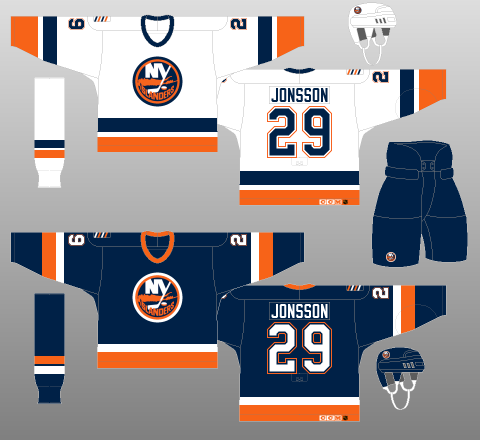
The Islanders original 1972-73 jerseys had a laceup collar and orange numbers. They quickly changed to white numbers for their second season and changed to a v-neck collar in 1977. Their jerseys underwent a minor striping tweak one year later, as a white stripe was added to the orange sleeve stripes and the blue in between the white and orange waist stripes went away, creating the jersey they would wear throughout their Stanley Cup dynasty of the 1980's.

The font for the numbers underwent some changes through time, including a switch to the same font used by the Pittsburgh Penguins for the 1991-92 season which featured squarish sleeve numbers and beveled angles the occasional odd serif, as shown on the "4" on today's featured jersey.

New York Islanders 93-94 jersey


Monday, August 23, 2010

1996-97 New York Islanders Ziggy Palffy Jersey

The Curious, Weird and Ugly™ Collection now recalls a jersey so despised that opposing fans used it as a chant to taunt the team wearing it.

We give you the one, the only, 1996-97 New York Islanders "Fish Sticks" jersey.


Kirk Muller popped into the home dressing room at Nassau Coliseum on a sunny June afternoon during the Stanley Cup finals in 1995. This was the big debut of the Islanders' new uniforms, the first glimpse of what many fans and media members immediately crowed was a blasphemous move by management to make a final break from the team's storied past.

The public relations fiasco that would be known as the Islanders' 1995-96 hockey season actually started near the end of the previous campaign, when Don Maloney committed the signature sin of what would be a short tenure in the general manager's office. He traded his best player, Pierre Turgeon, in a five-player deal for Kirk Muller, a widely respected leader who simply wanted no part of leading the Islanders bak to the playoffs after they failed to qualify during the lockout-abridged 1994-05 season.

If Maloney's worst crime was his misguided belief that his first blockbuster move would benefit he Islanders on the ice, the four-pronged managment group's decision to alter the team's fashion sense only accelerated their transformation into league laughingstocks.

"We never intended to strip the team of it's tradition," Islanders co-chairman Bob Rosenthal said. "But we made a mistake. We did not read the signals correctly. We misunderstood the underlying passion of the fans."

The team's dwindling yet impassioned fan base never forgave (former Islanders General Manager Don) Maloney for the Turgeon trade, not even after Maloney and (Kirk) Muller were both mercifully expunged from the organization over the next nine months. But the logo fiasco served as a rallying point for a segment of fed-up paying customers who suddenly found themselves forming activist groups and oranizing protest rallies rather than worrying about the power play or Stanley Cup playoffs.

"We believed that many of the people who had followed the team in the late seventies and eighties had moved off the Island," Rosenthal said. "Their kids had grown, and maybe they moved away as well. The season ticket base, which had been 13,000 to 14,000 at it's peak, had dropped to 5,000, so we not only were looking to improve our play on the ice, we started looking for ways to attract new fans."

In retrospect, the probably should've found another way.

For the first 23 years of their existence, the Islanders' uniforms were adorned with a simple logo, a circled crest of Long Island that also included an "NY" with the "y" appearing in the form of a hockey stick. It was designed on just three days' notice by John Alogna, who owned a Garden City ad agency, in 1971, and it quickly became synonymous with the Islanders as they ascended from expansion franchise to NHL champions.

Still, after the 1993-94 season ended in a disgraceful first-round playoff sweep by the Rangers, Islanders management "began to feel that younger fans were starting to think about the old logo in terms of the futility of the previous years, not the four Stanley Cups," according to Rosenthal.

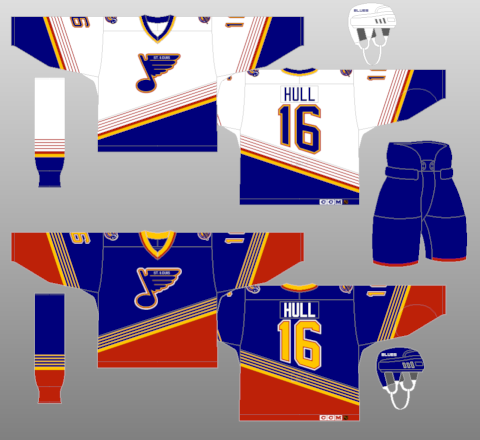
The NHL, buoyed by the marketing and sales success of merchandise adorned with logos of new franchises such as the Mighty Ducks of Anaheim and the San Jose Sharks, encouraged the Islanders to consider making a change, more in line with other cutting-edge sports fashions. The league recommended SME Design in Manhattan, which had modernized the uniforms of the St. Louis Blues and also designed the logo of the expansion Florida Panthers and other pro and college teams.

Initially, Walsh and vice president of communications Pat Calabria served as the point men for ownership.

"The Islanders were living in the shadow of the Rangers," designer Ed O'Hara toldNewsday's Steve Zipay in 1997. "We all agreed that a strengthened tie to Long Island was important, to keep the heritage of the Island and amplify it. Savvy marketers will tell you to think locally."

As New Coke and Pepsi Clear showed, sometimes it's better to leave well enough alone.

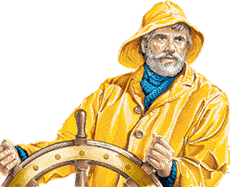
Walsh, who allowed his children's opinions to influence his decision, had a vision of a maritime theme. SME submitted a proposal to the Islanders with three to five concepts. In April, designs with various colors and logos of a lighthouse, a bearded grimacing mariner and the steering wheel of a fishing boat were offered.

"Everyone agreed that the bayman was the one, although the entire process was a huge concern. There was always self-doubt," O'Hara said. The NHL approved the entire concept in early fall of 1994 for implementation during the 1995-96 season.

Beat writer Colin Stephenson of the Daily News was the first to report the changes and updated colors, remarking how the chosen logo resembled the frozen-food advertising icon Gorton's fisherman. In a photograph accompanying the story, former captain Denis Potvin was pictured hoisting the Stanley Cup while wearing a computer-generated uniform adorned with the new logo and deeper color schemes. SportsChannel announcer Stan Fischler was cited as bearing a remarkable resemblance to the logo fisherman.

Barely one week after the official introduction on June 22, 1995, 78 percent of 1,006 respondents to a Newsday poll asking for responses panned the new logo. To prove there's no accounting for the taste of the consumer public, Team Licensing Business, a publication that tracks purchases of sports apparel, reported as of March 31, 1996 that the Islanders have moved up to No. 17 of the 26 clubs in jersey sales. According to the NHL, that was three or four slots higher than the previous season.

Still, the Islanders fans deplored the blasphemous changes, with many comparing it to the Gorton's fisherman. That comparison prompted Rangers fans to mockingly chant, "We want fish sticks!" when the Islanders visited Madison Square Garden for the first time that season.

Peitions were drawn up and signatures gathered. The Gang of Four was chided mercilessly at Nassau Coliseum, including an ugly incident in which Palleschi's teenaged daughter was booed while singing the National Anthem before one game. A small but vocal contingent of disgruntled fans even formed a group that initially was spawned in protest of the logo.

"With change comes risk; with change comes unhappy fans," Rosenthal said. "As the team continued to lose, fans needed something to cling to and homed in on the logo. We began to realize it was not dying down. In the final analysis, we didn't want our fans or players to be subjected to ridicule for something other than our play."

To be sure, there was plenty of room to mock all aspects of the operation. Ultimately, the one thing that all sides agreed on was that the fisherman logo became the lightning rod for all of the team's misfortunes and the focal point of fan frustration "There's no doubt it was the scapegoat. But winning would have helped," O'Hara said.

On April 11, 1996 - a few games before the end of another disastrous season - the Islanders announced plans to restore the old logo for 1997-98 while retaining the new colors and wavy designs.

"Good," Islanders defenseman Darius Kasparitits told reporters after he was informed of the reversal back to the original logo. "We looked like idiots."

First used in the 1995-96 season, the new Islanders home and away jerseys would immediately receive scorn and ridicule from both the media and fans alike. The comparison of the new logo to the Gorton's fisherman logo, from the well known brand of frozen fish sticks, would spawn chants by Rangers fans of "We want fish sticks! We want fish sticks!"

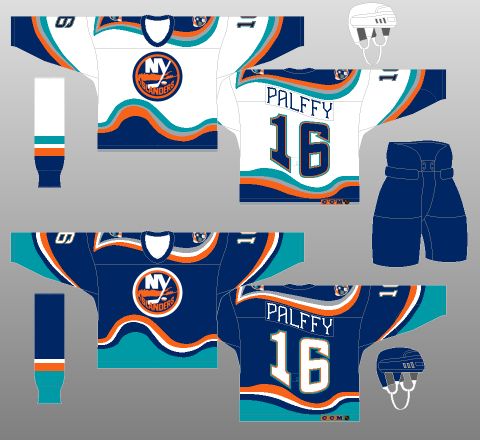
Aside from the logo, the jerseys too were such a radical departure from the classic look of the previous jerseys worn during the Islanders' Stanley Cup dynasty that they were doomed from the start. The basic Islanders color scheme of blue and orange was retained for the most part, but the addition of generous amounts of teal combined with the wavy waist stripes and rolling shoulder area, plus the addition of the rising and falling font for the names and numbers on the back, gave the whole look of the jersey the appearance of a seasickness generating permanent state of motion.

After two seasons on the ice, the Islanders began to phase out the fisherman logo, returning the classic "Long Island/NY" logo to the wavy jerseys as an alternate for the 1996-97 season and the exclusive jersey for the 1997-98 season. The season after that would see a wholesale return to an updated version of the four time Stanley Cup winning classic jersey, this time with three color numbers and four stripes on the shoulders to symbolize the team's four championships.

The fisherman jersey, while only used for two seasons, did sport a patch in 1996-97 for the Islanders 25th anniversary season, worn on both the fisherman and NY logo alternates.

We classify this jersey as "Curious". We can see the new Islanders owner's desire to rebrand their failing franchise at the time and actually find the blue road jerseys with the original "NY" logo to be quite striking and far from "ugly" in our book. We particularly like the secondary lighthouse logos and the attempt to break out of the mold of block numbers so commonly used at the time by creating a unique numbering font.

And this jersey is not nearly as "weird" as the Coyotes alternate since we can understand what they were trying to accomplish. If the Islanders had actually won a few playoff rounds while wearing these, perhaps the public would have given the jersey a fair chance on it's own merits, rather than making it "the lightning rod for all of the team's misfortunes".

The resemblance of the logo to the Gorton's fisherman is best qualified as "unfortunate", as having the rival New York Rangers fans mocking the Islanders because of the jersey meant it was never going to receive a fair shot at acceptability on Long Island.

New York Islanders 96-97 H F
New York Islanders 96-97 H B

In a special bonus today, we also present the road version of this jersey.

New York IslandersB96-97 F
New York IslandersB96-97 B

And for a super-special bonus today, I also own the 1997-98 "transition" jersey with the original "NY" logo as well.

New York Islanders 97-98 F
New York Islanders 97-98 B

Here's a quick video of ESPN introducing the Islanders' brand new uniforms and getting a stamp of approval from Gary Thorne.


We have a second video for you which quite nicely sums up the Fish Sticks era for the Islanders, as they are getting pasted by the Hartford Whalers in yet another classic jersey matchup.


For further reading, we recommend the Islander's longtime Media Relations Vice President Chris Botta's blog entry entitled, "The Tale of the Fisherman Jersey or Shame and Mutiny on the Bounty".