Showing posts with label Vancouver Canucks. Show all posts

Saturday, February 12, 2011

1975-76 Vancouver Canucks Dennis Ververgaert Jersey

Since the demise of the Brooklyn Americans in 1942, the NHL consisted of just six member teams, commonly referred to as "The Original Six". Finally, following the success of the Los Angeles Dodgers and San Francisco Giants in Major League Baseball on the west coast, the idea of expanding the NHL was first brought up in 1963, partly due to fears that the Western Hockey League was intending to operate as a major league in the near future and also in hopes of making the league more attractive to American television networks with coast-to-coast appeal.

The original discussions promoted San Francisco and Vancouver as acceptable locations with Los Angeles and St. Louis also as potential candidates in March of 1965.

In February of 1966, applications were received from groups from Los Angeles, Pittsburgh, Minnesota, Philadelphia, San Francisco, Baltimore, Buffalo and Vancouver.

In the end, franchises were awarded to Oakland (across the bay from San Francisco), Los Angeles, Minnesota, Philadelphia, Pittsburgh and... St. Louis.

The decision to exclude Vancouver caught many by surprise, especially those involved in the construction of the brand new Pacific Coliseum in Vancouver, and angered not only the locals, but all of Canada, since the six chosen cities were all in the United States. Various reasons emerged to explain the surprise inclusion of St. Louis, despite the fact there was no formal proposal from a group representing St. Louis!

Reportedly, Toronto and Montreal did not want to share Canadian TV revenues with a third club and support for expansion from Chicago was contingent on the creation of a team in St. Louis, which would result in the sale of the run-down St. Louis Arena, which just conveniently happened to be owned by the Chicago Black Hawks ownership group at the time.

Less than a year later the Oakland Seals franchise was having financial difficulties and an apparent deal was struck to move the club to Vancouver. The NHL however, did not want to see one of their brand new franchises moved so quickly and killed the deal. In exchange for avoiding a lawsuit, the NHL promised Vancouver a team in the next expansion, which occurred in 1970, when Buffalo and Vancouver were granted entry into the NHL, at a cost of $6 million, three times the cost in 1967.

Life for the Vancouver Canucks in the NHL the first few seasons was predictably rough, as the other six expansion franchises who began play in 1967-68 had a three year head start on the Canucks, not to mention the established powerhouses of the Original 6. Even tougher for the Canucks, they were placed in the "East" Division with the Boston Bruins, New York Rangers, Montreal Canadiens, Toronto Maple Leafs, Detroit Red Wings and their expansion cousins the Buffalo Sabres, while the West Division was comprised of the "Second 6" and the Chicago Black Hawks.

The Top 10 scoring leaders that season were all from Original 6 teams and nine of those resided in the East Division with the Canucks. That first season the Canucks were 0-4 against the Montreal Canadiens before managing a pair of late season ties on their way to a 24-26-8 record and a 6th place finish in the East, ahead of only the Red Wings by a single point.

1971-72 was a bit less successful than their debut season, as they dropped to last place in the East with a 20-50-8 record. Although they had four more wins than the Sabres, they fell behind them in the standings due to just 8 ties versus Buffalo's league leading 19. Montreal again dominated the series between the two clubs, including three overpowering shutouts by scores of 6-0, 7-0 and 5-0 on their way to sweeping the Canucks 5 games to none.

Vancouver showed little improvement with a 22-47-9 record, but were spared the basement due to the arrival of the expansion New York Islanders in 1972-73. Montreal again swept the board against Vancouver, taking all six meetings including wins of 9-1, 3-0 and 7-3.

For 1974-75, the Canucks were paroled from the mighty East Division and placed in the brand new Smythe Division with the Chicago Black Hawks, Minnesota North Stars, St. Louis Blues and expansion Kansas City Scouts. The resulting change in the Canucks schedule, as well as the team gaining experience and confidence from playing together for several seasons now, saw them leap up to a 38-32-10 record on their way to not only a Division championship, but their first playoff appearance. Still the specter of the Canadiens loomed, as they defeated the Canucks in all four regular season appearances and eliminated them from the playoffs.

The losing streak continued in 1975-76 with a 6-4 loss on November 29th, a 2-2 tie on December 20th. Another 2-2 tie on January 27th extended the Canucks streak of futility against Montreal to 30 games (0-25-5) prior to their meeting on this date in 1976 in Montreal.

Defenseman Mike Robitaille opened the scoring for the Canucks with an unassisted goal at 6:34 against the Canadiens Ken Dryden. Ron Sedlbauer added to the Canucks lead a minute later with his 12th goal of the season at 7:32. The Canucks leading scorer that season, Dennis Ververgaert, scored on the power play at 15:15 with both Mario Tremblay and Bob Gainey in the penalty box for Montreal. Sedlbauer shocked the fans at the forum with his second goal of the period at 18:09 to put the visitors up by a score of 4-0 after just 20 minutes while dominating play with a 16-8 lead in shots on goal.

Ron Sedlbauer
Ron Sedlbauer

Ververgaert extended the Canucks lead at 2:46 of the second before the Canadiens began their comeback. Jim Roberts scored to get Montreal on the board at 8:55 and Peter Mahovlich cut the lead to 5-2 at 17:07 of the second period.

Ververgaert Canucks
Dennis Ververgaert

Bobby Lalonde counted Mahovlich's goal just 1:36 into the third period to restore the Canucks four goal lead. Vancouver held Montreal off the board for the first half of the period, but the Canadiens showed signs of life with a pair of goals less than 30 seconds apart at the midway point of the period with scores from Mahovlich and Doug Risebrough at 10:26 and 10:55 to make the score 6-4 with plenty of time remaining for the defending Stanley Cup champions to come back.

Goaltender Ken Lockett held off the Canadiens for the remainder of the game as the Canucks played a disciplined game and stayed out of the penalty box the rest of the way to secure their first regular season win over the Canadiens in franchise history, and accomplish it on the road in the always tough Montreal Forum.

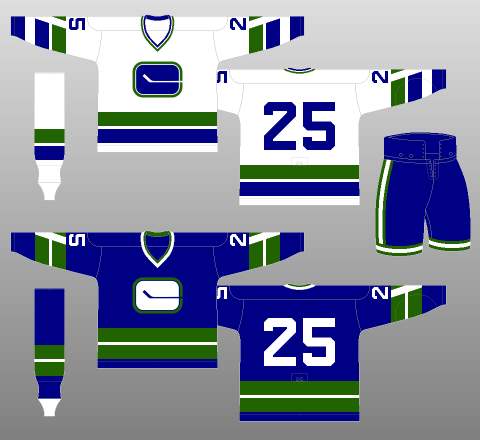
Today's featured jersey is a 1975-76 Vancouver Canucks Dennis Ververgaert jersey as worn during the Canucks first ever win against the Montreal Canadiens after five winless seasons and 30 tries. Ververgaert contributed to the Canucks win with a pair of goals that night.

The Canucks original jerseys had a pair of wide green stripes on the waist and arms, as well as a white "V" over the green stripes on the sleeves. This style lasted for only two seasons before a change to a single green stripe which was trimmed in white. No names were worn on the back until 1977.

Ververgaert was drafted third overall in 1973 by the Canucks and made the jump from junior hockey straight to the NHL. As a rookie he scored 26 goals. Two seasons later he had a career season, netting 37 goals and totaling 71 points. He had two more 20-goal seasons in his six seasons as a Canuck. He as traded to the Philadelphia Flyers halfway through the 1978-79 season. After a year and a half with the Flyers, Ververgaert's final NHL season was spent with the Washington Capitals. In all, he scored 176 goals and 392 points in eight NHL seasons and was the Canucks second leading goal scorer during their first decade.

Vancouver Canucks 75-76 F
Vancouver Canucks 75-76 B

Our video section today has home movies of the Canucks taken in 1976, featuring some overly dramatic music which tries to make the footage of warmups seems rather important, but still a nice look at the Canuck jerseys of the day.


Here, the rookie Ververgart slugs it out with Wayne Cashman of the Bruins, showing no intimidation as he establishes himself in the NHL.


Wednesday, December 8, 2010

1980-81 Vancouver Canucks Harold Snepsts Jersey

A rugged, stay at home defenseman, Harold Snepsts played junior hockey for the Edmonton Oil Kings in the Western Canadian Junior Hockey League in 1972-73 and 1973-74 before being drafted by the Vancouver Canucks 59th overall in the 1974 NHL Amateur draft. He was also selected by the Indianapolis Racers of the WHA, but elected to sign with the Canucks of the more established NHL.

He split his games in 1974-75 between the Seattle Totems of the Central Hockey League and the Canucks, with whom he appeared in 27 games and scored his first NHL goal. Snepsts story is not one of goals and points though, as he never had more than seven goals and only scored 30 points once during his long career.

Snepsts Canucks

He became entrenched in the Canucks lineup the following season and quickly became popular with the Canucks faithful through is hard work, rugged style, outgoing personality and legendary mustache, which still ranks highly on lists of the best mustaches in league history. Such was Snepsts popularity with the fans in Vancouver, that they would regularly chant "Har-old, Har-old".

In just his third season of 1976-77, his popularity grew as Snepsts made his first NHL All-Star Game appearance as the Canucks lone representative in the first All-Star Game hosted by Vancouver.

In 1978-79 , Snepsts had his best offensive season with career highs in goals with seven, assists with 24 and points, totaling 31. The next season Snepsts experienced the thrill of becoming the first defenseman in Canucks history to score on a penalty shot.

Between 1977 and 1982, Snepsts was named the Canucks top defender four times in five years and increased the rugged nature of his game in 1979-80 when he raised his average penalty minutes from 130 the previous four seasons to 206 the next two years.

Snepsts Canucks

In 1982, Snepsts would appear in his second All-Star Game. Later that season the Canucks would go on a run to the Stanley Cup Finals, the only finals appearance of Snepsts career as he was credited for his sound defensive play as the Canucks continued to advance.

After two more seasons in Vancouver, in a highly unpopular move, Snepsts was dealt to the Minnesota North Stars as part of a Canucks youth movement. He set a career high in penalty minutes while with Minnesota in 1984-85 before signing with the Detroit Red Wings for the next three seasons as a free agent.

Snepsts Red Wings

After rarely missing a game in ten seasons with the Canucks, with seven seasons of over 75 games played and only full season under 68, injuries began to catch up Snepsts during the latter part of his carer, as he never again reached 60 games in his final six seasons of play.

Knee and shoulder injuries would derail his time in Detroit and Snepsts would return to the Canucks as a free agent in 1988 to provide depth and veteran leadership, which helped the Canucks set a club record at the time for fewest goals against in a season.

Looking for that same depth and experience, the St. Louis Blues acquired Snepsts late in the 1989-90 season. He returned to the Blues for the 1990-91 season, which included his 1,000th game on this date in 1990, a 2-1 Blues win over the Red Wings.

Snepsts Blues

Snepsts would retire at the conclusion of the season, having appeared in 1,033 games, scoring 38 goals and 195 assists for 233 points while spending 2,009 minutes in the penalty box.

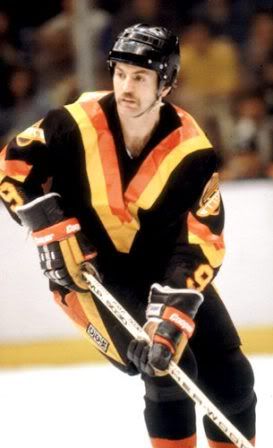
Today's featured jersey is a 1980-81 Vancouver Canucks Harold Snepsts jersey. From the Canucks inception in 1970-71 to 1977-78 the Canucks wore blue and green jerseys, but in 1978, all that came to an abrupt end.

Before the 1978-79 season the Canucks hired a professional psychologist to redesign their uniforms. The old colors were said to be "too bland, too tranquil and did not inspire emotion." The result was the "V" design, suggesting "victory" according to the designer, one of the strangest, yet most unforgettable jerseys to ever see the ice in an NHL contest.

The bright orange was said to "evoke passion and aggression" while the black road jersey was supposed to instill fear in the opposition.

The Canucks introduced the jerseys, which none of the players had seen prior to the game, at the season opener in Minnesota. As Stan Smyl said, "I've never been ashamed to wear the Canuck's uniform, but that night none of us wanted to leave the dressing room."

They were met with much derision around the NHL and were often referred to as "those Halloween suits". Time has settled on the nickname of "The Flying V" for these jerseys.

The basic jersey produced in 1978 remained in use until the 1984-85 season, but with a few adjustments along the way, such as a change in color for the names on the back, relocating the very unconventional sleeve numbers from the wrists to the shoulders and eventually evolving from one color names and numbers to two colors for both.

Despite others often ranking this as one of the top three, if not the worst, jersey of all time, we are actually fans of the whole concept of trying to design a jersey in an effort to aid your team in victory. It took some bold thinking and a lot of guts for the designer to create this jeresy and then even more for the club to support the concept and stick with it for seven seasons.

The "Flying V" jerseys are a curiosity, as no other team followed them down the same path, leaving the "Flying V" as a truly unique chapter in NHL history.

Vancouver Canucks 80-81 jersey

Today's video feature is a profile of Snepsts, which includes him as one of the seven greatest Canucks of all time and the only defenseman on the list.


Saturday, November 27, 2010

1986-87 Vancouver Canucks Michel Petit Jersey

Pull up a chair, sit back and let us tell you about a journey which follows a long and winding path across a vast continent from west to east, from the north to the south and finally to distant lands across a mighty ocean and back. And then back again...

The professional hockey career of Michel Petit began in 1982-83 when he made his NHL debut with a pair of games for the Vancouver Canucks after having been the Canucks 1st pick in the 1982 Entry Draft. He spent the majority of the season with the St. Jean Castors of the QMJHL in Canadian Juniors, 2,302 miles to the east but made the Canucks squad after 19 games with the Canadian National Team in 1983-84 and saw action in 44 games, which included the defenseman's first goal.

Petit Canucks

Petit played 69 games with the Canucks in 1984-85 and split time between the Canucks and the Fredericton Express of the AHL (in eastern Canada 2,670 miles away in New Brunswick) in 1985-86. After one more season with the Canucks, ten games into the 1988-89 season he was dealt to the New York Rangers for two players, across the border 2,425 miles away. Once in New York, he wasted little time establishing a career high in penalty minutes, racking up 223 in 64 games with the Rangers in addition to the 35 he had already accumulated in Vancouver.

Petit Rangers

After a second season on Broadway, the Rangers dealt Petit back across the border to the Quebec Nordiques 442 miles to the north. Following the season Petit had the honor of skating for Canada at the 1990 World Championships in Switzerland.

After 19 games of the 1990-91 season, Petit began his journey back west when he was included in a trade to the Toronto Maple Leafs, 451 miles to the southwest. He played in 54 games with the Maple Leafs and set a career high in goals and points that season, lighting the lamp 4 times in Quebec and 9 times in Toronto for a total of 13. His final point total reached 37, eclipsing his previous season's mark of 36.

Petit Maple Leafs

Petit once more was on the move 1,682 miles down the Trans Canada Highway when he was a part of the blockbuster ten player deal with the Calgary Flames which sent Doug Gilmour to Toronto. He played two and a half seasons with the Flames before completing his second trip across the continent, and third trip across the border, when he signed as a free agent with the Los Angeles Kings for the 1995-95 season, 1,194 miles south.

Petit Flames

Racking up the frequent flyer miles, the Kings sent Petit was sent 2,148 miles across the United States 9 games into the following season when they traded him to the Tampa Bay Lightning, a season which included the most playoff action of his career with six postseason games.

Petit Lightning

It was back north across the Canadian border 2,363 miles up to Edmonton where he signed as a free agent to start the 1996-97 campaign. By January he had only seen action in 18 games and was claimed off of waivers by the Philadelphia Flyers across the border once more 2,009 miles to the east.

Petit Flyers

He began the 1997-98 season with the Detroit Vipers of the IHL (441 miles from Philadelphia) and was then signed by the Phoenix Coyotes in November, adding another 1,686 miles to his journey and making him the first player in NHL history to play for ten different teams when he made his Coyotes debut on this date in 1987.

Petit Coyotes

He began the 1998-99 season 256 miles north with the Las Vegas Thunder of the IHL but missed the majority of the season when he suffered a head injury which limited him to just six games.

Petit's journey through the world of hockey now expanded beyond North America when he signed to play with the Frankfurt Lions of the German DEL for 1999-00, adding 5,577 miles to his itinerary. Still with the Lions at the start of the 2000-01 season, he returned to North America when he joined the Chicago Wolves in the IHL, 4,341 miles on the return leg to the United States.

With no North American opportunities available for the 2001-02 season, Petit packed his gear bag for the final time when he closed out his playing career with 14 games with HC Bolzano of the Italian Serie A in the far northeast of Italy where the Italian Serie A hockey league is concentrated, 4,571 miles from the midwest.

By our calculations, Petit played professionally for 16 different clubs in four different countries which included crossing an international border to change clubs ten different times, traveling 34,558 miles from club to club, and he wore a total of 21 different NHL jerseys.

Michel Petit jersey history

While a remarkable number, it falls far short of the estimated 40 worn by Third String Goalie legend Mike Sillinger.

Today's featured jersey is a 1986-87 Vancouver Canucks Michel Petit jersey. This jersey was worn during Petit's sixth season with the Canucks prior the beginning of his hockey odyssey that would send him back and forth across North America seven times.

This style of Canucks jersey was adopted in 1985 after seven seasons with the controversial "flying V" style worn in Petit's NHL debut season. In 1985-86 when this jersey debuted it was worn with both the Expo 86 patch as well as the City of Vancouver 100th Anniversary patch.

During the season our featured jersey was worn, the Canucks wore one of the most unique patches in NHL history, a patch supporting Rick Hansen's Man in Motion World Tour, where Hansen pushed his wheelchair nearly 25,000 miles to raise money for spinal cord injury research over two years through 34 countries and 4 continents, which raised $26 million. It is the only patch in league history to be placed on the lower left hem.

Two seasons later the Canucks wore a memorial patch to former NHL player and Canucks goodwill ambassador "Babe" Pratt, making for four different patches worn during the four year lifespan of this style Canucks jersey before it evolved to an even simpler style in 1989-90.

Vancouver Canucks 86-87 jersey
Vancouver Canucks 86-87 patch

Bonus Jersey: Today's bonus jersey is a 2000-01 Frankfurt Lions Michel Petit jersey from his second season with Frankfurt in the German DEL. Petit was not alone that season, as the nine leading scorers for Frankfurt were fellow Canadians!

The Lions were founded in 1959 and won the DEL championship in 2004, but sadly ceased operations at the end of the 2009-10 season after 50 seasons of competition.

Frankfurt Lions 00-01 jersey

In today's video section, Dale Henry of the Islanders shreds Petit's jersey in the early part of a brawl and Petit responds by knocking Henry into the middle of next week.


Here, Petit stands in against Bob Probert, and while he may not have won the fight, he certainly earns our respect for getting back up off the ice twice and continuing to battle the feared Probert, even landing a few solid blows in the process.


Friday, November 12, 2010

1991-92 Vancouver Canucks Pavel Bure Jersey

Born in 1971 in Moscow in the Soviet Union, Pavel Bure was once selected to practice with Wayne Gretzky and Vladislav Tretiak for a television program at the age of 11. By the age of 14, Bure was named to the famed Central Red Army's junior team.

In 1986, five years before playing in Vancouver as a professional, Bure toured Canada with a Soviet youth team and played a game at the Pacific Coliseum, his future home rink.

Bure made his debut with the Central Red Army senior club in 1987-88 at the age of 16 as a fill-in player when the Red Army Club was without several regulars who were participating in the 1987 Canada Cup. In all, he managed to get into five games, which included scoring his first goal.

While with CSKA Moscow, Bure was teamed with Alexander Mogilny and Sergei Fedorov, a dangerously potent line combination that was set to dominate not only Soviet hockey, but international hockey for years to come, until politics interfered and changed everything.

Bure set a Soviet League record for goals by a rookie in 1988-89 when he totaled 17 goals in 32 games, a mark that would stand for 18 years. He was recognized for his for his efforts by being named the rookie of the year. He also participated in the 1989 World Junior Tournament, with his eight goals tying for the tournament lead. Additionally, his 14 points led the tournament in scoring, earned him Best Forward honors and led the Soviet Union to the gold medal.

It was following this tournament that Mogilny would defect, breaking up the line the Soviets expected would lead them into the future.

Later on June 17, 1989, thanks to some detective work by their head scout, the Vancouver Canucks were able to draft Bure one year earlier than many thought he would be eligible due to a rule that stated he needed at least two seasons of play, with a minimum of 11 games each season, for his top-level European club.

Although Bure only played in five league games, it was discovered he had also competed in enough exhibition and international games to make him eligible to be chosen 113th overall in the 6th round. The Detroit Red Wings had even been told by an NHL vice-president that Bure was not eligible prior to their fifth round pick. Verbal complaints and written protests followed, which resulted in a formal investigation, which ended in league president John Ziegler declaring the pick illegal on May 17, 1990.

Bure would compete in the 1990 World Junior Championships, this time scoring seven goals in seven games, but come up short with a silver medal. Later that spring he made is debut with the Soviet National Team as a 19-year-old at the World Championships in Switzerland in which he scored six points in ten games on the way to a gold medal.

Pavel Bure
Pavel Bure at the 1990 World Junior Championships

Another international tournament was on the calendar for 1990, this time in Seattle, Washington for the Goodwill Games. While the Soviet Union won the gold medal, and Bure contributed four goals and an assist in five games, the tournament is best remembered for the defection of Bure's other linemate, Fedorov, who tried to persuade Bure to defect with him. Bure declined out of concerns about the repercussions for his brother Valeri, who was then an up and coming 15-year-old in the Soviet Union.

After the Canucks selection of Bure was negated by the league's ruling, Vancouver appealed to the league and provided game sheets proving his participation in the required number of games. On June 15, 1990, the day before that year's Entry Draft in which Bure would have been fair game for any team who wished to select him, Vancouver's selection of Bure was permanently reinstated.

In Bure's third season with Central Red Army in 1990-91, he tied for the team lead in scoring with 46 points in 44 games. His 35 goals were one behind the league leader in that category. During the season he also participated in his third World Junior Championships. Bure finished as the tournament's leading scorer once more following his 12 goal, 15 point effort, but had to once more settle for a silver medal. He concluded his junior career with a tournament record 27 goals.

Later that spring he participated in the 1991 World Championships where he tied for the team lead with 11 points in 11 games on his way to a bronze medal finish.

Bure left Moscow on September 6, 1991 and the Canucks began to negotiate a contract with Bure, but before it could be finalized, the Canucks also had to deal with the Central Red Army club, who had an existing contract with Bure. The two sides met in late October of 1991 in Detroit and in the end, Bure was free to join the Canucks following a $250,000 payment to Central Red Army. Once that deal was settled, Bure signed a four year contract with Vancouver, making him the second highest paid player on the team behind only team captain Trevor Linden.

Due to the court proceedings, Bure missed the first month of the season and eventually made his NHL debut on November 5, 1991 against the Winnipeg Jets which ignited "Pavel-mania". His speed on the ice was eye-catching and led to his eventual nickname of "The Russian Rocket".

Pavel Bure
Prior to his NHL debut, Bure poses for one of
Upper Deck's unconventional "lifestyle" cards

After a 4-3 win over the Los Angeles Kings on November 7th, Bure got his first NHL point on November 10th with an assist on a goal by Cliff Ronning in a 6-0 win over the New York Islanders.

Finally on this date in 1991, Bure scored his first goal in the NHL when he beat Daniel Berthiaume of the Los Angeles Kings and added a second one in an 8-2 win in Vancouver. As he adjusted to life in North America and the NHL style of game, he was able to score 12 goals in 42 games. It was at that point that Bure caught fire and surged to the end of the season with a stellar 22 goals in his final 23 games, which sent Vancouver into a frenzy and gave him 34 goals and 60 points in 65 games, which tied a team record for points by a rookie.

Pavel Bure
Bure as a rookie in 1991-92

Once in the playoffs, Bure registered his first hat trick during Game 6 of the Canucks opening round series against Winnipeg. The Canucks would participate in two rounds of the playoffs that season, with the confident rookie scoring 6 goals and 10 points in 13 games.

At the conclusion of the season, Bure was named the winner of the 1992 Calder Trophy as NHL Rookie of the Year, the first Canuck's player to win an individual award in the team's 21 seasons.

Pavel Bure
Bure poses with the Calder Trophy

Today's featured jersey is a 1991-92 Vancouver Canucks Pavel Bure jersey as worn during his rookie season in which he scored his first two NHL goals on this date in 1991.

This jersey features the NHL 75th Anniversary patch on the right chest as worn by all players in the NHL that season. This style of jersey was adopted in 1989 and worn through the 1996-97 season, with the only notable change being the addition of the "Canuck Place" patch in 1992.

Vancouver Canucks 91-92 jersey

Bonus Jersey: Today's bonus jersey is a 1991 Soviet Union Pavel Bure jersey. Following Adidas in the mid to late 1980's, the Finnish brand Tackla became the supplier for the World Championships and Olympics through 1993. Their jerseys featured mesh fabric and classic styling (for the most part), with contrasting colored shoulders which contained repeating diamond shapes, which is the Tackla company logo.

Their jerseys are also instantly recognizable by their block font numbers with the "3-D" drop shadow effect. These jerseys are all sublimated, and therefore age very well, retaining their bright colors over time.

Jerseys worn in 1994 and 1995 were branded as Reebok jerseys, but have all the hallmarks of being produced by Tackla, the dye-sublimated mesh fabric and 3-d block numbers, especially the logo on the lower left hem on the back which reads "manufactured by Tackla"!

Soviet Union 1992 jersey

In today's video segment, a look at what could have been, with Bure, Mogilny and Fedorov playing together at the 1989 World Junior Tournament.


Next, a look at "Pavel-mania" during Bure's rookie season, including footage of his first NHL game and his first two NHL goals.


Saturday, September 4, 2010

1994-95 Vancouver Canucks Sergio Momesso Jersey

Born on this date in 1965, Sergio Momesso was drafted 27th overall by the Montreal Canadiens in the 1983 NHL Entry Draft after scoring 69 points in 70 games with the Shawinigan Cataractes of the QMJHL.

He continued to play for Shawinigan the following season, raising his point totals to 42 goals and 130 points. The 6' 3" left winger also made ruggedness apparent with 235 penalty minutes. After scoring 8 points in 6 playoff games, Momesso gained more experience by joining the Nova Scotia Voyageurs of the AHL for the remainder of their playoffs. Additionally, he made his NHL debut with a single game with the Canadiens.

1984-85 saw Momesso gaining more confidence and experience with the Cataractes as he scored 56 goals and 146 points in 64 games, earning QMJHL Player of the Year recognition.

He made the Canadiens roster following an impressive training camp in 1985, but suffered a knee injury after 24 games, which included his first NHL goal. The injury prevented Momesso on opportunity to play for the Stanley Cup, which Montreal would go on to win at the conclusion of the season.

Momesso played for his hometown Canadiens for two more seasons before being traded to the St. Louis Blues after a 53 game season in 1988-89, he would set an NHL career high with 24 goals and 56 points, as well as 199 penalty minutes, while playing with the high scoring Brett Hull and Adam Oates for much of the 1989-90 season.

At the 1991 trade deadline, Momesso was one of four Blues sent to the Vancouver Canucks, a trade considered one of the best in Canucks history, as addition to Momesso, Vancouver also received Geoff Courtnall and Cliff Ronning as part of the deal.

The highlight of Momesso's four seasons in Vancouver was the team's run to the Stanley Cup Finals in 1994, where they took the New York Rangers to a decisive Game 7. Momesso contributed 3 goals and 7 points in the Canucks 24 playoff games, including the game winner in overtime in Game 4 of Round 2 against the Dallas Stars.

Following the 1994-95 season, he was dealt to the Toronto Maple Leafs where he played 54 games before being moved to the New York Rangers. He started the 1996-97 season with the Rangers, but after just nine games, he landed back in St. Louis for the final 31 games of his NHL career.

Unable to find work in the NHL for the following season, Momesso signed with the Cologne Sharks of the DEL in Germany for the 1997-98 season. The German game agreed with Momesso, as he scored 33 points in 42 games that season. He played for the Nuermberg Ice Tigers in 1998-99 where he set a professional high with 59 points which came in just 48 games.

A return to the Sharks came for 1999-00 followed by one final season with Cologne before Momesso retired following the 2000-01 season.

His final NHL career totals were 152 goals and 193 points in 345 games, plus an additional 63 goals and 151 points in Europe.

Today's featured jersey is a 1994-95 Vancouver Canucks Sergio Momesso jersey. This jersey style was first introduced in 1989-90. The NHL 75th Anniversary patch was worn in 1991-92, the Canuck Place patch arrived in 1992-93, along with the Stanley Cup Centennial patch worn that season.

1993-94 saw the 2 Pts. F. G. patch worn as a memorial to team owner Frank Griffiths, which was later joined by the 1994 Stanley Cup Finals patch.

Today's featured jersey sports the Vancouver Canucks 25th Anniversary patch, as worn in the 1994-95 season. There were no additional patches worn for the final two seasons of life for this highly decorated style, which saw six different patches worn in eight seasons, including a high of three at the same time during the 1994 cup finals.

Vancouver Canucks 94-95 jersey

Bonus Jersey: Today's Bonus jersey is a 1997-98 Cologne Sharks Sergio Momesso jersey as worn during the final four seasons of Momesso's career following his move to the German DEL.

This jersey is typical of the European leagues with it's multiple sponsorship logos which are often given priority over even the club's own identity.

Cologne Sharks 97-98 jersey

All of the available videos online of Sergio Momesso are fighting videos, and here is the best of the lot.

First up, Momesso gives as good as he gets when he and Mark Tinordi exchange blows in a great scrap called.


Momesso apparently has an issue with Minnesota North Stars, as here he has a go with Basil MacRae and gets in a clean shot that staggers MacRae, who to his credit gathers himself up and comes back for more. Take note of MacRae's doctored sleeves, which open up to free his arms for fighting, particularly his left sleeve at the :50 mark!


Wednesday, August 25, 2010

1980-81 Vancouver Canucks Richard Brodeur Jersey

Today's Curious, Weird and Ugly™ Collection jersey sees us return to Vancouver once more with one of the strangest and unforgettable jerseys to ever see the ice in an NHL contest.

From the Canucks inception in 1970-71 to 1977-78 the Canucks wore blue and green jerseys, another one of those lame "blue for water, green for trees" jerseys where a professional sports team feels they must be the leading voice for the local board of tourism. Well, in 1978 all that came to an abrupt end.

Before the 1978-79 season the Canucks hired a professional psychologist to redesign the uniforms. The old colors were determined to be "too bland, too tranquil and did not inspire emotion." The result was the "V" design, suggesting "victory" according to the designer. The bright orange was said to "evoke passion and aggression" while the black road jersey would instill fear in the opposition.

The jerseys featured no main team logo on the front, but instead a giant "V" shape done in bright orange and yellow on a black jersey. The sleeves also featured smaller "V" shapes midway down the arm with a new "Flying Skate" logo for the shoulders and the very unusual placement of the sleeve numbers at the very bottom of the arms on the wrists!

The "V" shape was not limited to just the jerseys either, as the breezers had giant multi-colored "V's" as well. During the first year these jerseys were worn, they even had "V" shaped stripes on the socks.

Photobucket

The Canucks introduced the jerseys, which none of the players had seen prior to the game, at the season opener in Minnesota. As Stan Smyl said, "I've never been ashamed to wear the Canuck's uniform, but that night none of us wanted to leave the dressing room."

They were met with much derision around the NHL and were often referred to as "those Halloween suits". Vancouver nearly got the last laugh however, as they made it all the way to the Stanley Cup Finals in 1982 before running smack into the New York Islanders dynasty, which was in full stride. Time has settled on the nickname of "The Flying V" for these jerseys.

The basic jersey produced in 1978 remained in use until the 1984-85 season, but with a few adjustments along the way, such as a change in color for the names on the back, relocating the very unconventional sleeve numbers from the wrists to the shoulders and eventually evolving from one color names and numbers to two colors for both.

Some feel that the Canucks have never gotten it right, as the original logo was too simplistic, the Flying V was too hideous, the Flying Skate was too busy and the Orca logo too corporate, as the Canucks were owned by Orca Bay Entertainment when the Orca/Killer Whale logo was adopted.

This online exchange seems to sum up the Canucks jersey history quite succinctly.
Q: "Why are the Vancouver Canucks jersey's always ugly?

Seriously, there [sic] always horrible. Do the designers for Vancouver really think they look good? I always get a headache watching them play.

Vancouver fans, please answer! Please explain why you have idiots as designers?"

A: "I thought it was a league rule. Vancouver must always have the ugliest sweaters."
Maxim magazine, which I only read for the articles, rated the Flying V jerseys as "The Worst Sports Uniform" in any sport.

The only patch the Canucks wore on the Flying V jerseys was a "JCM" memorial patch to honor former GM Jake Milford in 1984-85.

We classify this jersey as "Curious" and "Weird". Many consider it ugly, but we're actually quite a fan of the whole idea of trying to design a jersey in an effort to aid your team in victory. It took some bold thinking and a lot of guts for the designer to create it, and then even more for the club to support the concept and stick with it for seven seasons. I can't see anyone in the NHL being bold enough to risk the large amounts of income clubs rely on from the marketing of jerseys by trying something so far outside the norm these days.

Yes, they are weird, when compared to the jerseys of the day, quite weird. One almost wonders why they even bothered to include the tiny sleeve numbers on the cuffs since they are so small and out of the way. The "Flying V" jerseys are also certainly a curiosity, as no other team followed them down the same path, leaving the "Flying V" as a truly unique chapter in NHL history.

This first example is a 1980-81 Vancouver Canucks Richard Brodeur jersey with the one color names and numbers with the sleeve numbers on the cuffs as worn during their second season of use.

Vancouver Canucks 80-81 F
Vancouver Canucks 80-81 B

This second example is a 1982-83 Vancouver Canucks Dave "Tiger" Williams jersey showing the evolution of the design, now with two color names and numbers and now having the sleeve numbers relocated to a more traditional shoulder location.

Vancouver Canucks 82-83 F
Vancouver Canucks 82-83 B

Here are some highlights of the Flying V jerseys in action, particularly from the Canucks 1982 Stanley Cup run.


Monday, August 9, 2010

1995-96 Vancouver Canucks Trevor Linden Jersey

Today kicks off a new theme to fill the dog days of the hockey off season where the historical events in hockey history are few and far between.

Without further delay, we give you The Curious, Weird and Ugly™ Collection. we don't actually dislike all of the jerseys that we will be featuring, in fact we like a few of them very much, but there are others that are so bad, so horrible, that they make us downright angry that they ever saw the light of day in the first place. Seriously, it was bad enough that some dummy came up with the concept in the first place, but then a whole series of people in authority had to approve them before they ever saw the light of day!

Without further delay, a 1995-96 Vancouver Canucks Trevor Linden jersey.

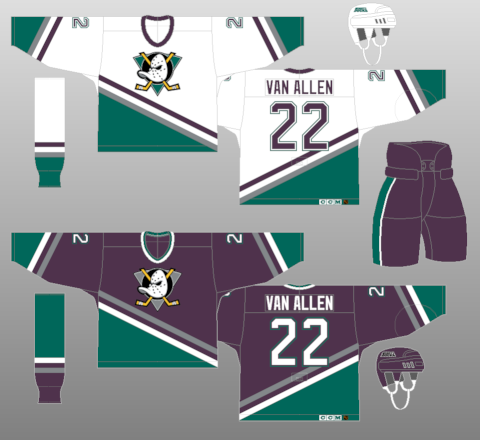
Now, there had been diagonal elements in jerseys prior to the introduction of this Vancouver Canucks red (or is it black?) first-ever alternate jersey, such as the Mighty Ducks of Anaheim jerseys of 1993-94, but gradients were a new development in 1995-96. To the best of our knowledge the dye-sublimation printing process, which allowed for the gradients to be incorporated into jersey designs had never been used for NHL jerseys before, but the process made it's presence known with the first NHL alternates introduced in early 1996 with gradients incorporated into the designs from the Los Angeles Kings, Pittsburgh Penguins and Vancouver Canucks.

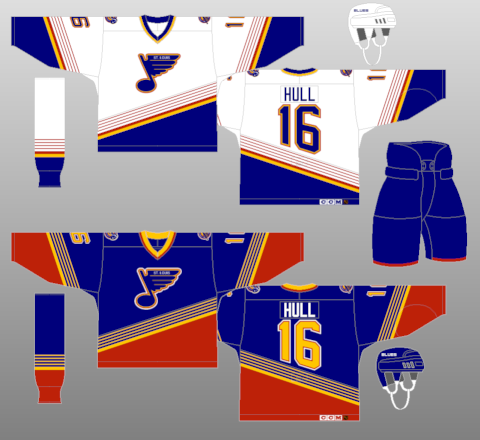
While the diagonally striped jerseys from the Mighty Duck of Anaheim and the St. Louis Blues had a different color below the lower stripe, the Canucks was really the first genuine two color affair, with the amount of black and red being much closer to 50-50 than the Mighty Ducks mainly eggplant jerseys and the Blues predominately blue road sweaters.

The main design element of the Canucks jersey is the rather clever extension of the coloring of the Canucks logo across the body of the jersey. The black background of the logo, as was the yellow lettering of the word "Canucks" that made up the skate blade, were both extended outward from the diagonally oriented logo, with the striping on the left side of the jersey fading away to nothing. An odd decision was the upward angle the stripes took on the right side of the jersey, giving the stripes a "checkmark" look instead of having them continue uninterrupted to the side of the jersey, as the Mighty Ducks and Blues jerseys did.

Yet another curious choice was that the upward tick to the chest stripes were not in alignment with the arm stripes. You would think as long as they decided to make the chest stripes change direction in midstream, they would have continued those stripes at a matching angle across the arm instead of orienting the arm stripes at their own unique angle independent of the chest stripes.

Unlike some of the contemporary alternates introduced by other clubs that same season, which were quickly rejected failures, the Canucks new alternate jerseys lasted two full seasons, worn with solid black socks their first season and with red socks with stripes similar to the jerseys the second. No additional patches were worn on this alternate jersey during it's brief existence.

This Canucks jersey does have a few things in it's favor though. The list of players who wore it is rather impressive, as the Canucks were filled with recognizable names like Alexander Mogilny, captain Trevor Linden, Cliff Ronning, Martin Gelinas, Esa Tikkanen, Bret Hedican, Adrian Aucoin, Markus Naslund, goaltender Kirk McLean and superstar Pavel Bure, who was temporarily wearing sweater #96 at the time.

Another thing it has going for it is the way it fits in with the home and road jerseys, as it uses the same main crest and uses what is normally a trim color, red, as a primary color. The names and numbers are all very legible, with the yellow standing out nicely from the red background, and are done in the same fonts as the home and road jerseys for a consistency across the entire set.

Overall, we classify this jersey as "Curious" due to mainly the "checkmark" chest stripe and the introduction of the gradient stripes.

Vancouver Canucks 95-97 F
Vancouver Canucks 95-97 B

Here's a lucky find, the Vancouver Canucks red alternates in game action versus the Hartford Whalers (for a truly excellent jersey matchup), although it's more fist throwing action than puck shooting action, but sometimes you take what you can get. Don't forget to take notice of future Italian National Team goaltender Jason Muzzati in net for the Whalers.