Showing posts with label Los Angeles Kings. Show all posts

Thursday, March 31, 2011

1972-73 Los Angeles Kings Butch Goring Jersey

Drafted by the Los Angeles Kings in the 1969 NHL Amateur Draft, Butch Goring split his first two seasons between the Kings and their minor league affiliate, the Springfield Kings of the AHL. During his first season with Los Angeles Goring scored 13 goals and 36 points in 59 games and a whopping 8 penalty minutes, setting the tone for the remainder of his career.

In 1971-72, Goring became a full-time NHLer, playing 74 games exclusively with Los Angeles. He registered exactly 50 points that season and a mere 2 penalty minutes.

Goring Kings

He bettered his point totals in 1972-73 when he set new personal bests with 28 goals and 31 assists for 59 points and, on this date in 1973 in the Kings final game of the season, Goring scored a goal and an assist, but more notably, he was whistled for his only penalty of the entire season midway through the game!

1973-74 saw Goring better his point total by 2 with 61 and again received but one penalty the whole season, his third consecutive season with but a single penalty.

Over the course of the next five seasons Goring would remain a model of consistency, playing in 398 out of a possible 400 games while setting new personal highs in points three times, finally topping out at 87 in 1978-79, a season in which Goring would "goon it up" with a career high 16 penalty minutes, one of only three times in 17 seasons he would reach double digits in minutes served in the penalty box.

Prior to setting his career point and penalty minute highs in 1979, Goring established a career best mark with 37 goals scored in 1977-78, a season in which he would also win the Masterton Trophy as well as a long overdue Lady Byng Trophy for gentlemanly play after being bypassed his previous six full seasons by players who had as many as 18 minutes in a season. Goring equalled a then career low with just 2 penalty minutes, the fourth time to date he would be whistled for just a single penalty during a season in which he played a minimum of 67 games.

Goring would play 69 games of the 1979-80 season with the Kings before being traded to the New York Islanders in March. He competed in the final 12 regular season games for New York and was regarded as a key element which put the Islanders over the top, as the club had made it as far as the playoff semifinals four times in the previous five seasons without having ever made it to the Stanley Cup Finals.

With Goring on board, the Islanders not only qualified for the finals for the first time ever, they successfully defeated the Philadelphia Flyers 4 games to 2 to capture the first of four consecutive Stanley Cups of the Islanders dynasty. The 21 playoff games Goring played during the 1980 playoffs compared to the 30 Goring had appeared in during his previous 10 seasons in Los Angeles and his 19 points during that playoff season eclipsed the 18 he had in all his years in Los Angeles combined.

Goring Stanley Cup

The Islanders success following the acquisition of Goring is perhaps the one trade which began the current tradition of contending clubs looking to add key pieces to their roster in preparation for the playoffs that created the frenzy which the NHL trade deadline has now become.

During the final 12 regular season contests for New York, Goring received one penalty, which brought his career total in xx seasons up to 68, one more than the NHL single game record of 67 set by former Kings' teammate Randy Holt one year earlier.

In 1980-81, Goring played 78 games for the Islanders, scoring 60 points and competing the season without a single penalty for the only time in his career. Shockingly, Goring was passed over for the Lady Byng Trophy once more.

During the postseason, Goring scored 10 goals and 10 assists for 20 points in 18 games. While he came in fourth in playoff scoring for the Islanders, 15 points behind team leader Mike Bossy, Goring's tireless efforts and stellar two-way play were recognized with the Conn Smythe Trophy as the Islanders repeated as Stanley Cup champions, perhaps making up for the injustice of not receiving his much deserved Lady Byng Trophy.

Goring Islanders

Goring's role would switch more towards the defensive side over the remainder of his time in the NHL, as his point totals would drop from the 60-80 point range to the 30-45 range, but he remained an integral part of the Islanders, as they still had two more Stanley Cups to capture in 1982 and 1983.

He would play one more full season with the Islanders in 1983-84, which included a fifth consecutive trip to the Stanley Cup Finals, only to see their dynasty come to and end with the rise of Wayne Gretzky and the Edmonton Oilers dynasty of their own.

Goring's final NHL season began with 29 games with New York before he was released by the Islanders and picked up by the Boston Bruins, with whom he was a very effective player, scoring 34 points in 39 games, an average he had not achieved since his first season on Long Island.

The following season Goring was named the Bruins head coach, a position he held for all of the 1985-86 season and 13 games of 1986-87 before being relieved of his duties. Unusually, after losing his position as the Bruins coach, Goring returned to the ice as a player with the Nova Scotia Oilers of the AHL!

His stint with the Oilers lasted ten games and brought an end to his playing days. His final NHL totals were 1,107 games played, 375 goals and 513 assists for 888 points and 102 total penalty minutes over 16 seasons, a number which compares to the single season record of 472 by Dave Schultz and Tiger Williams career record of 3,996.

Despite his notable lack of penalty minutes, Goring is best remembered for wearing the same Snaps brand helmet since he was 12 years old, famous for it's small size and lack of gloss while with the New York Islanders.

Goring Islanders helmet

Goring actually had a pair of the helmets, one for at home and one for the road. They went through several color alterations as Goring moved from the Kings to the Islanders and later the Bruins and eventually the Nova Scotia to close out his career.

When Goring was traded from the Kings to New York, the Islanders equipment man didn't have the right color blue paint available and had to improvise while on the road to get Goring in line with the rest of the team, as his road helmet was currently painted Kings' purple while the other was painted gold. The solution was to cover one of the helmets with blue tape, giving the headgear it's distinctive flat appearance, as if it had been flocked.

"It looked pretty good, you couldn't tell the difference." Goring said. "The tape was light enough so it was no big deal, it did the job."

"I didn't wear it for the protection. It was almost why do you wear gloves, why do you wear pads? For me, it was like I didn't know any other way to play hockey other than with my helmet. I grew up in an era where helmets were mandatory as a kid and it just didn't make any sense to take it off because it wasn't anything cumbersome that I needed to get rid of."

"Hockey players are like any other athletes, they get attached to certain things and they had good success and the helmet for me and I actually had a couple of items I kept for a long period of time but I think it is just a comfort zone more than anything else," Goring recalled.

Today's featured jersey is a 1972-73 Los Angeles Kings Butch Goring jersey as worn the season Goring received his only penalty of the year halfway through the final game of the season.

The Kings began play in 1967 with gold jerseys with single color purple numbers, which became two color numbers in 1969-70 with the addition of white outlines, which was also added to the front crest at the same time. Names on the back of the gold jerseys would arrive in 1970-71. The following season the purple stripe on the gold jerseys would move down to the very bottom of the jersey, which would eliminate the gold stripe which previously existed beneath it. The Kings jerseys would exist in this configuration until being replaced after the 1979-80 season.

Los Angeles Kings 72-73 jersey

Los Angeles Kings 72-73 jersey

Today's video selection is the Islander celebrating their 1981 championship, which includes the presentation of the Conn Smythe Trophy to Butch Goring.


Friday, March 11, 2011

1978-79 Los Angeles Kings Randy Holt Jersey

One of the toughest players in the NHL during his career, Randy Holt began his junior hockey career with the Niagara Falls Flyers of the Ontario Hockey Association in 1970-71. The defenseman scored five goals and 12 points in 35 games with 178 penalty minutes. After another season with the Flyers, Holt moved to the Sudbury Wolves. With Sudbury, Holt attracted the attention of NHL scouts with a complete season, scoring seven goals and a noteworthy 42 assists in 55 games for 49 points while racking up 294 penalty minutes, second most in the OHA. That combination of offensive contribution combined with his undeniable toughness led to him being taken early in the 4th round, 41st overall, by the Chicago Black Hawks in the 1973 NHL Amateur Draft.

Holt would spend the next four seasons playing primarily with the Black Hawks minor league affiliate in the Central Hockey League, the Dallas Black Hawks. In 1973-74 he was second in the league in penalty minutes, with 222 in 66 games. During the playoffs, Holt and the Black Hawks captured the CHL championship.

For the 1974-75 season Holt again spent the majority of his time in Dallas. In 65 games he scored 8 goals and 32 assists for 40 points. More noteworthy however, was his 411 penalty minutes, a full 167 more than the league runner-up (and over 200 more than his older brother Gary of the Salt Lake Golden Eagles)!

He also made his NHL debut that season, playing in 12 games with Chicago which included his first NHL point with a single assist. He also registered his first NHL fight on his way to the first 13 penalty minutes of his career.

In 1975-76 Holt again saw action in 12 games for the Black Hawks but once again spent the majority of the season in Dallas. He again contributed offensively with 46 assists and 52 points, but reigned in his aggression, reducing his penalty minutes to just 161. He split time once more between the NHL and CHL in 1976-77, his third consecutive year playing exactly 12 games with Chicago.

He began the 1977-78 season with Chicago, but after six games, Holt was traded to the Cleveland Barons in November. In 48 games with the Barons, Holt saw his penalty minutes climb to 229. Combined with the 20 he already accumulated in Chicago, Holt's 249 (in 54 games) was good enough for 4th most in the league.

In an unusual business deal, the Barons franchise was merged with the Minnesota North Stars and Holt was claimed by the Vancouver Canucks in a dispersal draft as part of the process. he was a member of the Canucks for 22 games, which included scoring his second NHL goal, prior to being traded to the Los Angeles Kings on December 31, 1978.

After joining the Kings, he played in 36 games, racking up 202 penalty minutes, which included a league record 67 minutes on this date in 1979 during the first period of a game against the Philadelphia Flyers in Philadelphia.

Holt received his first minor penalty at 10:25. At 14:48 he was charged with two majors and a 10 minute misconduct, raising his total to 22. At the conclusion of the period a the players came together and a fight broke out. Finally Holt and noted Flyer tough guy Paul Holmgren fought for a time. After another fight involving other players, Holt and Holmgren again began to brawl, this time throwing some real bombs. After the brawling was over, Holt received a fighting major, a misconduct and three game misconduct penalties for 45 minutes, which added on to his earlier 22 minutes, gave him a record 67 minutes in penalties, which still stands today. He also holds the distinction of being the only player in NHL history penalized more minutes than the length of an actual game! Holt was eventually suspended three games for his part in the melee, which he was ruled to have instigated in an attempt to get at the Flyers Ken Linseman who Holt wanted to retaliate against for an elbow to the mouth earlier in the period.

In all, ten players were tossed out of the game, including Frank Bathe of Philadelphia, who set a Flyers club record with 55 penalty minutes of his own.

"I've been in all-outers five times in my life," Holt recalled, explaining that an "all-outer" is a bench clearing brawl. "Of those five, four have been against Philadelphia. And all four was because of me, because I'd stand up to them. The way Philadelphia plays is a gang war against one guy.

"I got in a couple of fights with a defenseman by the name of Frank Bathe. Then
Blake Dunlop was playing for them, and he turned around and said something to me which you would never say under normal circumstances. Only because he's in Philly and playing for them.

"So I drove him in the head. I went to the bench, and then
Bobby Clarke skated to their bench and said: 'We're gonna get him at the end of the period.' Soon as the period ended, they all leaped over the boards for me. So I already had the two fights, then I caught (Paul) Holmgren and a couple other guys. I don't know how they sorted it (the penalty minutes) all out.

"It's not a thing I'm proud of. But I am proud to say I stood up to them. Anything they threw at me I threw back."

Holt's combined 282 minutes were second in the league for 1978-79, just 16 behind the legendary Dave "Tiger" Williams, with whom Holt fought on a number of occasions throughout his career.

Following the 1979-80 season during which Holt played 42 games for the Kings, he was traded to the Calgary Flames. He played in 48 games for Calgary plus an additional 13 playoff games.

Holt Flames

1981-82 saw Holt again on the move, for after eight games with Calgary, a trade was completed which saw him join the Washington Capitals.

He found much more playing time with the Capitals, 53 games for the remainder of 1981-82, which included a career "high" of two goals, and 70 games in 1982-83, by far the highest total of his NHL career. While his 259 minutes in penalties were just enough to scrape him into the top 10, Holt's 275 minutes in 1982-83 made him the NHL's most penalized player for the season for the first time in his now nine year career, besting Williams by ten minutes.

Holt signed as a free agent with the Flyers for the 1983-84 season, but only saw the ice in 26 games before retiring from hockey. His final NHL totals are 395 games played over ten seasons, 4 goals and 37 assists for 41 points and 1,438 penalty minutes, the equivalent of 24 full games in the penalty box.

Today's featured jersey is a 1978-79 Los Angeles Kings Randy Holt jersey as worn during the game during which he was assessed an NHL record 67 penalty minutes. The Kings original 1967 jerseys were very much the same as the 1978-79 jerseys, only with simple one color numbers and no names on the back. Two seasons later white outlines were added to the crest and numbers, with names permanently arriving in 1977. These jerseys would continue to be used through the 1979-80 season.

Los Angeles Kings 78-79 jersey

Today's video segment begins with the record setting brawl at the end of the period which earned Holt the single game penalty minute record. The video is a a bit unusual, as it's from a video tape, which is at times both fast forwarded and rewound!


Our second video is another coming together between Holt and Linseman, which causes both benches to empty after Holt attempts to ram Linseman's face into the ice.


Thursday, December 16, 2010

2007-08 Lowell Devils Noah Clarke Jersey

Noah Clarke was born in 1979 in La Verne, California, 44 miles from The Forum, home of the Los Angeles Kings. Clarke was nine years old and already a Kings fan when Wayne Gretzky was dealt to the Kings and was no doubt aided and influenced by Gretzky's arrival in Southern California - a phenomenon known as "The Gretzky Effect" which resulted in a dramatic increase in youth hockey in California. Clarke has been quoted as saying that some of the rinks he ended up playing on probably wouldn't have been there if not for Gretzky's presence in Los Angeles.

Clarke moved to Minnesota to play at Shattuck-St. Mary's to further his hockey career, which led to him joining the Des Moines Buccaneers of the United States Hockey League. After two years of play in the junior league averaging more than a point a game as well as being drafted by his hometown Los Angeles Kings, Clarke became a member of Colorado College Tigers of the Western Collegiate Hockey Association under head coach Scott Owens, who had coached Clarke in Des Moines.

Clarke immediately led the Tigers in scoring as a freshman with 37 points in 39 games. After consistent seasons of 32 and 37 points, Clarke exploded for 21 goals and 49 assists for 70 points in 42 games as a senior to lead the nation in assists and finish second overall to teammate and Hobey Baker Award winner Peter Sejna.

Following the conclusion of his college career, Clarke played three games with the Kings minor league affiliate the Manchester Monarchs in preparation for a full season with the Monarchs in 2003-04 as well as a pair of games with the Kings, the first of which came on this date in 2003 when Clarke became the first native Californian to ever play for the Kings in their 37 year history. He also scored his first NHL point with an assist on Jon Sim's goal in the Kings 4-2 win over the Edmonton Oilers.

Clarke Kings
Clarke in one of his two games with the Kings in 2003-04 wearing the Kings Vintage jersey style

Clarke spent the next three seasons with the Monarchs, including highs of 24 goals and 57 points in the 2006-07 season. Clarke also played another five games with the Kings in 2005-06 and 13 more in 2006-07 which included his first two NHL goals, the first of which came on March 12, 2007, which was also the first Kings goal ever scored by a Californian.

Clarke Kings

Unable to crack the Kings lineup, Clarke signed with the New Jersey Devils who assigned him to their AHL affiliate, the Lowell Devils. Clarke played 47 games with Lowell, scoring 14 goals and 31 points. He also was called up for a single game with New Jersey in which he scored a goal.

Clarke Devils

Clarke then moved to Europe to continue his career in 2008-09, first with HC Ambri-Piotta of the Swiss National League A for 28 games before moving to Lukko Rauma of the Finnish SM-Liiga. He returned to HC Ambri-Piotta to start the 2009-10 season before changing teams again, this time moving to Slavia Praha HC in the Czech Republic.

Noah Clarke Ambri Piotta
Clarke while with Ambri Piotta in Switzerland

For the 2010-11 season Clarke signed with the Augsburg Panthers of the German DEL.

Clarke concluded his time in the NHL with 21 games, 3 goals and 1 assist for 4 points.

To date, the only other native of California to play for the Kings was Gabe Gauthier of Torrance, California, who skated for the Kings in five games in the 2006-07 season without a point.

For an extensive interview with Clarke, please visit MayorsManor.com.

Today's featured jersey is a 2007-08 Lowell Devils Noah Clarke jersey from his time with the New Jersey Devils organization. The Lowell Devils came into being when New Jersey moved their minor league affiliation to Lowell, causing the club to change from their previous name as the Lowell Lock Monsters.

The club was founded in 1998 as the Lock Monsters and were originally affiliated with the New York Islanders from 1998 to 2001, then the Los Angeles Kings for a year prior to the Carolina Hurricanes from 2001 to 2006. After two seasons with the Calgary Flames and one with the Colorado Avalanche, the club changed their name and began their final four years in Lowell as the top minor league club of the New Jersey Devils. The 2009-10 season was the final one in Lowell for the club, which relocated to Albany, New York for the 2010-11 season while retaining their affiliation with New Jersey and the Devils name.

While in Lowell, the club won two division titles, the first in 199 and the second in 2002. Playoff success eluded the club however, as they made the playoffs six times in 12 years, never making it past the second round in two tries.

Lowell Devils 06-07 F
Lowell Devils 06-07 B

Today's video section begins with a look at the intensity of the fans of Ambri Piotta in Switzerland.


Here in an interview with Clarke following his first NHL goal as a member of the Kings, the first California-born player to ever score for Los Angeles.


Here is a clip of Clarke scoring his only goal while with the New Jersey Devils and an unfortunate slip of the tongue by the announcer while recapping Clarke's stats. Oops.


Monday, October 25, 2010

1998-99 Los Angeles Kings Doug Bodger Jersey

Doug Bodger played his junior hockey with the Kamloops Junior Oilers in the Western Hockey League. There, the defenseman caught the eye of the Pittsburgh Penguins after scoring 21 goals and 98 points from the blueline in 1983-84, prompting the Penguins to draft him 9th overall in the 1984 NHL Entry Draft.

He joined the Penguins later that year and played for Pittsburgh four seasons in which he averaged 40 points per season including a career high 14 goals in 1987-88. Early in the 1988-89 season, Bodger was traded to the Buffalo Sabres as part of a deal which brought goaltender Tom Barasso to the Penguins.

While with Pittsburgh, Bodger was chosen to play for Canada at the 1987 World Championships, the first time he would play for his country.

While the Penguins were in a down period while Bodger was with Pittsburgh, never qualifying for the playoffs, the season he joined the Sabres they made the playoffs for the first of seven consecutive seasons, including the 1992-93 season in which he set a career high with 54 points. Bodger proved to be a very reliable player while in Buffalo, regularly playing 70 games or more.

Doug Bodger Sabres

Bodger was then traded to the San Jose Sharks early in the 1995-96 campaign for two players and a pair of draft picks. While in San Jose, he added a veteran presence to the young Sharks blueline.

Doug Bodger Sharks

Following the season, Bodger completed for Canada at the World Championships once more, this time earning a silver medal.

He would again rack up the games the following season with the Sharks, appearing in 81 contests. After 28 games of the 1997-98 season, Bodger was dealt across the continent to the New Jersey Devils for the last 49 games of the schedule, followed by his first playoff appearance since 1995 with Buffalo.

Doug Bodger Devils

The Devils then traded Bodger, sending him all the way back to California, this time with the Los Angeles Kings for the 1998-99 season, which would include his 1,000th NHL game on this date in 1998, a 3-2 win for the Kings over the Carolina Hurricanes. He would complete his season by making his third appearance for Canada at the World Championships in 1999.

For the 1999-00 season, Bodger signed with the Vancouver Canucks as a free agent, but would play just 13 games for the Canucks prior to retiring on December 14th of that season.

His final NHL stats are 1,071 games played, 106 goals and 422 assists for 528 points. He would also play in 47 playoff games, scoring 6 goals and 24 points.

In 2006, he was inducted into the British Columbia Hockey Hall of Fame after being the highest scoring defenseman from British Columbia.

Today's featured jersey is a 1998-99 Los Angeles Kings Doug Bodger jersey. This was the first year for this style Kings jersey and the only season it was made by Starter. This style replaced the black and silver "Gretzky era" jerseys.

One issue we had with this style jersey was the small details of the main coat of arms crest being too fine when viewed at any sort of a distance. Someone apparently agreed with us, as the Kings flipped the coat of arms crest on their home and road jersey with the bolder crown logo used on their purple alternate jersey for the 2002-03 season.

For collectors, this relatively unique situation means you must pay attention to details, as all three colors of Kings jerseys, the black, white and purple, have all been made in both the coat of arms and crown logo versions at different times.

Los Angeles Kings 98-99 jersey

Here's an easy way to get an assist, pass the puck to Mario Lemieux and let him do the rest.


Hallelujah, Hollywood, Bodger scores for the Penguins in 1986, with an assist to the flashy Ron Duguay.


Here is Bodger's second goal of the same game as above.


Monday, September 27, 2010

1991-92 Los Angeles Kings Wayne Gretzky Jersey

On this date in 1991, the very first NHL exhibition to take place outdoors was held when the Los Angeles Kings faced off against the New York Rangers in a parking lot at Caesar's Palace in Las Vegas, Nevada.

Caesars Palace outdoor game

"We were a little bit in awe and I'm sure [the Rangers] were too," said Wayne Gretzky. "We kept looking at each other and couldn't believe we were playing hockey in 80º weather, but it was real nice."

Caesars Palace outdoor game
Gretzky spars with Adam Graves, wearing #11 in honor of Mark Messier

Three huge refrigeration units, three times the normal ice making capacity for a normal game, were brought in at a cost of $135,000. Insulation boards coated with a vapor barrier were laid down first, then covered with sand to form a base for 22 miles of refrigeration tubes, which carried the super-cooled methanol and water solution to freeze the ice. The process began on Tuesday to be read in time for testing on Thursday night.

The heat did cause some issues with the ice, as a tarp had been erected roughly seven feet over the ice to keep the sun's rays from directly shining on the playing surface. That was all well and good, but when the tarp was being removed, it, and some cables, came in contact with the ice. Since the tarp had been heated up by the sun, some huge gouges were melted into the ice, which required some repairs before the players could take to the ice later on.

Aside from the heat, the only other weather related problem was rain on Friday afternoon which turned the rink into a lake, but the refrigeration system and a Zamboni quickly had the ice back into playing shape in short order.

Caesars Palace outdoor game

The main technical problem was that the refrigeration system actually made the ice too cold, causing the ice to crack. This was detected early enough for the technicians to react and raise the temperature of the ice enough to alleviate the problem.

Another issue never before seen on NHL ice were giant grasshoppers that would land on the ice during the game and freeze in place! "They would land on the ice and freeze right there, so by the end of the second period they were everywhere on the ice and it was kind of funny," recalled Kings forward Luc Robitaille.

Kings broadcaster Jim Fox remembers, "If you looked directly down you would see hundreds of bugs. The bugs had fallern and either died or drowned from the water that was being put on the ice. So that was the weirdest part of that game and I think most everyone remembers that."

Gretzky was of course the featured attraction and did not disappoint, scoring a goal in the Kings 5-2 win played in front of 13,000 fans, who paid between $20 to $75, in temperatures in the mid 80's.

Caesars Palace outdoor game

The idea for the came three years earlier from Rich Rose, president of Caesars World Sports. "When I went to [my bosses] with the idea, the only thing they said was, 'Can it be done?'Around here, the don't say, 'No.' They say, 'Yes, find a way to make it happen.' "

Having already staged ice skating in late spring of 1988 in 108º heat, Rose was confident the hockey game would work. "I went to the NHL," he said, "and once they got over the shock and asked me if I really wanted to do this, they gave their approval."

Rose then contacted the Kings owner Bruce McNall about bringing Gretzky and the Kings to Las Vegas, and McNall was all for it.

Caesars Palace outdoor game

Bob May of Ice Systems of America was given the task of creating the rink, having installed 151 permanent and 14 temporary rinks, but never anything quite like the one in Las Vegas. "This was a big challege," he said as he watched the finishing touches being applied to the rink with a smile.

Ironically, another exhibition game scheduled for indoors at the Florida Suncoast Dome between the New York Islanders and Boston Bruins had to be cancelled because the ice inside was too soft.

Today's featured jersey is a 1991-92 Los Angeles Kings Wayne Gretzky jersey as worn in the outdoor exhibition game in Las Vegas. The Kings were actually wearing their 1990-91 jerseys in this game, for after the exhibition schedule was completed, the Kings would debut brand new jerseys with three color names and numbers along with the addition of the Kings 25th Anniversary patch as well as the NHL 75th Anniversary patch for the regular season.

It would be the only season with this exact combination, as the Kings would adopt one color names for the remainder of the life of this jersey style in 1992-93, as well as changing the silver names and numbers to a much more readable black.

Los Angeles Kings 1991 Exhibition jersey

Here's some fisticuffs from the game as Caesar's Palace. Rumor has it there were also some goals scored that night.


The outdoor hockey game was not the only unusual event at Caesar's Palace, as Evel Knievel wadded himself into a little ball trying to jump the fountains in front of the complex. The fountains were later tamed by Evel's son Robbie.


Wednesday, September 8, 2010

1971-72 Los Angeles Kings Rogie Vachon Jersey

Born on this date in 1945, Rogatien "Rosie" Vachon followed the pattern at the time of first playing for the Montreal Junior Canadiens then moving to the Quebec Aces of the AHL before making the trek down to Houston to play with the Apollos of the CHL prior to joining the Montreal Canadiens, making his NHL debut in the 1966-67 season with 19 games and an impressive 11-3-4 record with a 2.48 goals against average.
With goaltender Charlie Hodge gone due to the expansion of the NHL from six teams to 12, Vachon split the starting duties for the 1967-68 season with Lorne "Gump" Worsley. The duo shared the Vezina Trophy, then awarded to the goaltenders of the team who allowed the fewest goals against each season. The Canadiens went on to capture the Stanley Cup that season, earning Vachon the first Stanely Cup ring of his career.
Rogie Vachon

Vachon again split the goaltending duties with Worsely in 1968-69 and posted a 22-9-3 record for the powerhouse Canadiens during the regular season prior to leading Montreal to a second consecutive Stanley Cup by going 7-1 in eight playoff games.

He took the bulk of the workload in 1969-70, appearing in 64 games, winning 31. The following season Vachon teamed up with Phil Myre to return the Canadiens to the Stanley Cup championship, with Vachon getting his name on the Stanley Cup for the third time in four seasons.

After playing in just a single game for Montreal in 1971-72, Vachon was traded to the Los Angeles Kings for four players. The change from the defending champions to the lowly Kings had the expected impact on Vachon's statistics, as his record in 28 games for Los Angeles was 6-18-3 in 28 games and his goals against average went from 2.64 with Montreal to 4.05 with the Kings.

He became a workhorse in goal for the Kings over the next six seasons, playing at least 53 games and as many as 70. His win totals also increased to 22 in 1972-73 and then stayed consistently between 26 and 29 with one year reaching 33. 1974 saw the Kings reach the playoffs for the first of five consecutive seasons with Vachon in goal.

Rogie Vachon

Vachon appeared in his first NHL All-Star Game in 1973 and again in 1975 and 1978. He was named the Kings Most Valuable Player in 1973, 1974, 1975 and 1977.

With his contract in Los Angeles at an end, Vachon signed with the Detroit Red Wings as a free agent for the 1978-79 season, where he would play for two years. During the summer of 1980, Vachon was traded to the Boston Bruins for the final two seasons of his career.

His final NHL totals show him playing 795 games, winning 355 and posting and final goals against average of 2.99 despite playing on some less than great teams early in Los Angeles and a pair of downright poor Red Wings teams.

Internationally, Vachon stood out in his only appearance for Team Canada, which came during the 1976 Canada Cup. His stellar play led to him playing in every game for Canada as he went 6-1 with a pair of shutouts and a 1.39 GAA in 7 games to lead Canada to the championship over Czechoslovakia on his way to being named the tournament's Most Valuable Player.

Rogie Vachon

Vachon's #30 was the first number retired by the Kings on February 14, 1985.

Today's featured jersey is a 1970-71 Los Angeles Kings Rogie Vachon jersey. When the Kings jerseys were first introduced in the 1967-68 expansion year, the purple and gold colors were a shocking addition to the NHL's color palette of the day, as only the gold Bruins jerseys departed from the red, white blue and black colors used by the other five Original Six clubs.

Additionally, the Kings gold jerseys were a unique departure, as all the other 11 teams in 1967-68 wore white jerseys at home.

In 1969 the Kings added white trim to their previously one color numbers. The following season names appeared on their gold jerseys and were occasionally used on the purple ones for games on television before becoming a permanent fixture in 1977.

This basic jersey style would remain in use from the Kings debut in 1967 through the end of the 1979-80 season.

Los Angeles Kings 70-71 jersey

Here is a video tribute to the 1976 Canada Cup Team Canada squad, which featured Vachon in goal. Everyone snap your fingers!


Here is a nice video feature on the players who have had their numbers retired by the Los Angeles Kings, which includes game footage of Vachon.


Friday, August 27, 2010

1995-96 Los Angeles Kings Wayne Gretzky Jersey

Curious, Weird and Ugly™ makes it's way out to the west coast today for one of the most notorious jerseys in the history of the NHL.

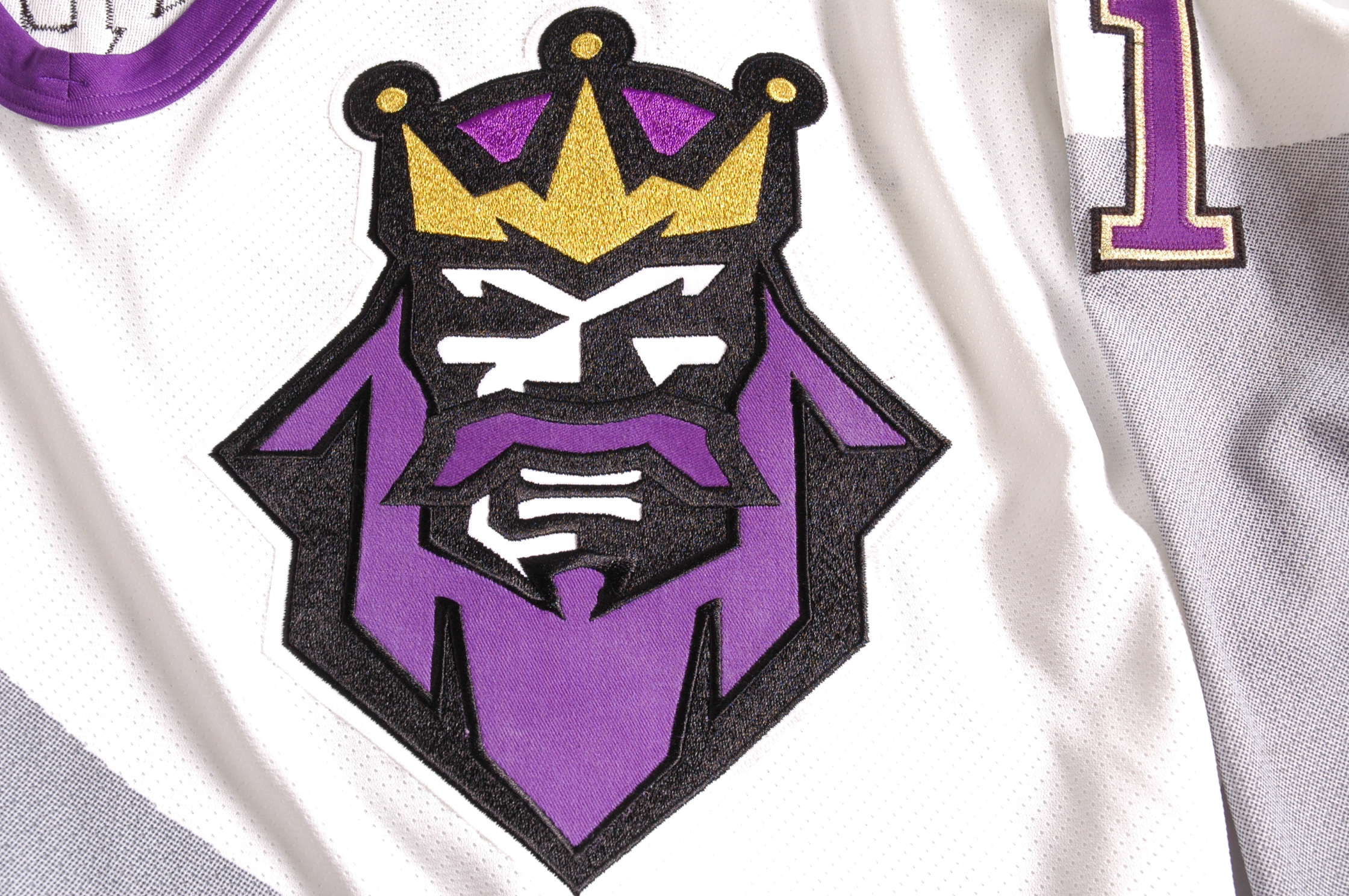
The dye-sublimation printing process rears it's ugly head once more with this 1995-96 Los Angeles Kings Alternate Wayne Gretzky jersey. The jersey features a large swooping stripe that crosses the jersey from the upper right shoulder to the lower left side, fading from dark grey (never quite black) to light while getting narrower in the process. The basic striping pattern of the jersey is unusual, if not odd, enough, but then the Kings got busy customizing it, first adding an angry stylized King's head logo, offset to the upper left chest, something no other jersey of the era, or perhaps in the history of the NHL, dared to do. But that was not all. While the Kings home and road jerseys were exclusively black, white and silver, the King's head logo was done in a garish purple and with a metallic gold crown, one of the earliest uses of metallics in the NHL.

Once the basic jersey was completed, the individual player's identity needed to be addressed. The font chosen for the back and sleeve numbers was a flamboyant, italicized font done in purple, trimmed in metallic gold and outlined in black. The same treatment was given to the names on the back, with the letters also italicized in the same three color combination.

While purple and gold might be associated with royalty, the net effect of the strange swooping stripes, grimacing King's head logo and flashy font executed in the royal purple and metallic gold was much more ridiculous than regal.

Fans dubbed the jersey "The Burger King Jersey", adding it to the list of jerseys so heinous that it earned a coveted nickname. The resemblance between the Los Angeles Kings logo and the fast food chain's creepy monarch is undeniable.

Photobucket

The Kings began wearing this jersey midway through the 1995-96 season, when the first NHL alternate jerseys debuted, beginning with a game against the Mighty Ducks of Anahiem, who also wore their new "Wild Wing" alternates for the first time, on January 27, 1996 in what has to be easily be The Worst Dressed Game in NHL History.

The Kings only wore their new alternates for a mere six or seven games before the negative reaction of the players and fans caused them to be retired permanently.

It's not known if being forced to wear this jersey caused Wayne Gretzky to ask for a trade out of Los Angeles so he wouldn't have to wear it any longer, but he was dealt to the St. Louis Blues for the last 18 games of the 1995-96 season.

Photobucket

This style jersey was never made in an authentic version for retail, so there are none available outside of game worn or team issued with fight straps. They are highly sought after by collectors and usually attract multiple bidders when they come up for auction, no doubt due to their scarcity, but more importantly the fact this style was worn by Gretzky, meaning not only collectors of ugly jerseys want the "Burger King" jersey, but also collectors of rare jerseys as well as people who specialize in Gretzky items are all after the same limited supply of one of the worst jerseys to ever see the ice in an NHL contest.

We classify this jersey as "Weird", due to the curving, radiating grey stripes that fade from dark to light, the newly introduced grimacing Burger King logo, the name and number font that would look more at home at Mardi Gras than on an NHL jersey, the addition of the color purple to a Kings jersey during the black and silver era, and finally the use of the flashy metallic gold for the number trim and King's crown.

Also weird is the fact Wayne Gretzky agreed to wear it at all. There's really not a single element of this jersey that isn't weird.

Let us reword that last sentence.

There's not a single element of this jersey that isn't really weird.

Los Angeles Kings 95-96 Alt F
Los Angeles Kings 95-96 Alt B

Here are the Los Angeles Kings debuting their new alternate "Burger King" jerseys against the Mighty Ducks of Anaheim, who were wearing their "Wild Wing" jerseys in what ranks as The Worst Dressed Game in NHL History.


Next Ugly Fest '96 between the Kings and Mighty Ducks continues as Wayne Gretzky sets up Jari Kurri for a power play goal.